Choosing business structure is one of the first legal decisions an entrepreneur makes and unfortunately, one of the most expensive mistakes if done wrong.
While starting a business is exciting, many founders rush the legal setup phase. As a result, they end up choosing the wrong structure based on cost, convenience, or incomplete advice. Later, when the business grows, these early decisions turn into legal roadblocks, tax inefficiencies, compliance stress, and lost funding opportunities.
This article breaks down the 7 legal mistakes entrepreneurs commonly make while choosing a business structure in India, along with practical insights to help you avoid them.
If you’re planning to register a company or already running one this guide can save you time, money, and serious legal trouble.
Why Choosing Business Structure in India Is a Legal Decision (Not Just Paperwork)
Many entrepreneurs treat business registration as a formality. However, in reality, choosing business structure in India determines:
- Your personal legal liability
- How disputes are handled
- Your eligibility for funding
- Compliance obligations under Indian law
- How easily ownership can change
- Your long-term exit options
Once a structure is chosen, reversing it is neither simple nor cheap. That’s why understanding these legal mistakes early is critical.
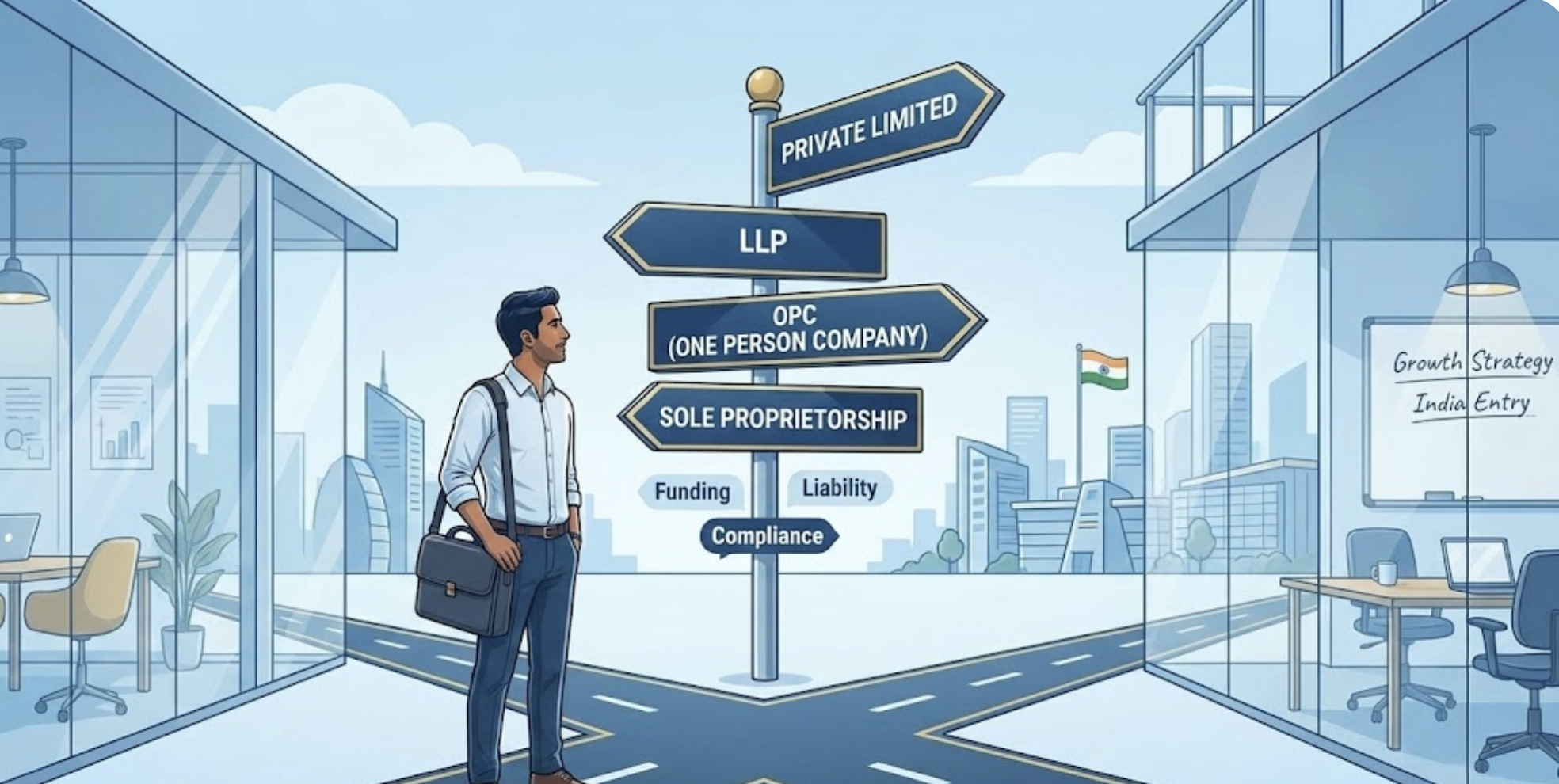
Mistake #1: Choosing the Cheapest Structure Without Legal Foresight
One of the most common mistakes entrepreneurs make is choosing a Sole Proprietorship or Partnership only because it is cheap and quick.
Why Choosing Business Structure becomes a legal problem:
- No separation between personal and business assets
- Personal liability for business debts and lawsuits
- Weak legal standing in contracts
- Difficult conversion later
What seems affordable today often becomes legally dangerous tomorrow.
Smart alternative – Choosing Business Structure:
Instead of focusing on registration cost, evaluate:
- Risk exposure
- Client contracts
- Revenue potential
- Growth plans
Legal safety should always come before short-term savings.
Mistake #2: Ignoring Unlimited Personal Liability
Many founders underestimate legal risk, especially in early stages.
Common assumptions include:
- “My business is small”
- “Clients won’t create issues”
- “We trust each other”
However, even a single legal notice, GST issue, or unpaid invoice can turn into a personal financial disaster if your structure does not offer limited liability.
Structures with unlimited liability:
- Sole Proprietorship
- Partnership Firm
Structures with legal protection:
- One Person Company (OPC)
- LLP
- Private Limited Company
When choosing a business structure in India, limited liability is not optional for any serious entrepreneur.
Mistake #3: Not Planning for Future Funding or Investment
A critical legal mistake founders make is assuming they can “convert later” if funding comes.
In reality:
- Investors do not invest in proprietorships, partnerships, LLPs, or OPCs
- Shareholding clarity is legally required
- ESOPs cannot be issued without a company structure
- Conversion delays can kill deals
Choosing Business Structure – Legal reality:
If there is even a remote possibility of raising angel or VC funding, you must start as a Private Limited Company.
Delaying this decision often results in:
- Legal restructuring
- Shareholding confusion
- Compliance backlogs
- Missed funding windows
Mistake #4: Copying Someone Else’s Business Structure
Another legal mistake is blindly copying what worked for someone else.
Examples:
- A friend registered an LLP → you do the same
- A CA suggested a partnership → you agree without question
- A YouTube video recommended OPC → you follow it
However, Choosing Business Structure is not transferable advice.
Legal suitability depends on:
- Business model
- Industry risk
- Number of founders
- Revenue expectations
- Compliance capacity
When choosing a business structure in India, your vision matters more than someone else’s experience.
Mistake #5: Choosing Business Structure Only for Tax Benefits
Tax optimization is important, but choosing a structure only to save tax is a legal and strategic mistake.
Why this backfires:
- Tax laws change frequently
- Compliance remains constant
- Growth creates new obligations
- Wrong structure limits flexibility
Many founders choose LLPs or proprietorships believing they will “save tax,” only to later realize they sacrificed:
- Funding eligibility
- Credibility
- Scalability
- Legal clarity
The correct approach is:
- Choose the right legal structure
- Then plan tax efficiently within that structure
Mistake #6: Underestimating Ongoing Legal Compliance
Some entrepreneurs register a Private Limited Company without understanding the legal responsibilities that come with it.
Common surprises include:
- ROC filings
- Board resolutions
- Statutory audits
- Director obligations
- Penalties for non-compliance
While Private Limited Companies are powerful, they demand discipline and legal awareness.
If a founder wants limited liability but lower compliance, an LLP may be legally more suitable.
Choosing a business structure in India requires honesty about your ability to manage compliance—not just ambition.
Mistake #7: Starting Informally and “Legalizing Later”
Many entrepreneurs start operating without proper registration, thinking they’ll “formalize later.”
This creates serious legal risks:
- Contracts may not be enforceable
- GST penalties may apply
- Banks may reject accounts
- Ownership disputes become complex
From a legal standpoint, operating without registration weakens your business foundation.
Even small businesses should ensure their legal identity is established from day one.
Quick Legal Checklist Before Choosing Business Structure
Before finalizing your structure, ask yourself:
- Do I need limited liability protection?
- Will I raise funds in the future?
- How much legal compliance can I handle?
- Will I hire employees or sign contracts?
- Is long-term scalability important?
If the answer to most is “yes,” then choosing the right business structure in India becomes non-negotiable.
Conclusion: Legal Mistakes Are Avoidable – If You Plan Early
Most entrepreneurs don’t fail because their idea is weak.
They struggle because their legal foundation is flawed.
The good news?
Every mistake listed above is 100% avoidable with proper planning.
Choosing a business structure in India is not about speed or shortcuts. It’s about:
- Legal protection
- Strategic flexibility
- Long-term growth
If you get this decision right at the start, everything that follows becomes easier.
FAQs
1. What is the biggest legal mistake in choosing business structure?
Choosing based only on cost without considering liability, funding, and compliance.
2. Can I change my business structure later?
Yes, but conversion involves legal procedures, cost, and time.
3. Is a Private Limited Company always the best option?
No. It is best for scalable and funded businesses, not always for small lifestyle businesses.
4. Why is limited liability important legally?
It protects personal assets from business losses, lawsuits, and debts.
5. When should a startup choose a Private Limited Company?
If growth, funding, or professional credibility is part of the plan.
Read More – Startup Guides India