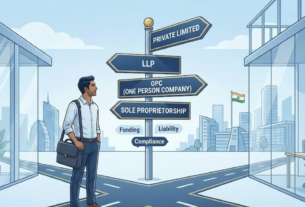
Choosing the right legal structure is one of the most critical decisions you will make as a founder. In fact, many entrepreneurs later realize that selecting the wrong structure slowed their growth, increased compliance costs, or blocked funding opportunities. That’s why the debate around Private Limited vs LLP vs OPC vs Sole Proprietorship in India is so important.
Each structure serves a different purpose. There is no “one-size-fits-all” answer. However, there is a right choice for your goals, scale, and vision.
This article provides a clear, side-by-side comparison so you can confidently decide which structure fits your business today and tomorrow.
Why This Comparison (Private Limited vs LLP vs OPC) Matters More Than You Think
Before diving into the comparison, let’s understand why this decision matters:
- It defines personal liability protection
- It impacts tax planning
- It affects fundraising eligibility
- It determines compliance burden
- It shapes brand credibility
- It influences long-term scalability
In short, the structure you choose can either support your growth or silently limit it.
Quick Overview of the Four Business Structures
| Structure | Best For |
|---|---|
| Sole Proprietorship | Freelancers & small local businesses |
| OPC | Solo founders wanting limited liability |
| LLP | Agencies & professional firms |
| Private Limited | Startups & scalable businesses |
Now let’s break each one down clearly and practically.
1. Sole Proprietorship – Simple but Limited
A Sole Proprietorship is the most basic form of business in India. There is no legal separation between the owner and the business.
✔ Advantages
- Extremely easy to start
- Minimal compliance
- Low operational cost
- Full control over decisions
✘ Disadvantages
- Unlimited personal liability
- No investor funding possible
- Weak business credibility
- Difficult to scale or sell
Who should choose this?
If you are a freelancer, tutor, consultant, or running a very small local business with low risk, this structure works.
Who should avoid it?
Anyone planning growth, hiring, loans, or partnerships.
2. One Person Company (OPC) – Corporate Identity for Solo Founders
An OPC was introduced to help solo entrepreneurs enjoy the benefits of a company without needing partners.
✔ Advantages
- Separate legal identity
- Limited liability protection
- Better credibility than sole proprietorship
- Single owner control
✘ Disadvantages
- Not investor-friendly
- Mandatory conversion after threshold limits
- Slightly higher compliance than sole proprietorship
OPC is ideal if:
You’re a solo founder who wants legal protection but doesn’t plan to raise venture capital soon.
3. LLP (Limited Liability Partnership) – Balanced & Flexible
An LLP combines the flexibility of a partnership with the safety of limited liability.
✔ Advantages
- Limited liability for partners
- Lower compliance than Private Limited
- No dividend distribution tax
- Flexible internal management
✘ Disadvantages
- Investors generally avoid LLPs
- Cannot issue equity shares
- Slightly complex compliance compared to partnership
Best suited for:
Agencies, consulting firms, CA firms, IT services, and professional partnerships.
4. Private Limited Company – The Startup Powerhouse
When discussing Private Limited vs LLP vs OPC vs Sole Proprietorship, the Private Limited Company is the clear winner for long-term growth.
✔ Advantages
- Limited liability protection
- Eligible for angel & VC funding
- Can issue shares and ESOPs
- High credibility with banks & clients
- Easy ownership transfer
✘ Disadvantages
- Higher compliance
- Mandatory audits
- Slightly higher setup cost
This is the best option if:
You plan to scale, raise funds, build a brand, or expand nationally or globally.
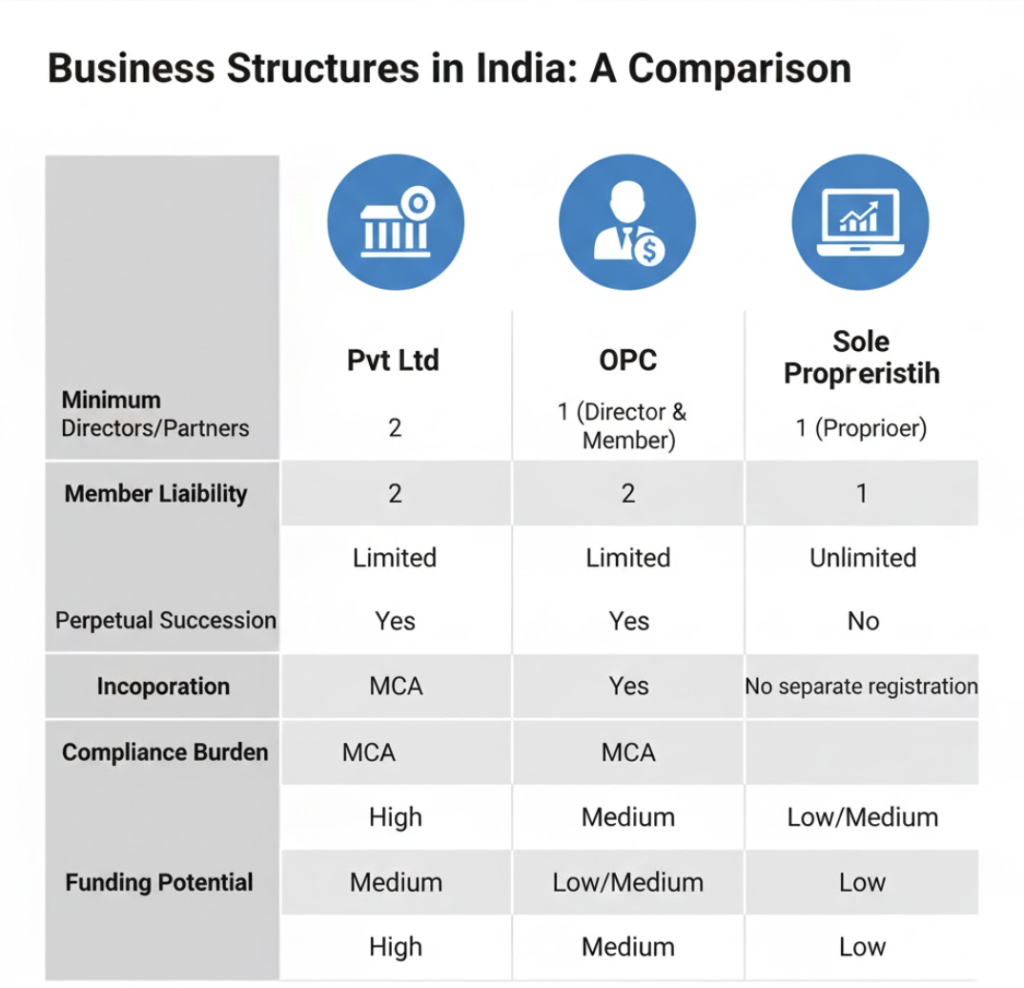
Side-by-Side Comparison Table – Private Limited vs LLP vs OPC
| Feature | Sole Prop | OPC | LLP | Pvt Ltd |
|---|---|---|---|---|
| Legal Entity | ❌ | ✅ | ✅ | ✅ |
| Liability Protection | ❌ | ✅ | ✅ | ✅ |
| Minimum Owners | 1 | 1 | 2 | 2 |
| Fundraising | ❌ | ❌ | ❌ | ✅ |
| Compliance | Very Low | Medium | Medium | High |
| Scalability | Low | Medium | Medium | High |
| Investor Friendly | ❌ | ❌ | ❌ | ✅ |
Which Structure Is Best Based on Your Goal – Private Limited vs LLP vs OPC?
✅ You want to start quickly & cheaply
→ Sole Proprietorship
✅ You are a solo founder & want protection
→ OPC
✅ You run a service firm or agency
→ LLP
✅ You want funding, growth & credibility
→ Private Limited Company
Founder Insight: The Most Common Mistake
Many founders start as sole proprietors to “save money,” only to later spend more time and cost converting their business when growth begins.
If your vision is even moderately ambitious, starting with a Private Limited Company often saves effort long-term.
Tax & Compliance Perspective (Simplified)
- Sole Proprietorship → Personal income tax slabs
- OPC → Corporate tax
- LLP → Flat LLP tax rate
- Pvt Ltd → Corporate tax + startup incentives
👉 Tax planning alone should never be the only deciding factor.
Conclusion: Choose for the Future, Not Just Today
When comparing Private Limited vs LLP vs OPC vs Sole Proprietorship, the “best” structure depends entirely on your vision.
- Small & simple → Sole Proprietorship
- Solo but serious → OPC
- Professional services → LLP
- Scalable startup → Private Limited Company
Your business structure is not just paperwork, it’s the framework your growth stands on.
FAQs
1. Which business structure is best for startups in India?
A Private Limited Company is best for startups planning growth or funding.
2. Can I convert OPC or LLP to Private Limited later?
Yes, conversion is allowed, but it involves time, cost, and compliance.
3. Is LLP better than Private Limited?
LLP is better for service firms, while Private Limited is better for startups.
4. Can a sole proprietor raise funding?
No. Investors only fund Private Limited Companies.
5. Which structure has the least compliance?
Sole Proprietorship has the least compliance.
Ministry of Corporate Affairs (MCA): https://www.mca.gov.in