Choosing the right business structure is not just a legal formality, it is a foundational business decision that directly impacts your risk, taxes, credibility, and long-term growth.
Yet, many founders choose a structure based on hearsay, cost alone, or what someone else did — and then struggle when investors, banks, or compliance requirements appear.
This article provides a clear, step-by-step decision framework for choosing the right business structure in India, designed specifically for founders, freelancers, and early-stage entrepreneurs.
If you follow this guide carefully, you’ll avoid common mistakes and start your business on the right legal foundation.
Please click on StartUp India Guide to read all the articles.
Right Business Structure – Why You Need a Step-by-Step Framework
India offers multiple business structures because business goals vary. A freelancer, a bootstrapped agency, and a VC-funded startup cannot and should not use the same structure.
This framework helps you decide based on:
- Risk exposure
- Ownership model
- Growth ambition
- Funding plans
- Compliance capacity
Let’s break it down step by step.
Step 1: Are You Starting Alone or With Partners?
This is the first and most important filter.
✔ If you are starting alone
You can choose from:
- Sole Proprietorship
- One Person Company (OPC)
✔ If you are starting with 2 or more people
You can choose from:
- Partnership Firm
- LLP
- Private Limited Company
👉 Already, half the options get eliminated.
Step 2: Do You Need Limited Liability Protection?
Liability protection decides whether your personal assets are safe if the business fails.
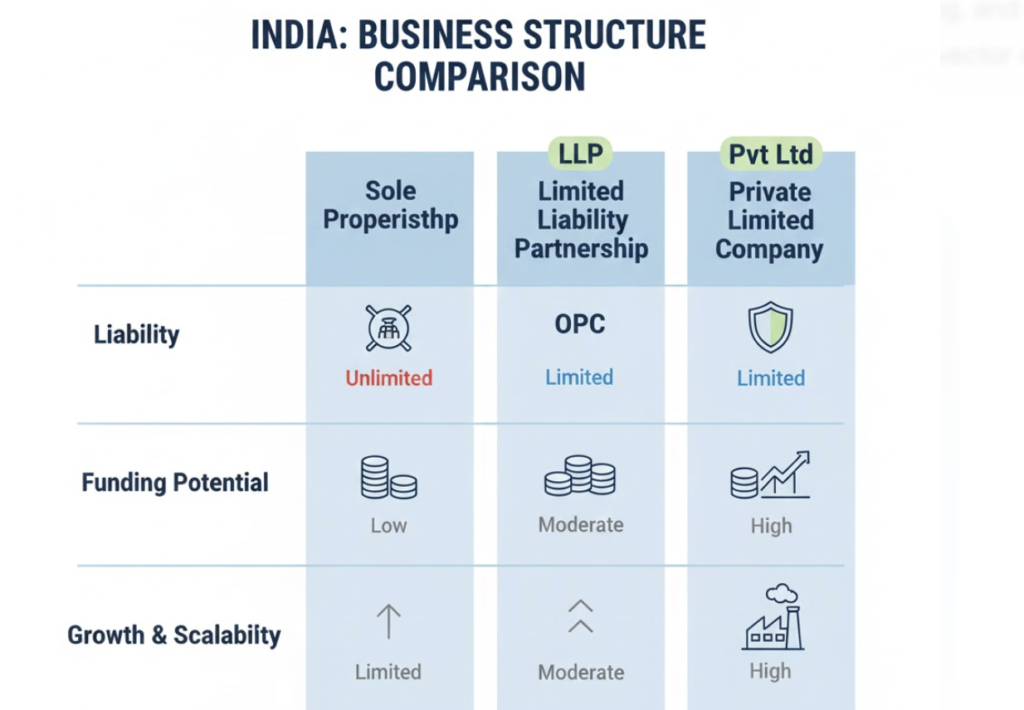
❌ Structures with Unlimited Liability
- Sole Proprietorship
- Partnership Firm
Your house, savings, and personal assets are at risk.
✅ Structures with Limited Liability
- OPC
- LLP
- Private Limited Company
Your personal assets stay protected.
👉 Founder Rule:
If your business involves clients, contracts, employees, or loans limited liability is non-negotiable.
Step 3: Do You Plan to Raise Investment or Funding?
This step immediately narrows your options.
🚫 If you plan to raise:
- Angel investment
- Venture capital
- Private equity
- ESOP-based hiring
👉 Only ONE structure qualifies:
✅ Private Limited Company
🚫 Structures investors avoid:
- Sole Proprietorship
- Partnership
- LLP
- OPC
Reality Check:
No serious investor puts money into anything other than a Private Limited Company in India.
Step 4: What Is Your Growth & Scale Vision?
Be honest about where you see your business in 3–5 years.
🔹 Small & Stable (Lifestyle Business)
- Freelancer
- Consultant
- Local service provider
✅ Sole Proprietorship / OPC / LLP
🔹 Medium Growth (Agency or Professional Firm)
- Digital agency
- IT services
- Consultancy
✅ LLP
🔹 High Growth (Startup / Scalable Product)
- SaaS
- EdTech
- FinTech
- D2C
✅ Private Limited Company
👉 Choose for future scale, not just today’s comfort.
Step 5: How Much Compliance Can You Handle?
Each structure comes with a different compliance load.
| Structure | Compliance Level |
|---|---|
| Sole Proprietorship | Very Low |
| Partnership Firm | Low |
| OPC | Medium |
| LLP | Medium |
| Private Limited | High |
Right Business Structure – Key Insight:
Low compliance feels good initially, but high growth always brings compliance.
If you avoid compliance now but plan to scale later, conversion becomes expensive and messy.
Step 6: How Important Is Brand Credibility?
Banks, clients, vendors, and even employees treat businesses differently based on structure.
High Credibility Structures:
- Private Limited Company
- OPC
Moderate Credibility:
- LLP
Low Credibility:
- Sole Proprietorship
- Partnership
If you want:
- Corporate clients
- Bank funding
- Government tenders
👉 Private Limited Company gives instant trust.
Step 7: Taxation Should Support – Not Decide
Tax is important, but it should never be the only deciding factor.
Simplified View:
- Sole Proprietorship → Personal tax slab
- OPC / Pvt Ltd → Corporate tax
- LLP → Flat LLP tax rate
👉 Smart founders choose structure for growth, then optimize tax legally later.
Right Business Structure – Final Decision Framework
| Your Situation | Best Structure |
|---|---|
| Freelancer / Individual | Sole Proprietorship |
| Solo founder, liability concern | OPC |
| Agency / Consulting firm | LLP |
| Startup / Funding plans | Private Limited Company |
| NGO / Social enterprise | Section 8 Company |
Right Business Structure- Most Common Founder Mistakes (Avoid These)
- Choosing Sole Proprietorship “to save cost”
- Ignoring future funding plans
- Underestimating liability risks
- Converting structure too late
- Choosing tax over scalability
👉 Correction later always costs more than doing it right early.
Right Business Structure – Conclusion: Structure First, Growth Next
Choosing the Right Business Structure in India is about clarity, not confusion.
If your vision includes:
- Growth
- Hiring
- Funding
- Credibility
👉 Start strong with the right structure.
- For most ambitious founders, that structure is a Private Limited Company.
- For professionals and agencies, LLP strikes balance.
- For solo beginners, OPC or Sole Proprietorship keeps things simple.
The right choice today saves years of correction tomorrow.
Right Business Structure – FAQs
1. What is the safest business structure in India?
Structures with limited liability — OPC, LLP, and Private Limited — are the safest.
2. Can I change my business structure later?
Yes, but conversion involves cost, compliance, and time.
3. Is Private Limited always the best choice?
It’s best for growth and funding, not always for small lifestyle businesses.
4. What structure should startups choose initially?
Startups planning growth should begin as Private Limited Companies.
5. Is LLP better than OPC?
LLP is better for multiple founders; OPC is designed for solo founders.
Ministry of Corporate Affairs (MCA): https://www.mca.gov.in
Please click on StartUp India Guide to read all the articles.