Conversational Search Redefines SEO in a way few founders and marketers expected just a few years ago. For a long time, search engine optimization meant ranking web pages for keywords, driving clicks, and measuring success through traffic graphs. That model is breaking fast.
Today, people no longer “search” the way they used to. Instead, they ask questions. They talk to voice assistants, type long queries into chat-based interfaces, and expect direct answers rather than ten blue links. Platforms like Google LLC with AI Overviews and Microsoft Bing with Copilot are reshaping how information is discovered and consumed.
For businesses, this shift is not theoretical. It directly affects visibility, brand authority, and revenue. If your content is not designed to answer questions clearly, conversationally, and across multiple platforms, you are already falling behind.
This article explains, in practical terms, how conversational search is changing SEO, what “Search Everywhere Optimization” really means, and how founders and SEO practitioners should adapt now.
4
What Is Conversational Search and Why It Matters
Conversational search refers to search experiences where users interact with systems in natural language, often in full sentences or dialogue form, instead of short keyword phrases.
Instead of typing “best CRM India”, users now ask:
“Which CRM works best for small businesses in India with under 20 employees?”
This change matters because conversational systems aim to answer, not just rank pages.
How Conversational Search Redefines SEO Fundamentals
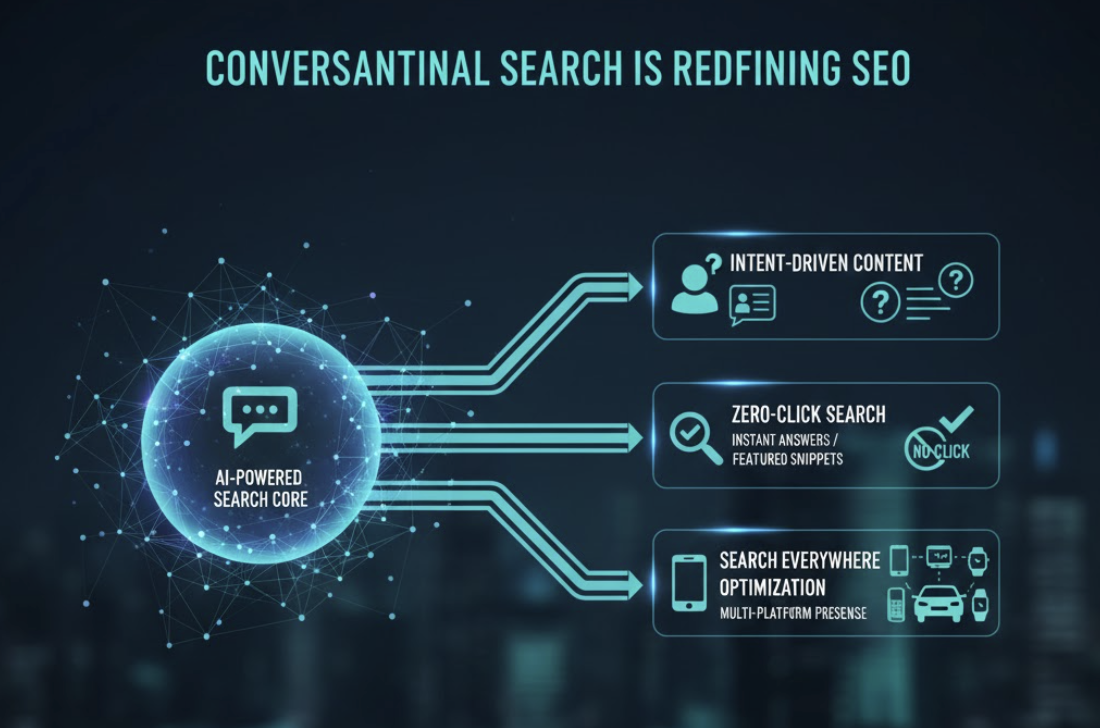
Conversational Search Redefines SEO by changing three core assumptions:
- From keywords to intent
The focus shifts from matching exact phrases to understanding user intent and context. - From clicks to answers
Users increasingly get answers directly on the search interface without visiting websites. - From search engines to search environments
Discovery happens across chat tools, voice assistants, social platforms, and AI systems.
This means traditional SEO metrics alone are no longer enough.
The Shift From Keyword Search to Intent-Driven Search
For years, SEO strategies revolved around keyword research tools, search volume, and ranking difficulty. While these still matter, they are no longer sufficient on their own.
Conversational Search Redefines SEO – Why Intent Now Beats Keywords
Conversational systems analyze:
- User context
- Follow-up questions
- Location and device
- Previous interactions
As a result, two users asking similar questions may see different answers.
Practical Example From a Founder’s Perspective
A SaaS founder once told me they ranked #1 for a high-volume keyword but still saw declining leads. The reason? AI-driven answers summarized their content without sending traffic.
The fix was not more keywords. It was better answers, structured clearly and aligned to real user intent.
Conversational Search Redefines SEO Measurement Metrics
One of the most uncomfortable truths for marketers is this: traffic is no longer the only success metric.
Understanding Zero-Click Search Scenarios
Zero-click search happens when users get what they need without clicking any result. This is now common with:
- AI-generated answer boxes
- Featured snippets
- Knowledge panels
- Voice responses
Instead of fighting this trend, smart brands adapt to it.
Conversational Search Redefines SEO – New Metrics That Actually Matter
When conversational search redefines SEO, success should be measured by:
- Brand mentions in AI answers
- Visibility in FAQ-rich results
- Voice assistant answer inclusion
- Engagement across platforms
- Brand lift and recall
These indicators show influence, not just traffic.
Search Everywhere Optimization: The New SEO Reality
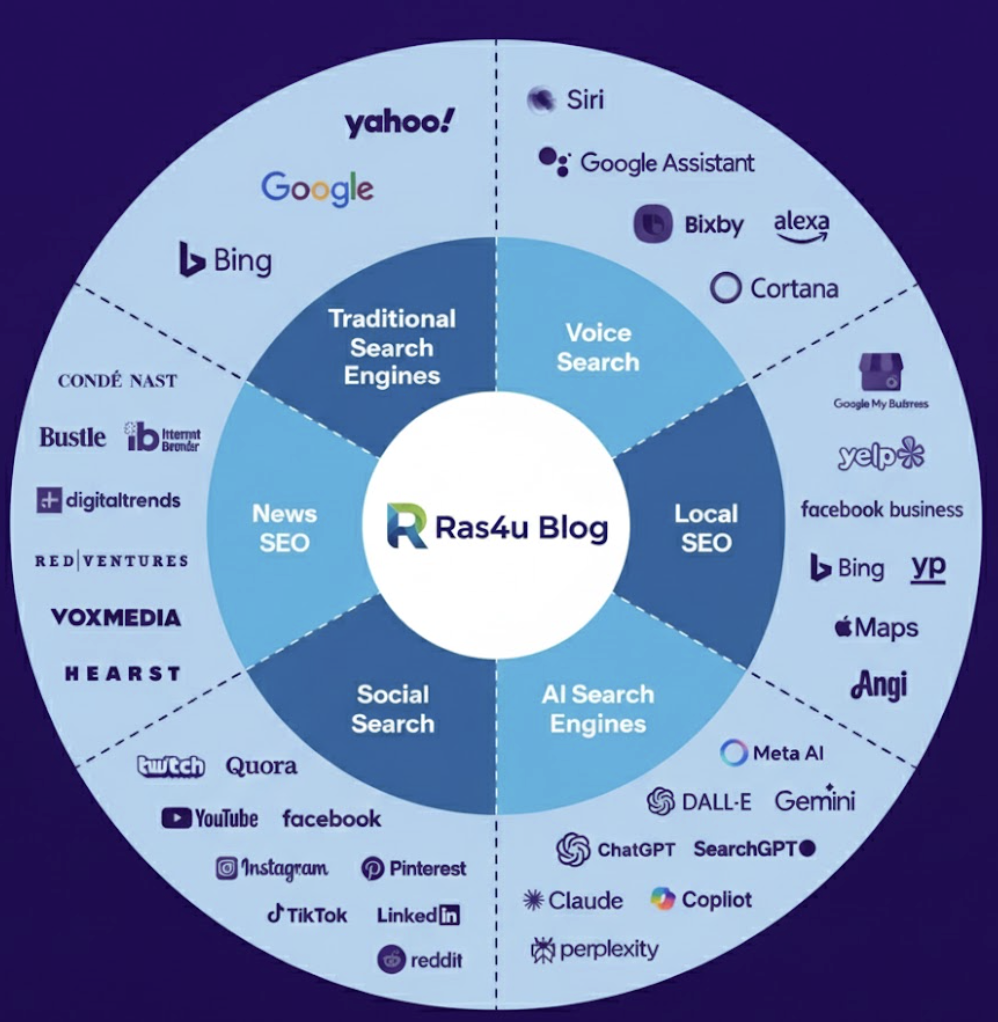
Search Everywhere Optimization is no longer optional. People ask questions on search engines, social media, AI tools, forums, and messaging apps.
What Search Everywhere Optimization Really Means
It means influencing audiences wherever they ask questions, including:
- Search engines
- AI chat interfaces
- Voice assistants
- Social platforms
- Community forums
Your content strategy must travel with your audience.
Why This Matters for Indian Businesses
India’s digital ecosystem is growing fast. With the digital marketing industry forecast to grow at around 13.9 percent CAGR, competition for attention will only intensify.
Brands that adapt early will own mind share before others even realize the rules have changed.
How Conversational Search Redefines SEO Content Strategy
From Pages to Answer-Centered Content
Instead of creating pages purely for ranking, focus on:
- Clear answers
- Simple explanations
- Real-world examples
- Structured responses
Your content should feel like a knowledgeable expert speaking directly to the reader.
The Role of Structured Data and Schema
Conversational systems rely heavily on structure. Using schema markup helps platforms understand:
- Questions and answers
- Reviews and ratings
- Product details
- How-to steps
This improves eligibility for featured snippets and AI summaries.
Designing Content for Voice and Multimodal Search
Conversational Search Redefines SEO not just for text, but for voice and visual discovery.
Voice Search Optimization Basics
Voice queries tend to be:
- Longer
- More conversational
- Question-based
Content should use natural language and short, direct answers.
Multi modal Search Considerations
Modern search blends text, images, and video. Your content should support:
- Visual explanations
- Clear headings
- Descriptive image metadata
Practical Checklist: How SEO Practitioners Should Adapt
| Area | Old SEO Approach | Conversational SEO Approach |
|---|---|---|
| Keyword research | High-volume terms | Intent and question mapping |
| Content | Long-form keyword pages | Answer-first content blocks |
| Metrics | Traffic and rankings | Visibility and brand influence |
| Structure | Plain HTML | Schema-rich structured data |
| Distribution | Search-only | Search everywhere |
Common Mistakes Businesses Make During This Shift
Even experienced teams make errors while adapting.
Mistake 1: Chasing Keywords Blindly
High search volume does not guarantee visibility in conversational results.
Mistake 2: Ignoring Zero-Click Impact
Seeing traffic drop does not always mean SEO is failing. Influence may still be growing.
Mistake 3: Writing for Bots, Not Humans
Conversational search systems reward clarity and usefulness, not keyword stuffing.
Conversational Search Redefines SEO – Regulatory and Trust Signals Still Matter
As AI-driven search grows, trust and authority become even more important.
For Indian businesses, official documentation, transparency, and compliance signals matter. Linking to authoritative sources such as the Ministry of Corporate Affairs (https://www.mca.gov.in) strengthens credibility and trustworthiness in content.
Conversational Search Redefines SEO – Real Takeaway for Founders and Marketers
Conversational Search Redefines SEO by forcing a mindset shift. The goal is no longer just rankings. It is being the best answer.
If your brand consistently provides clear, accurate, and helpful responses, AI systems and users will remember you.
Read Previous Article on Startup Guides India
The Future of SEO Is Already Here
Conversational search is not a future trend. It is today’s reality.
Brands that adapt now will enjoy compounding visibility. Those that wait will struggle to catch up.
Conclusion: How to Win as Conversational Search Redefines SEO
Conversational Search Redefines SEO by moving the goalpost from rankings to relevance, from clicks to credibility, and from search engines to entire ecosystems of discovery.
To stay competitive:
- Optimize for intent, not just keywords
- Structure content for answers and conversations
- Embrace zero-click visibility
- Measure impact beyond traffic
In the next article of this series, we will explore how to design content frameworks specifically for AI-generated answers and featured snippets, with real implementation examples.
FAQs: Conversational Search Redefines SEO
1. How does conversational search redefine SEO strategy?
Conversational search shifts SEO from keyword targeting to intent-driven, answer-focused content optimized for AI and voice systems.
2. Why is zero-click search increasing?
AI overviews and instant answers reduce the need for users to click websites while still consuming brand information.
3. What is Search Everywhere Optimization?
It is the practice of optimizing content for all platforms where users ask questions, not just search engines.
4. How should SEO success be measured now?
Beyond traffic, measure brand visibility, AI answer inclusion, FAQ appearances, and voice assistant responses.
5. Is traditional SEO still relevant?
Yes, but it must evolve. Technical SEO and authority still matter, combined with conversational and structured content.