Many Indian entrepreneurs start their journey alone. However, operating as a sole proprietor often exposes them to unlimited personal liability and limited credibility. To bridge this gap, the government introduced the One Person Company (OPC) under the Companies Act.
A One Person Company allows a single individual to run a corporate entity with limited liability, legal recognition, and better business credibility.
This article explains what a OPC is in India, its benefits, rules, limitations, and when it makes sense to choose OPC over other business structures.
Why One Person Company (OPC) Was Introduced in India
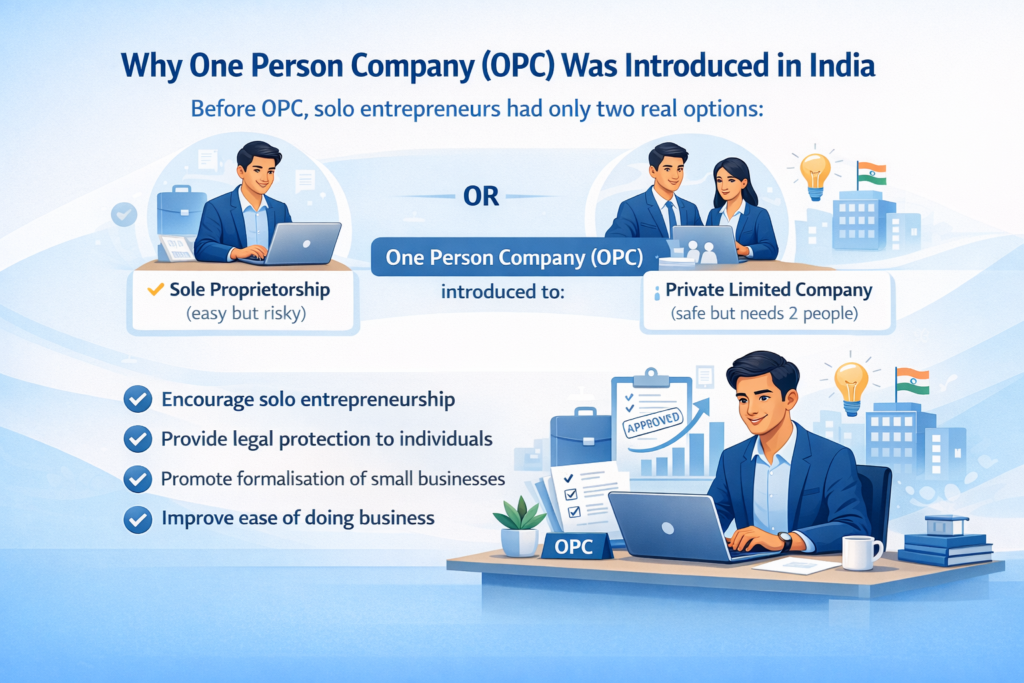
Before OPC, solo entrepreneurs had only two real options:
- Sole Proprietorship (easy but risky)
- Private Limited Company (safe but needs 2 people)
One Person Company (OPC) was introduced to:
- Encourage solo entrepreneurship
- Provide legal protection to individuals
- Promote formalisation of small businesses
- Improve ease of doing business
Understanding OPC registration in India starts with understanding this intent.
What Is a One Person Company (OPC)?
A One Person Company (OPC) is a company:
- Incorporated by one individual
- Having separate legal identity
- Offering limited liability protection
- Governed by the Companies Act, 2013
Unlike sole proprietorships, OPCs are legally distinct from their owners.
Key Features of One Person Company
Single Member
- Only one shareholder
- Full ownership and control
Separate Legal Entity
- Company exists independently of owner
- Can own assets and enter contracts
Limited Liability
- Personal assets are protected
- Liability limited to share capital
Mandatory Nominee
- Nominee takes over in case of death/incapacity
Eligibility Criteria for One Person Company (OPC) Registration in India
To register an OPC:
- Only Indian citizens can form OPC
- Must be resident in India
- One person can form only one OPC
- Nominee must also be an Indian resident
OPC registration is regulated by the Ministry of Corporate Affairs.
Benefits of One Person Company
✅ Limited Liability Protection
Unlike proprietorships, OPC shields personal assets.
✅ Full Control
Single owner, no partner conflicts.
✅ Better Credibility
More trust than sole proprietorship with banks & clients.
✅ Easier Compliance Than Pvt Ltd
Fewer board meetings and filings.
✅ Smooth Transition to Pvt Ltd
Easy conversion when business grows.
Read Previous Article on Startup Guides India.
Limitations of One Person Company
Despite benefits, OPC has limitations:
No Equity Funding
- Cannot raise VC or angel funding
Mandatory Conversion Thresholds
- Must convert if turnover exceeds ₹2 crore
- Or paid-up capital exceeds ₹50 lakh
Restricted Activities
- Certain NBFC and investment activities restricted
OPC is a transitional structure, not a long-term scaling model.
OPC vs Sole Proprietorship vs Private Limited
| Feature | OPC | Sole Proprietorship | Pvt Ltd |
|---|---|---|---|
| Owners | 1 | 1 | 2+ |
| Liability | Limited | Unlimited | Limited |
| Legal Identity | Yes | No | Yes |
| Fundraising | No | No | Yes |
| Compliance | Medium | Low | High |
When Should You Choose an One Person Company (OPC)?
Choose OPC if:
- You are a solo founder
- You want limited liability
- You don’t plan funding immediately
- You want corporate credibility
- You plan to convert later
Avoid OPC if:
- You plan to raise funds early
- You want co-founders
- You want ESOPs
Taxation of One Person Company
- Taxed as a company
- Corporate tax rates apply
- Dividend taxable in owner’s hands
Tax planning is similar to Private Limited Companies.
Compliance Requirements for One Person Company (OPC)
Compared to Pvt Ltd:
- Fewer board meetings
- Simplified filings
- Annual ROC compliance still mandatory
OPC compliance is lighter but not optional.
External Authority Reference
All OPC rules are governed by the
Ministry of Corporate Affairs
Conclusion: One Person Company (OPC) Is a Strong Start for Solo Founders
A One Person Company offers the perfect balance between independence and legal safety.
If you’re starting alone and want to:
- Protect personal assets
- Build credibility
- Keep future options open
…then OPC registration in India is a smart starting point.
However, as your business grows, OPC should be viewed as a stepping stone, not the final destination.
FAQs
1. Can an OPC have employees?
Yes, OPCs can hire employees like any company.
2. Is One Person Company (OPC) better than sole proprietorship?
Yes, OPC offers limited liability and better credibility.
3. Can One Person Company (OPC) raise funding?
No, OPC cannot raise equity funding.
4. Is nominee mandatory in OPC?
Yes, appointing a nominee is compulsory.
5. Can OPC be converted into Pvt Ltd?
Yes, conversion is allowed and common.