If someone told you today that there was once a bus service from London to Calcutta, you would probably laugh it off. In an age of budget airlines and overnight international flights, the idea of crossing continents by bus feels unrealistic even absurd.
But here is an unknown fact that history quietly remembers: A London – Calcutta service did exist. And it was once the longest bus route in the world.
This was not a myth, a publicity stunt, or a short-lived experiment.
It was a fully operational service that ran for nearly two decades and connected Europe and Asia by road long before globalization became a buzzword.
The London – Calcutta Bus Service: A Forgotten Wonder
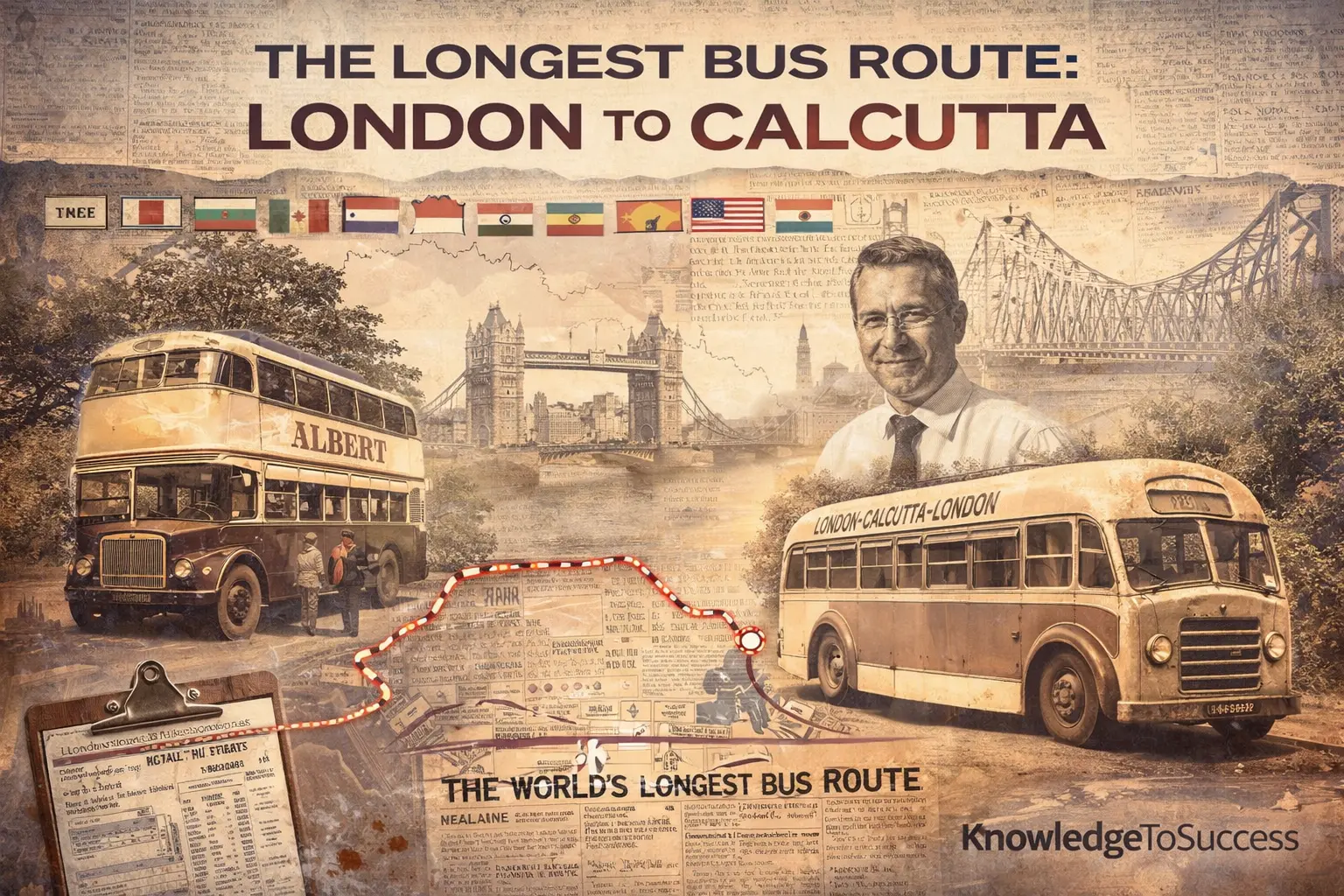
The service began in 1957 and was operated by a travel company called Albert Travels, based in Calcutta and was named “Albert.“
At its peak, this was:
- The longest bus route in the world
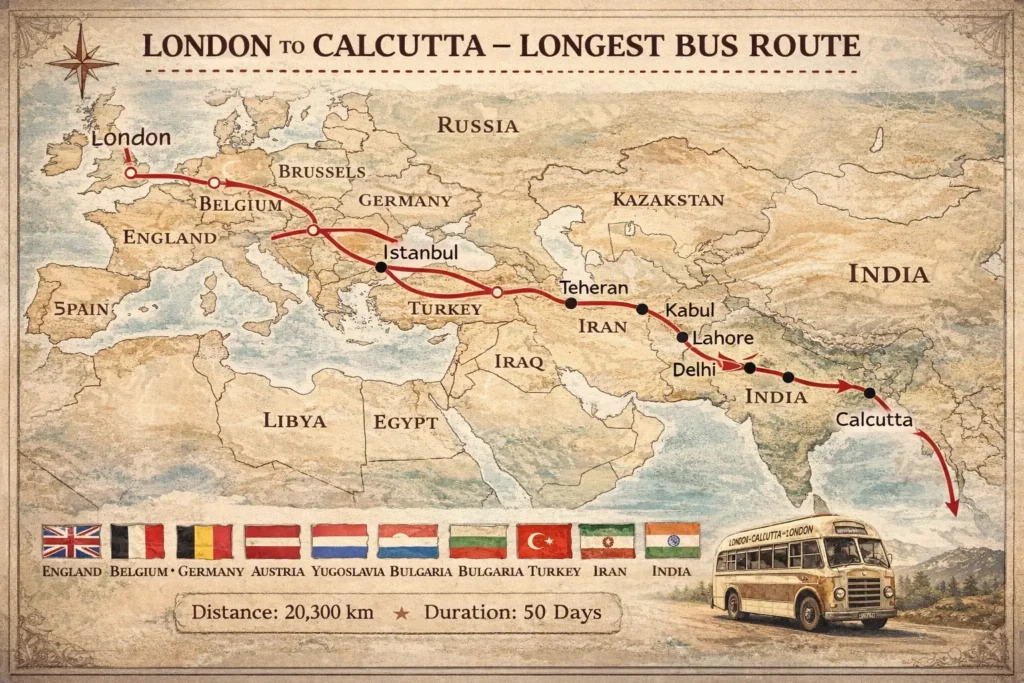
- A journey covering 32,669 kilometers
- A route that crossed 11 countries
- A trip that took around 50 days
- A ticket priced at ₹8,000
- A service that ran until 1976
What makes this extraordinary is not just the distance, but the era in which it existed.
A Route That Crossed Continents
The London – Calcutta bus traveled through an ambitious and complex route, passing through both Europe and Asia.
The countries on the route included:
- England
- Belgium
- Germany
- Austria
- Yugoslavia
- Bulgaria
- Turkey
- Iran
- Afghanistan
- Pakistan
- India
At a time when:
- Border crossings were slow
- Visas were complicated
- Roads were unreliable
this bus moved steadily across continents. Today, recreating this route would be nearly impossible due to geopolitical realities.
A Moving Hotel (Bus) on Wheels
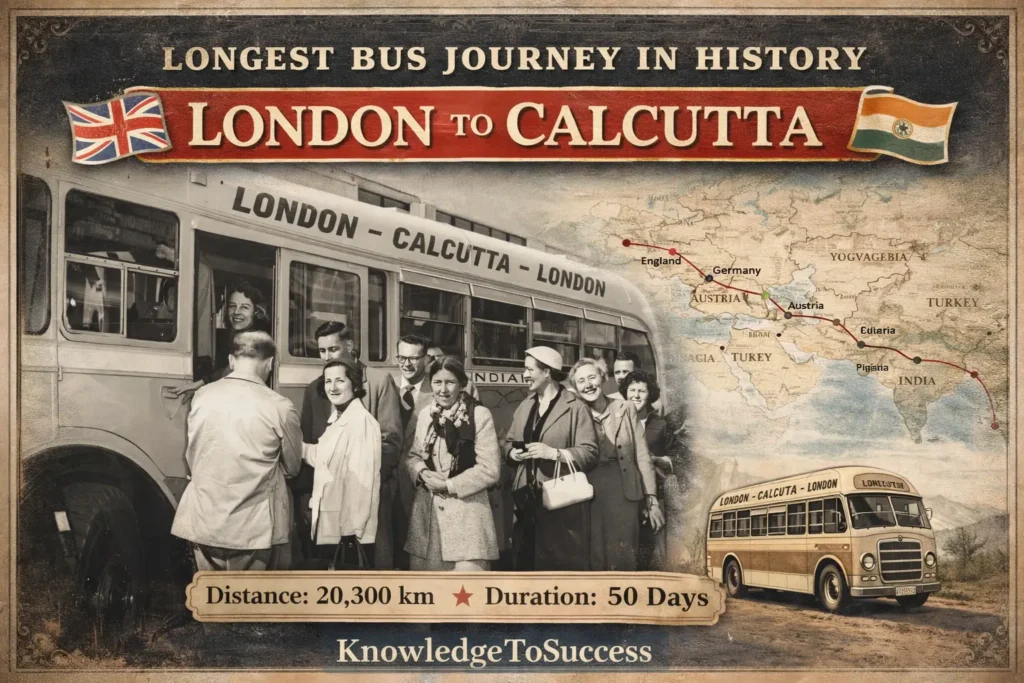
This was not a simple passenger vehicle. For its time, the Albert bus was considered a luxury vehicle.
It offered:
- Sleeping berths for passengers
- Cooking facilities
- A dining area
- Large panoramic windows
- Space for long-term travel comfort
In many ways, it functioned like a moving hotel, designed for people who valued experience over speed. Passengers didn’t just travel they lived on the road for nearly two months.
Who Took This Journey?
The London – Calcutta bus attracted a unique group of travelers:
- European adventurers
- Writers and photographers
- Cultural explorers
- Long-distance travelers seeking meaning, not convenience
This was slow travel, decades before the term existed.
Each passenger carried stories from dozens of cities, cultures, landscapes, and languages.
Why This Bus Service Was Historically Important
The London – Calcutta service was not just transportation, it was history in motion.
Its importance lies in several areas:
1. A Road Link Between Europe and Asia
This service physically connected two continents by land, something rarely attempted on such a scale.
2. A Pre-Globalization Experiment
Long before international tourism became common, this enabled cross-cultural movement.
3. Calcutta as a Global Travel Hub
The service positioned Calcutta as an international gateway, not just a regional city.
4. A Symbol of Human Ambition
It reflected a time when people believed distance could be conquered with patience, planning, and courage.
Why the Service Eventually Ended
Despite its success, the service could not survive changing times.
It ended in 1976, mainly due to:
- Political instability in regions like Iran and Afghanistan
- Increasing border and visa restrictions
- The rapid rise of commercial air travel
- High operational costs and security risks
As flights became faster and cheaper, long overland journeys slowly disappeared.
Why This Story Still Matters Today
Today, traveling from London to Calcutta takes just a few hours by plane.
But once upon a time, it was a 50-day journey filled with uncertainty, discovery, and human connection.
This forgotten bus service reminds us that:
- Travel was once about the journey, not the destination
- Borders were crossed with curiosity, not urgency
- Time was spent experiencing the world, not escaping it
A Forgotten Chapter of Travel History
The Albert Travels London – Calcutta bus was not just a vehicle.
It was:
- A bridge between cultures
- A lesson in patience
- A reminder of how bold human ideas once were
In an age obsessed with speed, this story quietly asks an important question:
What did we lose when we stopped traveling slowly?
🔗 Internal Category Link
Read more articles on Unknown Facts
For historical travel routes and transport history
Conclusion: When the World Felt Bigger and Closer
The London – Calcutta bus service may be gone, but its story still travels.
It reminds us of a time when the world felt vast, journeys felt meaningful, and travel itself was an act of courage.
Some unknown facts don’t just surprise us. They change how we see the past and the present.
FAQs : London – Calcutta Bus Service
1. Did a bus really travel from London to Calcutta?
Yes. The service operated from 1957 to 1976.
2. How long did the bus journey take?
Around 50 days.
3. How many countries did the bus pass through?
Approximately 11 countries across Europe and Asia.
4. Who operated the service?
Albert Travels, a company based in Calcutta.
5. Why is this bus service considered unique?
It was the longest bus route in the world and connected two continents by road.