
Marketing is changing faster than most professionals can adapt. Tools evolve. Platforms shift. Algorithms update. Meanwhile, artificial intelligence is rewriting how content, campaigns, and customer journeys are created. This is where Prompt Engineering Skills in Marketing become critical.
Today, marketers who know how to “talk” to AI systems have a serious advantage.
- They create faster.
- They test smarter.
- They optimize campaigns in minutes instead of days.
However, many marketers are still using AI casually. They type basic instructions and expect magic. That approach will not survive the next wave of competition.
Therefore, mastering prompt engineering is no longer optional. It is becoming a core growth skill.

What Is Prompt Engineering in Marketing?
Prompt engineering is the skill of designing precise instructions that guide AI systems to produce high-quality outputs.
In marketing, this means:
- Crafting better content briefs
- Generating optimized ad copy
- Designing email sequences
- Conducting audience research
- Creating campaign strategies
- Performing competitor analysis
Instead of asking AI vague questions, skilled marketers provide structured, contextual, and outcome-focused prompts.
For example:
Weak Prompt: “Write a product description.”
Strong Prompt: “Write a persuasive 150 -word product description for a premium organic skincare brand targeting urban women aged 28 – 40. Emphasize sustainability, skin sensitivity benefits, and luxury positioning.”
The difference is massive.
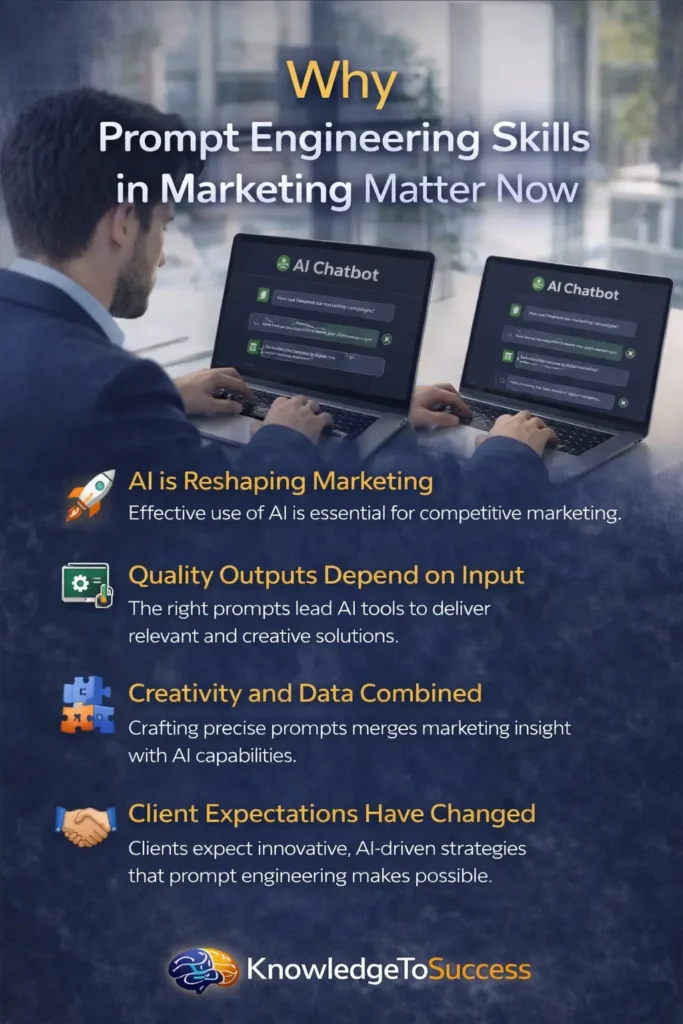
Why Prompt Engineering Skills in Marketing Matter Now
According to Harvard Business Review, AI adoption in business is accelerating across departments. Marketing leads the transformation because it depends heavily on communication and creativity.
Meanwhile, platforms like LinkedIn have identified AI-related skills as some of the fastest-growing professional competencies.
So what does this mean for marketers?
It means:
- AI is not replacing marketers.
- AI is replacing average marketers.
Those who understand prompt engineering control the output. Others simply accept whatever the tool generates.
That is a dangerous gap.
Learn Prompt Engineering from LinkedIn (Free Access)
If you want structured learning instead of random experimentation, here’s a valuable opportunity:
💡 Learn the basics of tactical marketing with ChatGPT (free LinkedIn Learning course until March 23)
Course Link: https://www.linkedin.com/learning/market-sizing-tam-sam-som-licensed/introduction-to-market-sizing
You can explore LinkedIn’s insights on fastest-growing marketing skills here: https://www.linkedin.com/pulse/linkedin-skills-rise-2026-10-fastest-growing-marketing-fzftf/
Learning directly from curated LinkedIn Learning programs helps you build real Prompt Engineering Skills in Marketing with practical use cases, not just theory.
Core Components of Prompt Engineering Skills in Marketing
1️⃣ Context Framing
AI performs best when it understands:
- Target audience
- Brand tone
- Objective
- Constraints
- Desired format
Without context, output becomes generic. With context, output becomes strategic.
2️⃣ Role-Based Prompting
You can assign AI a role.
Example: “Act as a senior performance marketing strategist for a D2C fintech brand.”
This shifts the tone and analytical depth instantly.
3️⃣ Structured Output Design
Instead of asking for a paragraph, ask for:
- Bullet points
- Tables
- Frameworks
- Funnel breakdown
- Campaign plan
Structured prompts reduce editing time significantly.
4️⃣ Iterative Refinement
Prompt engineering is not one command. It is a conversation.
First draft → Feedback → Refinement → Optimization.
Therefore, top marketers treat AI as a strategic assistant, not a content vending machine.
Step-by-Step Framework to Master Prompt Engineering
Here is a practical framework you can implement immediately.
Step 1: Define the Objective Clearly
Ask yourself:
- Is this for awareness, leads, or conversions?
- Who is the decision maker?
- What action must be taken?
Clarity improves AI precision.
Step 2: Provide Detailed Context
Include:
- Target persona
- Brand positioning
- Industry
- Tone of voice
- Word limit
The more specific you are, the less generic the output.
Step 3: Specify Format
Example:
“Provide response in a comparison table.”
“Create a 3-step funnel breakdown.”
“Write a LinkedIn carousel script.”
Structured formatting saves editing hours.
Step 4: Add Constraints
Constraints improve creativity.
For example:
- No jargon
- 120 words max
- Use emotional triggers
- Include CTA
Ironically, limits produce sharper results.
Step 5: Optimize Through Iteration
Ask:
- Can you make this more persuasive?
- Improve clarity.
- Make it more data-driven.
This is where Prompt Engineering Skills in Marketing truly mature.
Common Mistakes Marketers Make
Even experienced professionals make these errors:
❌ Being Too Vague
Generic prompts produce generic content.
❌ Ignoring Audience Persona
AI cannot guess your ideal customer.
❌ Skipping Iteration
First drafts are rarely final.
❌ Over-Reliance on Automation
AI assists strategy. It does not replace thinking.
❌ Not Fact-Checking
Always verify data through trusted sources such as Wikipedia or industry research reports.
Practical Prompt Engineering Checklist
Use this before finalizing any AI-generated output:
| Checklist Item | Yes/No |
|---|---|
| Defined clear objective? | |
| Added target audience? | |
| Specified tone? | |
| Set word limit? | |
| Requested structured format? | |
| Refined through at least 2 iterations? | |
| Verified accuracy? |
If you cannot check all boxes, improve your prompt.

How Founders Can Use Prompt Engineering
For startup founders, this skill is even more powerful.
You can:
- Draft investor emails
- Build pitch decks
- Conduct competitor scans
- Plan GTM strategies
- Design landing page messaging
Meanwhile, you reduce dependency on multiple external agencies.
Read more Article on Marketing Skills.
Future Scope of Prompt Engineering in Marketing
Large language models are evolving rapidly. Optimising outputs for models such as GPT systems is becoming a specialization itself.
Therefore, marketers who invest early in Prompt Engineering Skills in Marketing will:
- Increase productivity
- Improve campaign ROI
- Build authority
- Stay competitive
- Future-proof careers
This is not hype. It is a shift in how thinking work gets done.
Conclusion: Prompt Engineering Is Your Competitive Edge
Marketing is no longer just about creativity. It is about strategic clarity powered by AI.
Those who develop Prompt Engineering Skills in Marketing will outperform peers who rely on basic automation. However, this skill requires intention, structure, and practice.
Start small. Improve daily. Refine continuously.
In the next article, we will explore Visual Storytelling Skills in Marketing and why attention economics is redefining brand growth.
Stay ahead. Build capability. Lead the change.
FAQs
1️⃣ What are Prompt Engineering Skills in Marketing?
They are the ability to design precise AI instructions that generate strategic, high-quality marketing outputs.
2️⃣ Why are Prompt Engineering Skills in Marketing important?
Because AI is becoming central to content, ads, analytics, and automation. Skilled prompting improves efficiency and quality.
3️⃣ Can beginners learn prompt engineering easily?
Yes. However, consistent practice and structured prompting improve results significantly.
4️⃣ Is prompt engineering replacing marketers?
No. Instead, it enhances skilled marketers and replaces inefficient workflows.
5️⃣ Which tools help improve prompt engineering?
AI platforms like ChatGPT and enterprise AI tools are commonly used in marketing workflows.

informative article
Thanks, actually I was planning to learn Prompt engineering