
Marketing rarely fails because of lack of creativity. It fails because of misalignment. Campaign ideas are strong. Designers work hard. Performance teams optimize constantly. However, results fall short because teams operate in silos. This is why Collaboration Skills in Marketing Teams are becoming one of the fastest-growing professional capabilities.
Modern marketing is no longer a single-person function. It is a cross-functional engine involving:
- Content teams
- Designers
- Performance marketers
- Sales teams
- Product managers
- Founders
When collaboration is weak, growth slows. When it is strong, execution accelerates. Therefore, mastering collaboration is not soft skill training. It is growth strategy.

Why Collaboration Skills in Marketing Teams Matter Today
Marketing channels have multiplied.
Social media, SEO, email, paid ads, video, community building. Each requires expertise. Meanwhile, customer journeys have become more complex.
According to Harvard Business Review, high-performing teams outperform average ones not because of talent alone, but because of coordination and psychological safety.
Similarly, insights from LinkedIn show that collaboration is one of the fastest-rising professional skills across industries.
The reason is simple.
Growth requires alignment.
Without collaboration:
- Messaging becomes inconsistent
- Data insights stay isolated
- Campaign execution slows
- Budget decisions become reactive
With collaboration:
- Strategy becomes unified
- Execution becomes faster
- Decisions become smarter
- Results become predictable
What Are Collaboration Skills in Marketing Teams?
Collaboration skills include the ability to:
- Communicate clearly
- Align goals across functions
- Share data transparently
- Give and receive feedback constructively
- Resolve conflicts professionally
This is not about endless meetings. It is about structured alignment.
Core Elements of Strong Marketing Collaboration
1️⃣ Clear Shared Objectives
Everyone must understand:
- Revenue target
- Campaign goal
- KPI benchmarks
If content focuses on engagement while performance focuses on conversions, friction begins.
Alignment prevents conflict.
2️⃣ Defined Roles and Responsibilities
Who owns what?
Unclear ownership creates delays. Meanwhile, clear responsibility speeds execution.
Use frameworks like RACI:
- Responsible
- Accountable
- Consulted
- Informed
Structure reduces confusion.
3️⃣ Transparent Data Sharing
Data should not stay inside one department.
Performance insights help content. Sales feedback improves messaging. Product updates refine campaigns.
Open visibility builds trust.
4️⃣ Feedback Culture
Collaboration improves when:
- Feedback is direct
- Ego is controlled
- Focus stays on results
Healthy disagreement produces stronger campaigns.
Step-by-Step Framework to Improve Collaboration Skills in Marketing Teams
Here is a practical implementation model.
Step 1: Align on One Growth Metric
Choose a primary metric:
- Revenue
- Qualified leads
- Pipeline value
Secondary metrics can support, but one core metric keeps everyone focused.
Step 2: Create Weekly Alignment Reviews
Short meetings. Clear agenda:
- What worked?
- What did not?
- What will we test next?
Consistency builds momentum.
Step 3: Share Dashboards Across Teams
Do not restrict analytics to one group.
When everyone sees performance numbers, decision-making improves.
Step 4: Document Processes
Document:
- Campaign workflows
- Creative briefs
- Approval stages
Written clarity reduces repeated confusion.
Step 5: Encourage Cross-Skill Understanding
Performance marketers should understand content basics. Designers should understand conversion goals.
This reduces friction dramatically.
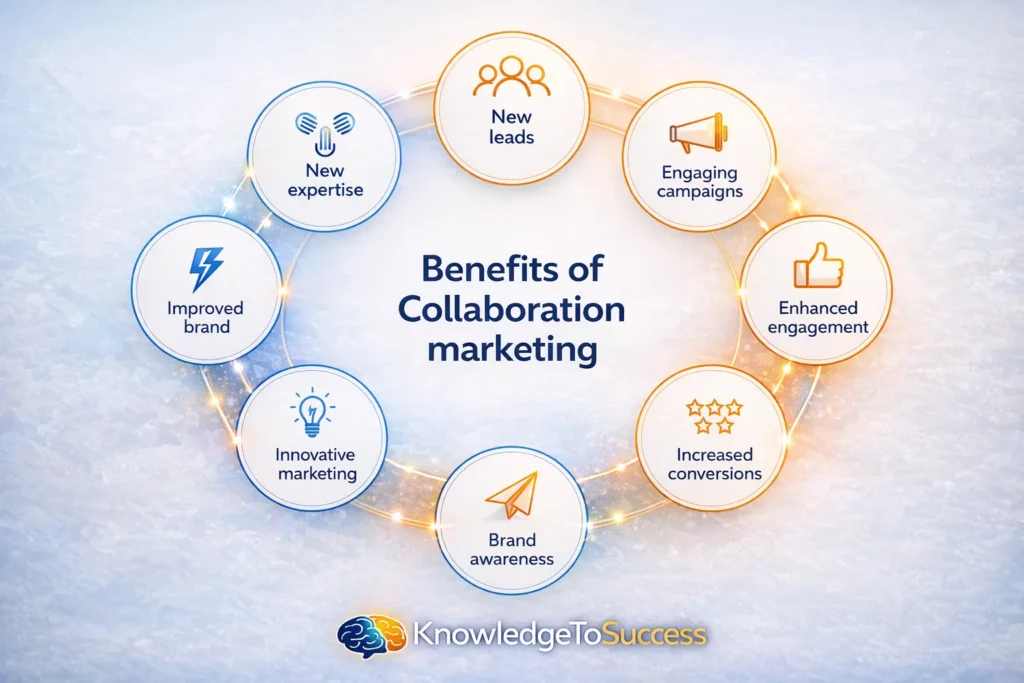
Learn to Strengthen Marketing Collaboration (Free Resource)
If you want to build structured growth thinking within teams, explore this LinkedIn Learning opportunity:
💡 Learn how to grow revenue with performance marketing (free LinkedIn Learning course until March 23)
While this course focuses on performance marketing, revenue alignment naturally strengthens collab across marketing teams.
Common Collaboration Mistakes in Marketing
Even experienced teams struggle here.
❌ Too Many Unstructured Meetings
Meetings without agenda waste time.
❌ Undefined Ownership
Tasks fall between departments.
❌ Data Silos
Information hoarding reduces performance.
❌ Blame Culture
Fear blocks innovation.
❌ Misaligned Incentives
If departments chase different goals, growth slows.
Practical Collaboration Checklist
Before launching any campaign, confirm:
| Checklist Item | Done? |
|---|---|
| Shared revenue goal defined? | |
| Roles clearly assigned? | |
| KPIs aligned across teams? | |
| Dashboard access shared? | |
| Feedback process defined? | |
| Review cadence scheduled? |
Structure improves teamwork quality instantly.
Founder Perspective: Why Collaboration Drives Scale
For startups, it directly impacts runway.
When marketing, sales, and product teams align:
- Customer feedback loops shorten
- Messaging improves
- Conversion rates rise
- Acquisition cost drops
Read More Article on Marketing Skills.
Conclusion: Collaboration Multiplies Marketing Results
Marketing success is not just about talent. It is about alignment.
Strong Collab Skills in Marketing Teams create speed, clarity, and accountability. Instead of fragmented execution, teams move as one unit.
Start by aligning on one metric.
Clarify ownership.
Share data openly.
In the next article, we will explore Creative Thinking Skills in Marketing and why originality still wins in an AI-driven world.
Build better teams. Build stronger growth.
FAQs
1️⃣ What are Collaboration Skills in Marketing Teams?
They are the ability to align goals, communicate clearly, and execute campaigns effectively across departments.
2️⃣ Why are Collab Skills in Marketing Teams important?
Because cross-functional alignment improves speed, efficiency, and revenue outcomes.
3️⃣ How can startups improve marketing collab?
By defining clear roles, sharing dashboards, and aligning around one growth metric.
4️⃣ What tools support marketing collaboration?
Shared dashboards, project management systems, and structured review meetings improve alignment.
5️⃣ Does collaboration directly impact revenue?
Yes. Better alignment reduces wasted budget and improves conversion performance.