
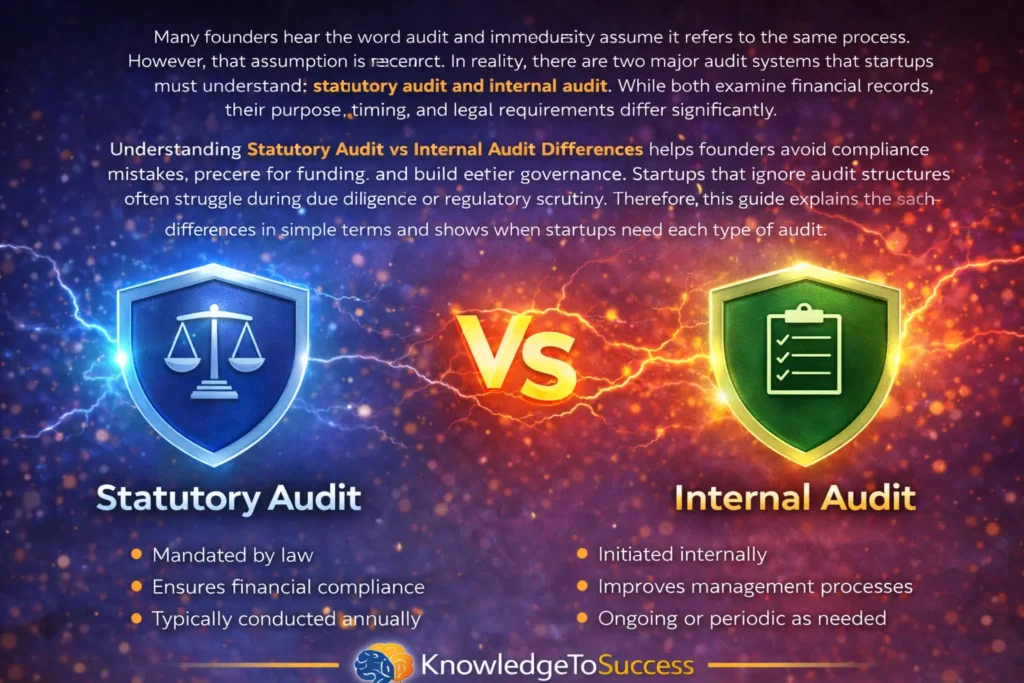
Many founders hear the word audit and immediately assume it refers to the same process.
However, that assumption is incorrect.
In reality, there are two major audit systems that startups must understand: statutory audit and internal audit. While both examine financial records, their purpose, timing, and legal requirements differ significantly.
Understanding Statutory Audit vs Internal Audit Differences helps founders avoid compliance mistakes, prepare for funding, and build better governance.
Startups that ignore audit structures often struggle during due diligence or regulatory scrutiny.
Therefore, this guide explains the differences in simple terms and shows when startups need each type of audit.
What Is a Statutory Audit?
A statutory audit is a legally required audit mandated by the Companies Act 2013.
It verifies whether a company’s financial statements present a true and fair view of its financial position.
Statutory audits are conducted by independent Chartered Accountants.
In India, most Private Limited Companies must undergo statutory audit every year, regardless of revenue.
Key characteristics include:
- Mandatory under law
- Conducted annually
- Performed by external auditors
- Focus on financial accuracy and compliance
Official guidelines can be found through the Ministry of Corporate Affairs
What Is an Internal Audit?
An internal audit is a management tool designed to improve operational efficiency and risk management.
Unlike statutory audits, internal audits are not always mandatory for startups. Companies introduce internal audits voluntarily to strengthen governance and detect issues early.
Internal audit focuses on:
- Process improvement
- Risk management
- Fraud prevention
- Operational efficiency
Instead of verifying financial statements for regulators, internal audit evaluates how well internal systems function.
Statutory Audit vs Internal Audit Differences
Understanding Statutory Audit vs Internal Audit Differences helps founders plan compliance and governance properly.
| Factor | Statutory Audit | Internal Audit |
|---|---|---|
| Purpose | Legal compliance | Process improvement |
| Requirement | Mandatory | Optional for many startups |
| Conducted by | Independent external auditor | Internal team or consultant |
| Frequency | Once per year | Periodic |
| Focus | Financial statements | Operational processes |
Both serve different objectives.
One ensures regulatory compliance.
The other strengthens internal systems.
Why Statutory Audit Matters for Startups
For startups incorporated as Private Limited Companies, statutory audit is unavoidable.
Key reasons include:
Regulatory Compliance
The Companies Act requires companies to submit audited financial statements.
Investor Confidence
Investors rely on audited statements during due diligence.
Financial Transparency
Statutory audit ensures financial reporting accuracy.
Funding Preparation
Audited financials are essential when raising capital.
Ignoring statutory audit obligations can lead to penalties and compliance issues.
Why Internal Audit Is Valuable for Growing Startups
Even when not mandatory, internal audits help startups scale responsibly.
Benefits include:
Early Fraud Detection
Internal audits identify suspicious financial activity early.
Process Improvement
They uncover inefficiencies in operations.
Risk Management
Internal audits highlight legal and financial vulnerabilities.
Stronger Governance
Structured audit systems signal maturity to investors.
As startups grow, internal audits become increasingly valuable.
When Startups Need Statutory Audit
Under the Companies Act 2013, statutory audit becomes mandatory immediately after company incorporation.
Even if:
- Revenue is zero
- Business operations are minimal
- The startup is still building its product
The company must appoint an auditor within 30 days of incorporation.
Annual financial statements must then be audited.
When Startups Should Introduce Internal Audit
Internal audit becomes important when:
- The company expands operations
- Multiple departments emerge
- Financial transactions increase
- Investor scrutiny increases
Startups planning funding rounds often implement internal audit early to strengthen governance.
Common Founder Mistakes About Startup Audit
Understanding Statutory Audit vs Internal Audit Differences prevents several common mistakes.
Assuming Both Audit Are the Same
Many founders think statutory audit covers internal controls. It does not.
Ignoring Internal Audits
Startups often delay internal audits until problems arise.
Poor Documentation
Missing financial records complicate both audits.
Delayed Auditor Appointment
Failure to appoint statutory auditors quickly may trigger penalties.
Avoiding these mistakes protects founders from compliance complications.
How Audit Affect Startup Funding
Investors examine financial governance before investing.
A startup with strong audit systems demonstrates:
- Financial discipline
- Transparency
- Reduced fraud risk
- Compliance maturity
Therefore, understanding Statutory Audit vs Internal Audit Differences improves investor confidence.
Weak audit processes often delay funding.
Practical Audit Framework for Startups
Founders can follow this simple framework.
Step 1: Appoint Statutory Auditor Early
Ensure compliance immediately after incorporation.
Step 2: Maintain Organized Financial Records
Proper bookkeeping simplifies audits.
Step 3: Introduce Internal Audit During Growth
Add process checks when transactions increase.
Step 4: Conduct Periodic Risk Reviews
Evaluate internal controls regularly.
Step 5: Prepare for Due Diligence
Maintain clean financial history.
This approach minimizes surprises during audits.
Read Previous Article on Startup Guides India.
Statutory Audit vs Internal Audit Differences: Quick Recap
To summarise:
- Statutory audit ensures legal compliance
- Internal audit improves internal systems
- Statutory audit is mandatory
- Internal audit is strategic
- Both together strengthen governance
Startups that understand Statutory Audit vs Internal Audit Differences build stronger financial foundations.
Conclusion: Smart Founders Respect Audit Systems
Audits may feel like compliance burdens.
However, they are actually governance tools that protect the startup.
Statutory audits keep companies legally compliant.
Internal audits improve operational discipline.
Together they help startups:
- avoid financial surprises
- build investor trust
- maintain regulatory credibility
Understanding Statutory Audit vs Internal Audit Differences allows founders to build strong, scalable companies.
FAQs
What are Statutory Audit vs Internal Audit Differences?
Statutory audit ensures legal compliance with financial reporting laws, while internal audit evaluates operational efficiency and internal processes.
Is statutory audit mandatory for startups?
Yes, Private Limited Companies must conduct statutory audits annually.
Is internal audit compulsory for startups?
Not always. However, larger companies or growing startups often adopt internal audit systems.
Who conducts statutory audit?
Independent Chartered Accountants appointed by the company.
Why should startups perform internal audit?
Internal audits detect risks early and improve operational efficiency.