
Every founder eventually faces this question: When should I raise funding?
Some raise too early and lose control. Others delay too long and lose growth.
The transition from bootstrapping to funding is one of the most critical decisions in a startup journey.
Understanding when to shift from bootstrapped to funded startup is not about trends, it’s about timing, readiness, and strategy.
What Does “Shifting to Funded Model” Really Mean?
Moving to a funded model means:
- Raising external capital
- Giving up equity
- Scaling faster
- Taking on investor expectations
This is not just a financial decision. It is a strategic shift in how your startup operates.
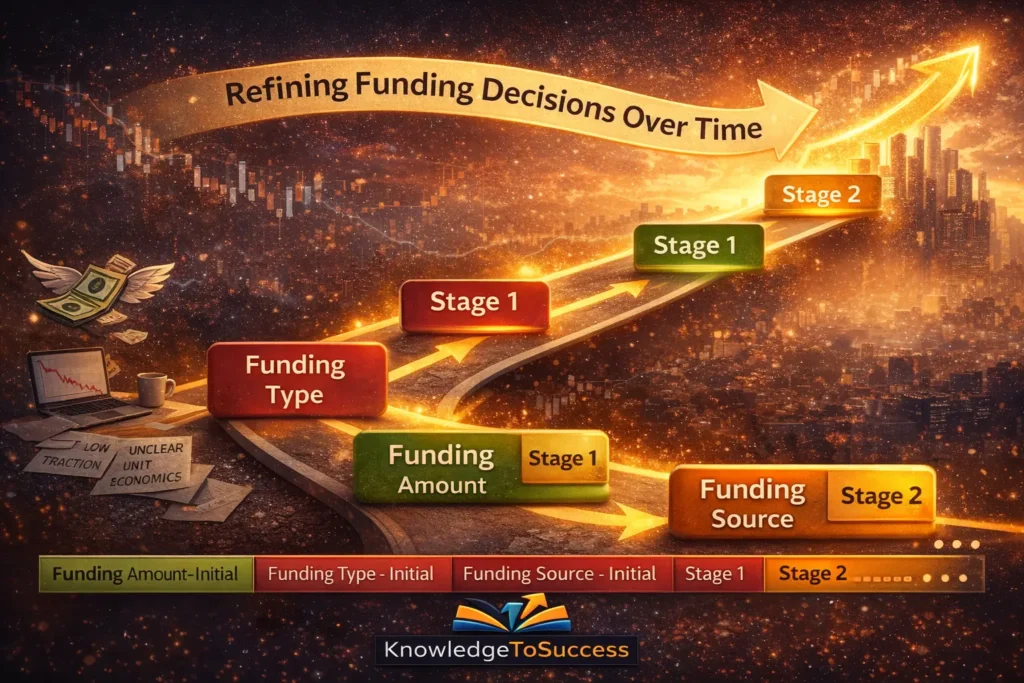
Why Timing Matters More Than Funding
Raising funds is easy for some startups. Raising funds at the right time is rare.
Wrong timing leads to:
- Poor valuation
- Loss of control
- Increased pressure
- Strategic misalignment
Correct timing leads to:
- Better deals
- Faster scaling
- Stronger investor trust
Key Signs You Are Ready to Shift to Funding
1. You Have Product-Market Fit
Customers are:
- Paying
- Returning
- Referring
This is the strongest signal.
2. You Understand Your Unit Economics
You know:
- Customer acquisition cost (CAC)
- Lifetime value (LTV)
- Profit margins
Without this, raising fund becomes risky.
3. You Have Early Traction
Traction can be:
- Revenue growth
- User growth
- Engagement metrics
Even small traction builds investor confidence.
4. You Know How to Scale
You must answer:
👉 If you get ₹2 crore today, what will you do?
If the answer is unclear, you’re not ready.
5. Market Opportunity Is Time-Sensitive
If competitors are moving fast, funding helps you:
- Capture market share
- Build brand faster
- Scale operations
Read More Article on Startup Guides India.
Signs You Are NOT Ready for Funding
1. No Clear Revenue Model
2. No Product-Market Fit
3. Weak Financial Understanding
4. Poor Compliance or Structure
5. Raising for “Validation”
Funding does not fix problems. It amplifies them.
Common Founder Mistakes
- Raising funds too early
- Delaying funding despite growth
- Choosing wrong investors
- Ignoring dilution impact
- Not preparing for due diligence
These mistakes can permanently affect your startup.
Bootstrapping vs Funding: Timing Framework
| Stage | Recommended Approach |
|---|---|
| Idea Stage | Bootstrapping |
| Early Validation | Bootstrapping |
| Product-Market Fit | Consider Funding |
| Growth Stage | Raise Funding |
| Scale Stage | Funded Model |
This framework helps you decide logically.
Real Founder Insight
Many successful startups follow this path:
👉 Bootstrap → Validate → Raise Funding → Scale
This hybrid approach balances:
- Control
- Growth
- Risk
How Investors Think About Timing
Investors look for:
- Proven traction
- Clear growth path
- Scalable model
- Strong founder understanding
According to Harvard Business Review, timing significantly impacts startup success and valuation.
Practical Decision Framework
Ask yourself:
- Do I need capital to grow or to survive?
- Can I scale without raising fund?
- Will raising fund accelerate results significantly?
- Am I ready for investor pressure?
If most answers are YES, you are ready.
Final Verdict: Timing Defines Outcome
Funding is not success.
Timing is.
Raising funds too early weakens your position.
Raising funds at the right time strengthens your growth.
Understanding when to shift from bootstrapped to funded startup is what separates smart founders from struggling ones.
FAQs
1. When should a startup shift from bootstrapping to funding?
After achieving product-market fit and early traction.
2. Is raising funding early a mistake?
Often yes, unless strong growth opportunity exists.
3. Can startups scale without funding?
Yes, but growth may be slower.
4. What is the biggest risk of early funding?
Loss of control and pressure.
5. Should all startups raise funding?
No, it depends on business model and goals.