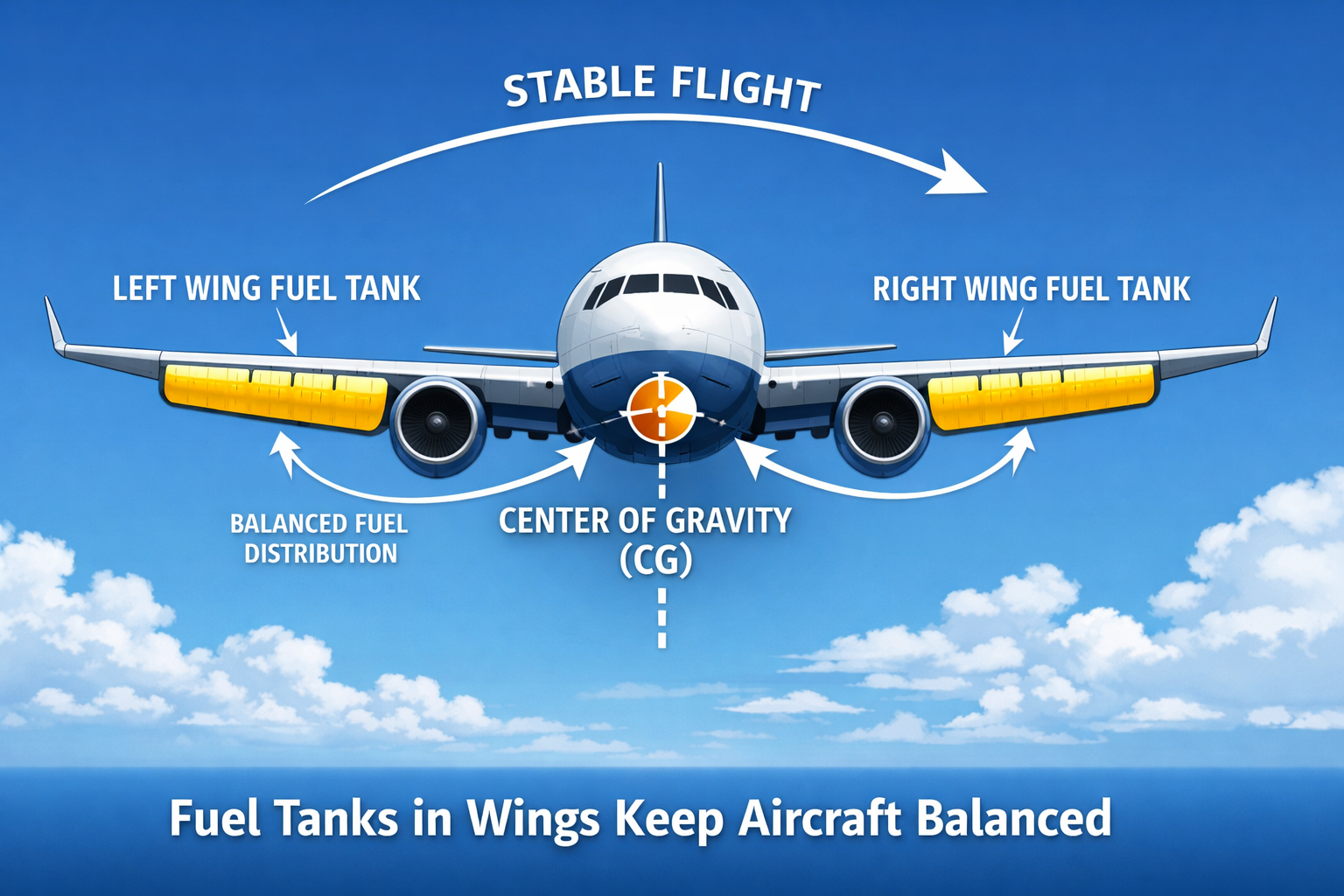
If you’ve ever observed an airplane closely, one detail often goes unnoticed. The fuel tank that powers this massive flying machine is not located inside the main body where passengers sit. Instead, aircraft fuel tanks are built into the wings.
At first, this may seem counter-intuitive. Wouldn’t it be simpler to store fuel in one large tank inside the aircraft body?
The answer is no.
Placing fuel tanks inside the wings is one of the most critical aircraft design choices, carefully balancing physics, safety, efficiency, and real-world engineering constraints.
Let’s break down why aircraft fuel tanks are placed in the wings and why this design has stood the test of time.
Understanding Basic Aircraft Structure
Before diving deeper, let’s clarify two basic terms:
- Wings: The long horizontal structures on both sides that generate lift
- Fuselage: The main body of the aircraft that carries passengers and cargo
Fuel tank could theoretically be placed anywhere. But aircraft design is not about “possible”, it is about optimal.
1. Center of Gravity: The Biggest Reason
One of the most critical factors in aircraft design is center of gravity.
As fuel burns during flight:
- The aircraft becomes lighter
- The weight distribution changes
If fuel were stored mainly in the front or rear of the fuselage, the center of gravity would continuously shift as fuel is consumed.
Why this is dangerous
- Aircraft stability depends on precise balance
- A shifting center of gravity makes the aircraft harder to control
- Pilots would need constant trim corrections
- More fuel would be wasted just to maintain balance
Why wings solve this problem
Fuel stored in wings is located close to the aircraft’s natural center of gravity.
As fuel burns:
- The balance remains largely stable
- Control inputs remain predictable
- Overall efficiency improves
This alone makes wing-mounted fuel tanks a near-perfect solution.
2. Structural Strength and Wing Load Relief
This is a lesser-known but extremely important reason.
Wings experience massive upward force due to lift. Fuel inside the wings adds downward weight, which:
- Reduces bending stress on the wings
- Acts as a natural counterbalance to lift
- Allows wings to be lighter yet stronger
In simple terms, fuel tank in the wings helps the wings carry themselves.
Without this:
- Wings would need heavier structural reinforcement
- Aircraft weight would increase
- Fuel efficiency would drop
3. Safety: Protecting Passengers

Passenger safety is always a top priority.
Why wing fuel tanks are safer
- Wings are away from the passenger cabin
- In survivable crashes or hard landings, wing tanks are more likely to rupture outside the cabin
- Fire risk inside the fuselage is reduced
- Evacuation becomes easier and faster
If fuel tanks were placed inside the fuselage:
- Any rupture could lead to fire inside the cabin
- Smoke and heat would spread faster
- Rescue operations would become much harder
Wing placement doesn’t eliminate risk, but it significantly reduces it.
4. Engine Placement Makes Fuel Delivery Efficient
Most commercial aircraft engines are mounted directly under the wings.
This design allows:
- Shorter fuel lines
- Equal fuel supply to both engines
- Reduced system complexity
- Lower maintenance risk
Fuel can be transferred evenly from multiple wing compartments, helping maintain left-right balance throughout the flight.
5. Wings Use Integral Fuel Tanks, Not Separate Containers
Another misconception is that aircraft wings contain “large fuel drums.”
They don’t.
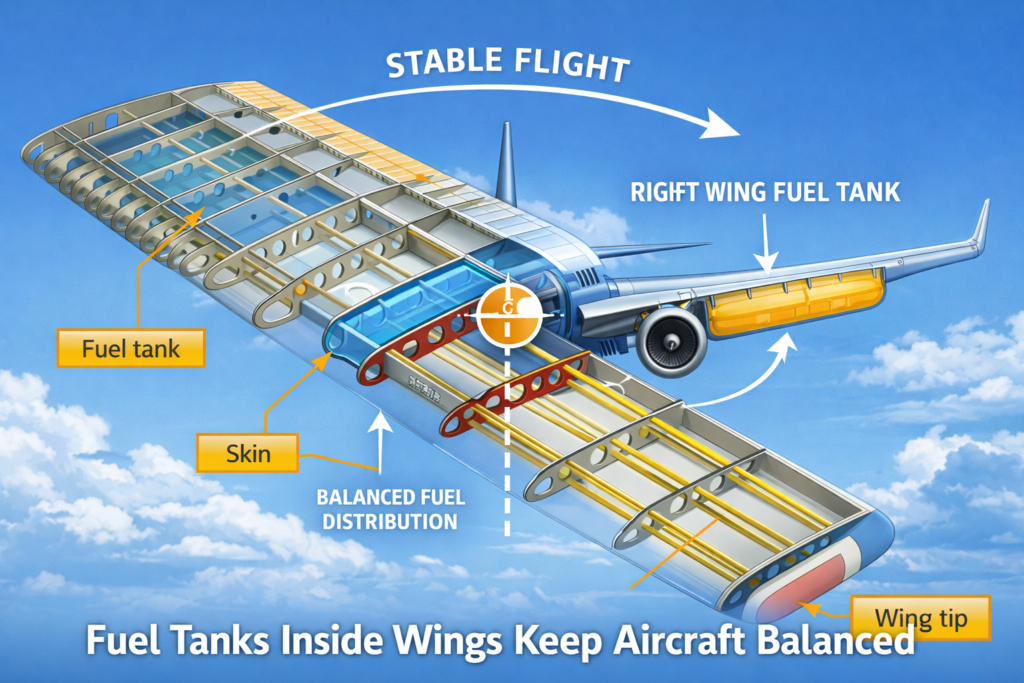
Modern aircraft use integral fuel tanks, where:
- The wing structure itself acts as the fuel tank
- Fuel is stored across multiple sealed compartments
- Each compartment has sensors and pumps
Benefits of this fuel tank design
- Prevents fuel sloshing
- Improves stability
- Adds redundancy
- Reduces overall aircraft weight
This design is both elegant and efficient.
6. Why Not Store All Fuel in the Fuselage?
While wings hold most fuel, some aircraft also have center fuel tanks in the fuselage.
These are used mainly in:
- Long-haul wide-body aircraft
- Military aircraft
- Business jets
However:
- Center tanks are placed close to the center of gravity
- They are used strategically, not as primary storage
- Wing tanks still carry the majority of fuel
So yes, fuselage tanks exist but wings remain the primary choice.
7. Fuel Management and Balance Control
Aircraft fuel systems are smart.
They:
- Monitor fuel levels in real time
- Transfer fuel between compartments when needed
- Ensure symmetrical weight distribution
This allows pilots to maintain balance even in:
- Long flights
- Turbulence
- Engine failure scenarios
Wing-based storage makes all of this easier and safer.
Read Article on Unknown Facts
Common Misunderstandings – Aircraft Fuel Tank
Fuel tanks in wings increase fire risk
Not true. Wing placement reduces cabin fire risk.
Fuel tanks could be anywhere
Technically yes, practically no.
It’s only for engine convenience
Engine placement is a reason, not the main reason.
The Big Picture: Engineering Is About Trade-offs
Aircraft design is a balance between:
- Physics
- Safety
- Efficiency
- Cost
- Maintainability
Wing-mounted fuel tanks satisfy all five better than any alternative.
That is why this design has remained unchanged for decades, even as aircraft technology has evolved rapidly.
Conclusion: A Smart Design Hidden in Plain Sight
The next time you board a flight, remember this:
The wings aren’t just helping the plane fly.
They are carrying its energy, its balance, and its safety system.
Placing fuel tanks inside the wings is not an accident or tradition.
It is a carefully engineered decision backed by physics, experience, and decades of real-world data.
Sometimes, the smartest designs are the ones we rarely notice.
FAQs
1. Why are aircraft fuel tanks placed in the wings?
To maintain balance, improve safety, reduce structural stress, and ensure efficient fuel delivery.
2. Do airplanes ever store fuel in the fuselage?
Yes, some aircraft use center fuel tanks, but wings hold most of the fuel.
3. Are wing fuel tanks safer in crashes?
Yes, they reduce cabin fire risk and improve evacuation chances.
4. How many fuel tanks does a wing have?
Each wing has multiple sealed compartments, not a single tank.
5. Does fuel tank in wings affect flight stability?
Yes, positively. It helps maintain a stable center of gravity.