SaaS startups in India scale differently from traditional businesses. They grow faster, serve global customers, rely on subscriptions, and often aim for funding early. Yet many SaaS founders make one critical mistake at the very beginning choosing the wrong business structure.
A SaaS product can succeed technically and still struggle commercially if the business structure doesn’t support funding, compliance, tax efficiency, and long-term scale.
This article explains which business structure works best for SaaS startup in India, why investors care so deeply about it, and how founders can avoid costly restructuring later.
Why Business Structure Is Critical for SaaS Startups
SaaS is not just software, it’s a scalable business model.
Your business structure affects:
- Ability to raise funding
- Shareholding and ESOPs
- Tax planning and reinvestment
- Global contracts and compliance
- Exit and acquisition readiness
For SaaS startups, choosing the right business structure is not optional, it’s foundational.
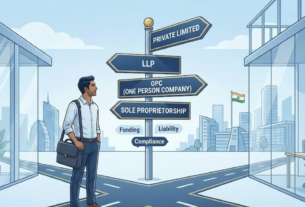
Common Business Structures SaaS Founders Consider
Most SaaS founders evaluate these options:
- Sole Proprietorship
- LLP (Limited Liability Partnership)
- OPC (One Person Company)
- Private Limited Company
Each looks similar at the start, but behaves very differently as the startup grows.
Why Sole Proprietorship Fails for SaaS Startups
Sole proprietorships are easy, but unsuitable for SaaS.
Key Limitations
- No separate legal entity
- No equity issuance
- No investor entry possible
- Unlimited personal liability
Even early-stage SaaS startups quickly outgrow this structure.
👉 For SaaS, sole proprietorship is a temporary stopgap, not a strategy.
Is LLP Suitable for SaaS Startups?
LLPs attract founders because of lower compliance.
But for SaaS startup, LLPs create long-term friction.
LLP Challenges for SaaS
- Cannot issue equity shares
- VC and angel investors avoid LLPs
- ESOP frameworks are weak
- Exit structures are complex
LLPs work well for consulting SaaS-like services, not for product-led SaaS startups.
Read Articles on Startup Guides India.
OPC for SaaS Startups: Limited but Useful Early On
OPC can work for:
- Solo SaaS founders
- Bootstrapped MVP phase
- Early customer validation
OPC Advantages
- Corporate tax benefits
- Separate legal entity
- Better credibility than individual
OPC Limitations
- No equity funding
- Mandatory conversion thresholds
- Not investor-friendly
OPC is best seen as a temporary structure, not a long-term SaaS foundation.
Why Private Limited Company Works Best for SaaS Startups
For most SaaS startups, a Private Limited Company is the most suitable business structure.
Key Reasons
1. Investor Readiness
- Allows equity issuance
- Preferred by angels and VCs
- Clean cap table management
2. ESOP-Friendly
- Attracts and retains tech talent
- Aligns long-term incentives
3. Global Compatibility
- Easy to sign international contracts
- Recognised by global clients and platforms
4. Tax Efficiency
- Corporate tax rates
- Startup tax exemption eligibility
- Better reinvestment planning
5. Exit & Acquisition Ready
- Simplifies M&A
- Cleaner due diligence
- Better valuation outcomes
For SaaS startups planning scale, Private Limited Company is not optional, it‘s expected.
Real-World SaaS Founder Scenario
Two SaaS startups launch identical products.
- Startup A registers as LLP
- Startup B registers as Private Limited
After 18 months:
- Both have customers
- Both want funding
Startup B gets term sheets.
Startup A is asked to convert—and loses momentum.
Structure matters before funding, not after.
Tax & Compliance Reality for SaaS Startups
Many founders fear compliance.
But SaaS startups benefit more from tax efficiency than compliance avoidance.
| Factor | LLP | OPC | Pvt Ltd |
|---|---|---|---|
| Funding Ready | ❌ | ❌ | ✅ |
| ESOP Support | ❌ | ❌ | ✅ |
| Tax Planning | Low | Medium | High |
| Scalability | Low | Medium | High |
When Should a SaaS Startup Register as Pvt Ltd?
You should start as a Private Limited Company if:
- You plan to raise funding
- You want ESOPs
- You serve global customers
- You’re building a scalable product
If not immediately, convert early before traction attracts investors.
Common Business Structure Mistakes SaaS Founders Make
- Starting as LLP to “save compliance”
- Delaying conversion until funding talks
- Poor cap table planning
- Ignoring ESOP requirements
These mistakes don’t break the product, but they break momentum.
Final Verdict: Structure for Scale, Not Comfort
SaaS startups are built for speed and scale.
Your business structure should support that ambition.
For most SaaS startups in India:
- Sole proprietorship is too weak
- LLP is too restrictive
- OPC is temporary
- Private Limited Company works best
Choose the business structure that investors, talent, and customers already trust.
FAQs
1. Can a SaaS startup register as an LLP?
Yes, but it’s not recommended for funded or scalable SaaS models.
2. Is OPC good for SaaS founders?
Only for early solo validation stages.
3. Do SaaS startups need a Private Limited Company?
Yes, if funding or scale is planned.
4. Does structure affect valuation?
Yes, significantly.
5. Can SaaS startups convert later?
Yes, but early conversion saves time and deals.