Most entrepreneurs in India believe high tax is unavoidable. It isn’t. In many cases, founders are paying extra tax not because their business earns more but because they chose the wrong business structure.
The harsh truth is this: Two businesses with the same revenue and same expenses can pay very different amounts of tax, purely based on how they are legally structured.
This article explains how your business structure directly impacts tax, why many founders overpay every year, and how choosing the right business structure can legally save lakhs over time.
Why Business Structure Decides How Much Tax You Pay
Many founders treat business registration as a one-time formality.
In reality, business structure is a long-term financial decision.
Your business structure determines:
- The base tax rate you pay
- Whether tax exemptions apply
- How profits are withdrawn
- How expenses are treated
- How much flexibility you have for tax planning
Once chosen, a business structure silently affects your tax outflow every single year.
The Hidden Cost of Choosing the Wrong Business Structure
Founders often choose a structure because:
- It is cheaper to register
- Someone “recommended” it
- Compliance feels simpler
What they don’t calculate is the compounding tax loss.
Paying even 5–10% extra tax annually can mean:
- Less money to reinvest
- Slower growth
- Higher dependence on funding
- Reduced personal income
This is why choosing the right structure early is critical.
How Different Business Structures Are Taxed in India

Let’s simplify this without legal jargon.
Sole Proprietorship
- Taxed as individual income
- Slab-based taxation
- Higher income = higher tax
- No separation between owner and business
👉 Often the highest tax burden as income grows.
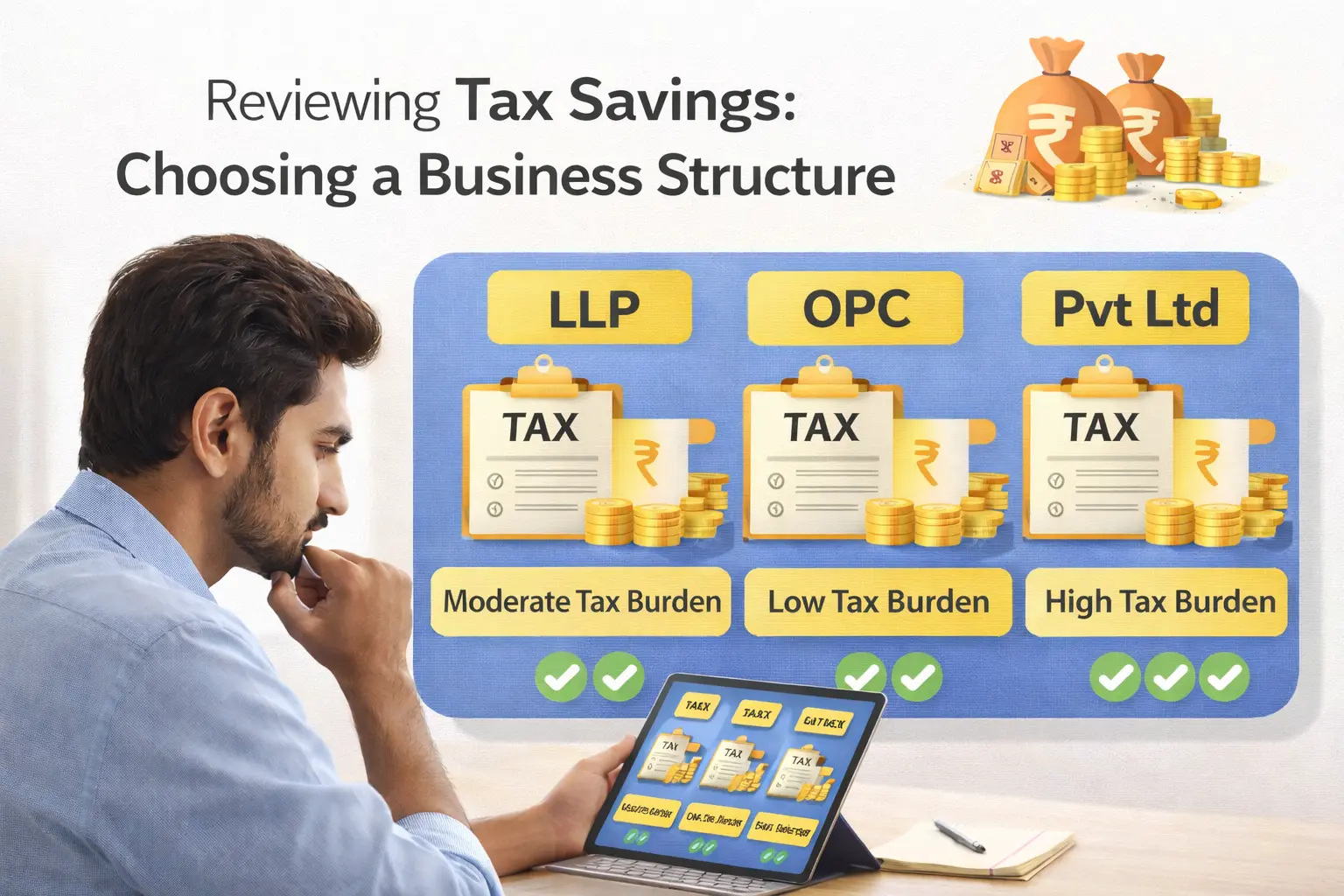
LLP (Limited Liability Partnership)
- Flat 30% tax on profits
- No dividend tax
- Limited tax planning flexibility
👉 Looks simple, but often tax-heavy for profitable businesses.
OPC (One Person Company)
- Taxed as a company
- Corporate tax rates apply
- Eligible for startup benefits
- Better expense optimisation
👉 A tax-efficient upgrade for solo founders.
Private Limited Company
- Lower corporate tax rates
- Startup tax exemption available
- Advanced tax planning options
- Best structure for reinvestment
👉 The most flexible and tax-efficient structure for growth.
Read Article on Startup Guides India.
Real-Life Example: Same Profit, Different Tax
Annual profit: ₹40 lakh
| Business Structure | Approx Tax Paid |
|---|---|
| Sole Proprietorship | ₹13–15 lakh |
| LLP | ₹13–14 lakh |
| OPC | ₹9–10 lakh |
| Private Limited Company | ₹8–9 lakh |
| Pvt Ltd (Startup Exempt) | ₹0 |
The difference is not small, it’s life-changing over time.
Why Many Founders Continue Overpaying Tax
Because:
- Tax impact is not explained at registration
- Short-term convenience is prioritised
- Compliance fear overshadows savings
- Structure upgrades are delayed
Most founders realise the mistake only after profits rise.

How to Choose the Right Business Structure for Tax Savings
Choosing the right structure depends on intent, not just income.
Choose a simpler structure if:
- Income is low
- Business is temporary
- Risk is minimal
Choose a corporate structure if:
- Profits are growing
- Reinvestment matters
- Long-term scalability is planned
The right structure should grow with your ambition, not restrict it.
Tax vs Compliance: The Real Trade-Off
| Factor | Low Compliance Structure | Corporate Structure |
|---|---|---|
| Compliance Effort | Low | Moderate |
| Tax Efficiency | Low | High |
| Growth Readiness | Limited | Strong |
| Long-Term Savings | Poor | Excellent |
Paying a little more for compliance often saves much more in tax.
Common Tax Mistakes Linked to Business Structure
- Staying in the same structure despite growth
- Avoiding company setup due to fear
- Ignoring startup tax exemptions
- Mixing personal and business finances
All these mistakes have one root cause: Choosing or sticking with the wrong structure.
When Should You Revisit Your Business Structure?
You should reassess your business structure when:
- Profits increase
- Funding is planned
- Team size grows
- Long-term contracts begin
- Tax outflow feels excessive
A structure that worked in year one may be damaging in year three.
Final Verdict: Extra Tax Is Optional, Not Inevitable
The question is not whether tax exists.
The question is whether you are paying more than legally required.
In many cases, founders don’t need complex tax tricks.
They just need the right business structure.
Choosing wisely can:
- Reduce tax legally
- Improve cash flow
- Accelerate growth
- Increase personal wealth
FAQs
1. Can changing business structure reduce tax?
Yes, upgrading structure often reduces long-term tax.
2. Is LLP tax-efficient in India?
Only for stable, non-scaling businesses.
3. Is Private Limited Company best for tax saving?
Yes, especially for growth-focused startups.
4. Is tax the only factor in choosing business structure?
No, but it is one of the most important.
5. When should founders rethink their structure?
When profits rise or growth plans change.