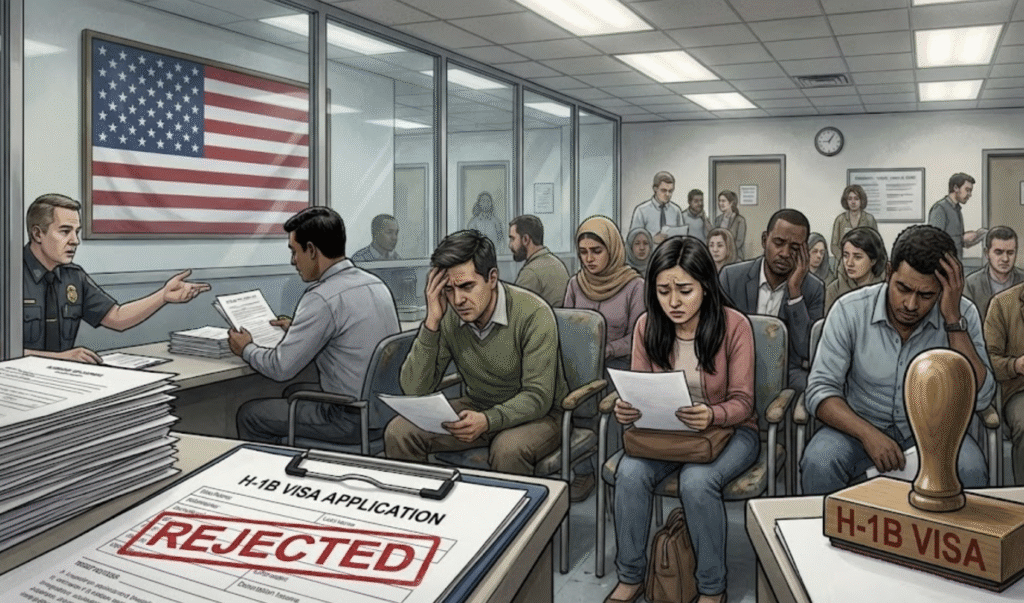
H-1B approvals have dropped sharply in 2025, sending shockwaves across the global tech community especially in India, where lakhs of professionals depend on the US work visa to build careers in American tech firms. In this article we are checking H-1B Approvals Plunge : What’s Really Going On?
With new USCIS scrutiny, shifting immigration priorities, and changing economic conditions, the H-1B landscape is no longer what it used to be.
This article breaks down why H-1B approvals plunged, who is affected, and what Indian professionals must do next.
What Does the “H-1B Approvals Plunge” Really Mean?
Official data and early reports indicate:
- Higher rejection rates during visa processing
- Stricter document checks
- More Requests for Evidence (RFEs)
- Fewer approvals for entry-level roles
- Increased scrutiny over specialty occupation
In short : USCIS has tightened the H-1B gate heavily in 2025.
Why Are H-1B Approvals Dropping in 2025?
Here are the biggest reasons behind the sudden decline:
A) Increased USCIS Scrutiny on “Specialty Occupation”
USCIS is rejecting applications that do not clearly prove:
- The role requires a bachelor’s degree specifically
- The job fits a high-skilled STEM category
- Salary meets updated wage-level criteria
Many tech-support and entry-level IT roles are being rejected for “insufficient specialization.”
B) AI & Automation Reducing Need for Low-Skill Tech Roles
The US job market has shifted.
- More AI tools
- Automated IT workflows
- Companies moving routine work offshore
This reduces demand for H-1B roles that are not deep-tech or highly specialized.
C) US Protectionist Hiring Policies
The US government is focusing on:
- Increasing local tech employment
- Reducing dependence on foreign entry-level workers
- Encouraging companies to hire more Americans
This directly affects H-1B applicants from India.
D) Higher Compliance Pressure on US Employers
Companies now face:
- Strict audits
- Penalties for misclassification
- Wage-level enforcement
Many small and mid-tier IT consulting firms are either:
- Avoiding H-1B hiring
- Filing fewer petitions
- Getting rejected due to compliance gaps
E) Over subscription of the H-1B Lottery
The H-1B cap remains at:
- 65,000 Regular Cap
- 20,000 Master’s Cap
But applications exceed 500,000+, meaning:
👉 Even with no policy change, approval ratios drop.
In 2025, the over subscription is higher due to slowing global job markets.
H-1B Approvals Plunge – How This Impacts Indian Tech Workers
Indians account for 75%+ of all H-1B visas, so the impact is huge:
✔ More delays
✔ More RFEs
✔ Higher rejection risk
✔ Tougher transition from F-1 to H-1B
✔ H-1B transfers also under scrutiny
Many employees already working in the US are now facing:
- Delayed stamping
- Background verification
- Additional compliance paperwork
How This Impacts Companies Hiring Foreign Talent
❌ Consulting firms hit hardest
❌ Small IT service companies see mass rejections
❌ Startup H-1B petitions delayed
❌ More legal costs
❌ Must meet higher salary brackets
Big tech companies are less affected because they pay top salaries and hire high-skilled workers.
H-1B Salary Rules Tightened
The wage requirement for H-1B now enforces:
- Higher minimum salary
- Level-2 and Level-3 wages for high-tech
- Location-based salary compliance
Entry-level jobs with Level-1 wages are most rejected.
Optional Practical Training (OPT) Students Also Affected
Indian students on:
- F-1 OPT
- STEM OPT
…are facing difficulty converting to H-1B because:
- Lottery is overloaded
- RFEs are stricter
- Companies are hesitant
Alternatives Indians Are Now Exploring
Indians are now aggressively looking at:
✔ Canada PR (Express Entry)
✔ UK Skilled Worker Visa
✔ Germany Blue Card
✔ Dubai Talent Visa
✔ Saudi Tech Visa
✔ Singapore Tech.Pass
Global mobility is shifting because the US is no longer the only dream destination.
What Should Indian Tech Professionals Do Now?
✔ Focus on Deep Skills
AI, Cloud, Cybersecurity, ML, Data, DevOps.
✔ Prefer product companies over bodyshops
Consulting firms see more rejections.
✔ Maintain strong documentation
Degrees, transcripts, client letters, job duties.
✔ Apply for roles with higher wage-levels
Level-2 or Level-3 = better approval odds.
✔ Keep backup visas ready
Canada, UK, Dubai.
🎯 Conclusion : H-1B Is Still Alive, But Much Harder
The H-1B visa is not going away, but the system is shifting to:
- Favor high-skill talent
- Reduce entry-level outsourcing
- Improve local hiring
- Tighten compliance
For Indian professionals, the path to the US is now:
✔ Harder
✔ More competitive
✔ Strictly merit-based
But not impossible, especially for highly specialized tech talent.
❓ FAQs
1. Why did H-1B approvals drop in 2025?
Due to higher scrutiny, salary rules, oversubscription, and fewer entry-level approvals.
2. Are Indian applicants most affected?
Yes. Indians form the largest share of H-1B filings.
3. Are big tech companies still getting approvals?
Mostly yes, because they offer high salaries and specialized roles.
4. Is H-1B becoming impossible now?
No. But only high-skilled, high-salary profiles have strong chances.
5. What alternatives to H-1B are trending for Indians?
Canada, UK, Germany, UAE, Singapore, Saudi.