Most people think the Moon has always stayed the same distance from Earth. However, that is not true.
The Moon is slowly moving away from Earth, and this process is happening right now, every single year.
It is not dramatic.
It is not visible overnight.
But it is constant.
Scientists have measured that the Moon drifts away by about 3.8 centimeters per year.
That may seem small. Yet over millions of years, it changes everything.
Why the Moon Is Slowly Moving Away from Earth
The reason the Moon is slowly moving away from Earth comes down to one key force:
Tidal interaction between Earth and the Moon
Here is how it works:
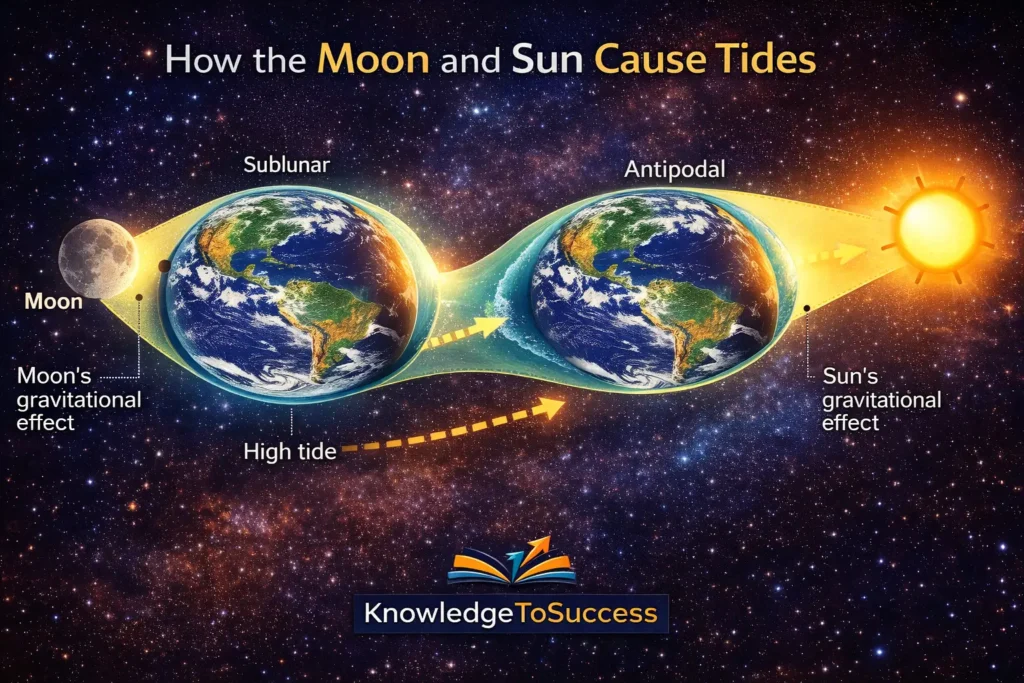
- The Moon’s gravity pulls Earth’s oceans
- This creates tides
- Earth rotates faster than the Moon orbits
- This creates a forward “bulge” in the oceans
That bulge pulls the Moon slightly forward in its orbit.
As a result:
- The Moon gains energy
- It moves into a higher orbit
- It slowly drifts away from Earth
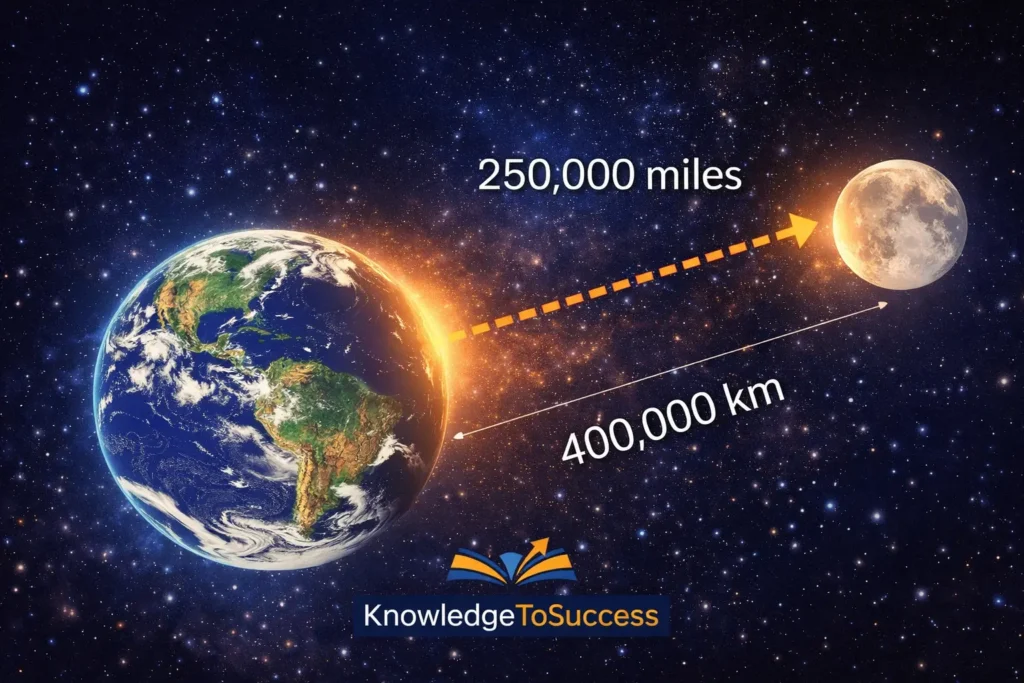
How Scientists Measure the Moon Moving Away from Earth
You might wonder how we know this with such precision.
The answer comes from the Apollo missions.
Astronauts placed laser reflectors on the Moon’s surface.
Scientists on Earth:
- Send laser beams to the Moon
- Measure the time it takes to return
- Calculate distance with extreme accuracy
This method confirms that the Moon is slowly moving away from Earth at a measurable rate.
The Moon Is Slowly Moving Away from Earth: What It Means for Us
This movement is not just a space fact.
It affects Earth in subtle but important ways.
1. Longer Days on Earth
As energy transfers to the Moon:
- Earth’s rotation slows down
- Days become slightly longer
Millions of years ago, a day lasted only about 18 hours.
2. Changes in Tides
The Moon controls tides.
As it moves away:
- Tidal strength gradually changes
- Ocean behavior evolves
3. Stable Planetary System
The Moon stabilizes Earth’s tilt.
Even as it moves away:
- Stability continues for billions of years
- Life remains unaffected in the short term
How Fast Is the Moon Moving Away from Earth
Let’s simplify the numbers.
| Time Scale | Distance Change |
|---|---|
| Per year | ~3.8 cm |
| Per century | ~3.8 meters |
| Per million years | ~38 km |
This is slow, but over long periods, the effect is massive.
Common Misconceptions About the Moon Moving Away
Mistake 1: The Moon is escaping quickly
No. The process is extremely slow.
Mistake 2: Earth will lose the Moon soon
Not anytime soon. It will take billions of years.
Mistake 3: This affects daily life
The impact is too gradual to notice in a human lifetime.
Step-by-Step: Why the Moon Is Slowly Moving Away from Earth
Let’s simplify the process:
- Moon’s gravity pulls Earth’s oceans
- Tidal bulge forms
- Earth rotates faster than Moon orbits
- Bulge pulls Moon forward
- Moon gains energy
- Moon moves into a higher orbit
That’s the complete cycle.
Why This Unknown Fact Matters
This fact teaches something bigger.
Small forces, applied consistently, create massive long-term change.
The Moon does not suddenly move away.
It shifts slowly, predictably, and continuously.
The same principle applies in:
- Nature
- Science
- Business
- Life decisions
Read more articles on Unknown Facts
The Future: What Happens Next?
In billions of years:
- Earth’s rotation will slow further
- The Moon will be much farther away
- A stable balance may eventually form
However, the Sun’s evolution will likely impact Earth before this process completes.
So practically, the Moon will remain part of Earth’s system for a very long time.
Conclusion: A Silent Change Happening Above Us
The Moon is slowly moving away from Earth, and it has been doing so for billions of years.
You cannot see it.
You cannot feel it.
But it is happening.
This quiet shift reminds us that not all important changes are dramatic.
Some of the most powerful transformations are slow, steady, and invisible.
FAQs
1. Why is the Moon moving away from Earth?
Due to tidal forces and energy transfer between Earth and the Moon.
2. How fast is the Moon moving away?
About 3.8 centimeters per year.
3. Will Earth lose the Moon?
Not anytime soon. The process takes billions of years.
4. Does this affect tides?
Yes, but the changes are extremely gradual.
5. How do scientists measure this movement?
Using laser reflectors placed on the Moon during Apollo missions.