
A job description looks simple at first glance. However, most candidates read it only once and move on. That’s where they go wrong. Decoding the job descriptions for interviews helps you understand what employers truly want often beyond what is written on the page.
In fact, recruiters use job descriptions as filters. Every word, requirement, and bullet point is intentional. Therefore, if you learn how to read between the lines, you gain a powerful advantage. You speak the employer’s language. You align your answers better. Most importantly, you stop sounding generic.
This article will show you exactly how employers think while writing job descriptions and how you can respond smarter during interviews.
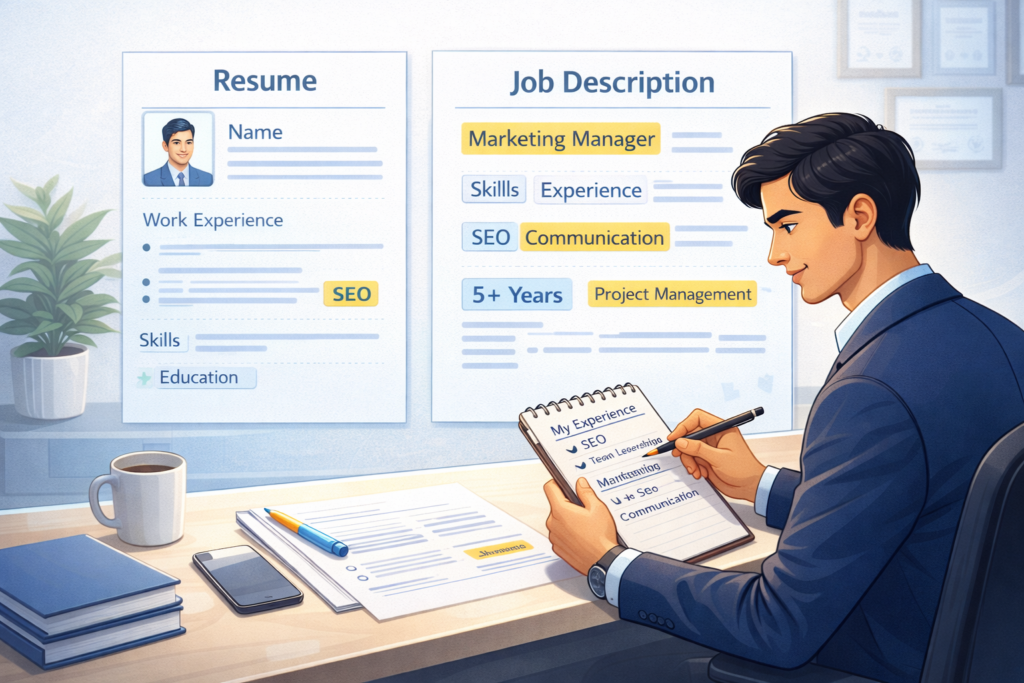
Why Decoding a Job Descriptions Matters More Than You Think
Many candidates assume job descriptions are just formal checklists. In reality, they are expectation maps.
Employers use them to:
- Filter unsuitable resumes quickly
- Define success for the role
- Set interview evaluation criteria
- Reduce hiring risks
Because of this, interview questions almost always come directly from the job description. If you decode it well, you can predict questions with surprising accuracy.
Step 1: Understand the Role Title (It’s Not Always Literal)
Job titles can be misleading. Sometimes, they are inflated. Other times, they are vague.
What to Ask Yourself
- Is this an individual contributor or leadership role?
- Is it execution-focused or strategy-focused?
- Is it junior, mid-level, or senior despite the title?
For example, a “Manager” role in a startup may involve hands-on work. Meanwhile, the same title in a large company could be purely people management.
Therefore, don’t rely on titles alone. Look deeper.
Step 2: Break the Job Descriptions Into Sections
Instead of reading everything at once, divide the job description into smaller blocks.
Typical Sections Include:
- Role summary
- Responsibilities
- Required skills
- Preferred qualifications
- Company overview
By breaking it down, patterns become clearer. As a result, you can prioritize what matters most.
Read all the articles on Career Guidance
Step 3: Focus on Repeated Skills and Keywords
When employers repeat certain words, they are sending strong signals.
Examples of Repetition
- “Cross-functional collaboration”
- “Stakeholder management”
- “Data-driven decision making”
- “Ownership” or “accountability”
If a skill appears more than once, it’s critical. Therefore, you must reflect it clearly in:
- Your resume
- Your interview answers
- Your examples and stories
This approach also helps with ATS (Applicant Tracking Systems).
Step 4: Decode Action Verbs to Understand Expectations
Action verbs reveal how employers expect you to work.
What Common Verbs Actually Mean
- Lead → Decision-making responsibility
- Own → Accountability, not just execution
- Support → Collaborative role, less authority
- Drive → Proactive, results-focused behavior
- Execute → Hands-on, delivery-focused work
Because of this, your interview answers should match the energy of these verbs. For example, if the role says “drive initiatives,” avoid passive examples.
Step 5: Separate “Must Have” From “Nice to Have”
Many candidates disqualify themselves unnecessarily. That’s a mistake.
How to Identify Priorities
- “Required,” “must,” or “essential” = non-negotiable
- “Preferred,” “good to have” = flexible
- Long skill lists = ideal candidate, not mandatory
According to Indeed’s career guide, candidates who meet around 60–70% of requirements are still strong applicants.
External reference: Indeed Career Guide
So, don’t panic if you don’t match everything.
Step 6: Understand the Problem This Role Is Solving
Every role exists for a reason. Therefore, ask:
- What problem is this hire meant to solve?
- Why is the company hiring now?
- What outcome would define success?
For example:
- Growth phase → scaling and speed matter
- Process-heavy role → accuracy and consistency matter
- New initiative → ambiguity handling matters
When you answer interview questions with this context, you sound thoughtful and business-aware.
Step 7: Decode the Soft Skills Hidden in Plain Sight
Soft skills are rarely listed directly. However, they are everywhere.
Hidden Signals
- “Fast-paced environment” → Adaptability
- “Wear multiple hats” → Flexibility
- “Strong communication” → Stakeholder interaction
- “Self-starter” → Minimal supervision
Therefore, prepare stories that show these traits naturally.
Harvard Business Review often highlights how soft skills influence hiring decisions more than technical skills in many roles.
Step 8: Match the Job Descriptions With Your Experience
Now comes the most important step alignment.
How to Align Effectively
- Pick 3 – 4 core requirements
- Prepare one strong example for each
- Use metrics where possible
- Keep stories simple and structured
This makes your answers focused instead of scattered.
Step 9: Prepare Job Descriptions Based Interview Questions
Most interview questions are recycled from the job description.
Predictable Question Patterns
- “Tell me about a time you handled ___”
- “How do you approach ___?”
- “What experience do you have with ___?”
Because of this, your preparation becomes targeted instead of random.
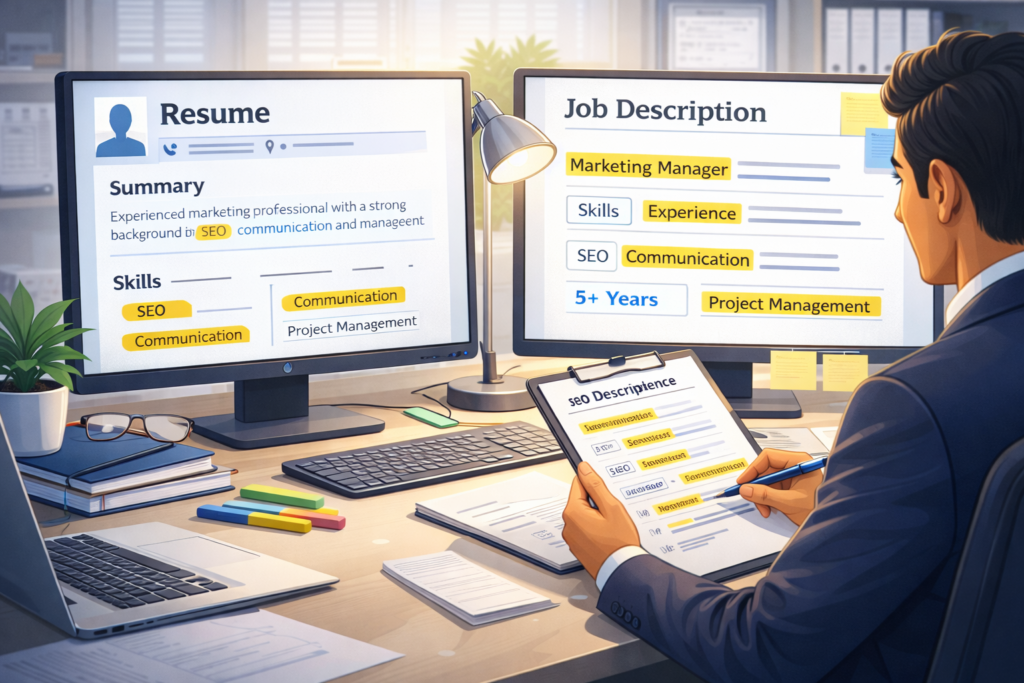
Common Mistakes While Reading Job Descriptions
Even strong candidates make these errors:
- Skimming instead of analyzing
- Focusing only on tools, not outcomes
- Ignoring soft skill signals
- Copy-pasting generic answers
- Overestimating missing skills
Avoiding these mistakes instantly improves interview performance.
Quick Job Descriptions Decoding Checklist
Before your interview, confirm you can answer:
- What is the core responsibility of this role?
- Which skills matter most?
- What problems will I solve?
- Which examples best match this role?
- Which keywords should I use naturally?
This checklist keeps your preparation sharp and efficient.
Conclusion: Job Descriptions Are Interview Blueprints
A job description is not just an announcement. Instead, it’s a blueprint for interviews, evaluations, and expectations. When you master decoding the job description for interviews, you stop guessing and start answering with clarity.
Most candidates read job descriptions casually. Smart candidates analyze them deeply. That difference often decides who gets the offer.
If you want consistent interview success, treat every job description like a strategy document not a formality.
FAQs
1. Should I memorize the job descriptions before an interview?
No. Instead, understand it deeply and relate it naturally to your experience.
2. What if the job descriptions is vague?
Focus on the role summary, company context, and similar roles on LinkedIn.
3. Do interviewers really stick to the job descriptions?
Yes, most questions are derived directly or indirectly from it.
4. Can I apply if I don’t meet all requirements?
Yes. Meeting 60 – 70% is often sufficient if core skills match.
5. How early should I analyze the job descriptions?
Ideally, before applying. At the latest, 2 – 3 days before the interview.


1 thought on “How to Decode Job Descriptions and Understand What Employers Want”