You prepare well. You revise your answers. You understand the role clearly. Yet, when the interview begins, something changes. Your heart beats faster. Your thoughts feel scattered. Your answers lose clarity. This is exactly where many strong candidates struggle.
Understanding how to handle stress and nerves during an interview is not optional. It is a core skill. Interviews are not only about knowledge. They are about performance under pressure.
Stress is natural. However, unmanaged stress affects how you speak, think, and present yourself. Therefore, controlling nerves is not about eliminating fear. Instead, it is about managing it effectively so your real ability becomes visible.
This guide will help you understand stress, control it, and use it to your advantage during interviews.
Why Interview Stress Happens
Stress during interviews is a biological response. Your brain treats interviews as high-stakes situations.
This happens because:
- You are being evaluated
- The outcome affects your future
- The situation feels uncertain
- You want to perform well
According to research discussed by the American Psychological Association, stress increases in situations involving performance and judgment.
Therefore, feeling nervous does not mean you are unprepared. It means your brain is alert.
How Stress Affects Your Performance
When stress increases, your body and mind react immediately.
Common Effects:
| Area | Impact |
|---|---|
| Thinking | Difficulty recalling information |
| Speech | Talking too fast or losing clarity |
| Body Language | Fidgeting, lack of eye contact |
| Confidence | Self-doubt increases |
This explains why strong candidates lose interviews to stress and nerves, even when they have the right skills.
Step 1: Accept Stress Instead of Fighting It
The biggest mistake candidates make is trying to eliminate stress completely.
That approach creates more pressure.
Instead, accept this:
A small amount of stress improves focus.
Once you stop resisting stress, your control improves immediately.
Read more articles on Career Guidance
Step 2: Prepare for Familiarity, Not Perfection
Stress grows when situations feel unfamiliar.
Therefore, focus on familiarity.
Build Familiarity By:
- Practicing common interview questions
- Doing mock interviews
- Rehearsing answer structure
- Simulating real interview conditions
The more familiar the situation feels, the calmer you become.
Step 3: Use Breathing to Control Stress Instantly
Breathing is one of the fastest ways to calm your body.
Simple Technique:
- Inhale for 4 seconds
- Exhale for 6 seconds
- Repeat 5 times
Longer exhalation signals safety to your brain. This reduces anxiety quickly.
Use this before entering the interview or while waiting.
Step 4: Slow Down Your Response
Stress makes candidates rush.
However, rushing reduces clarity.
Instead:
- Pause before answering
- Speak slowly
- Use short sentences
Interviewers prefer clear answers over fast answers.
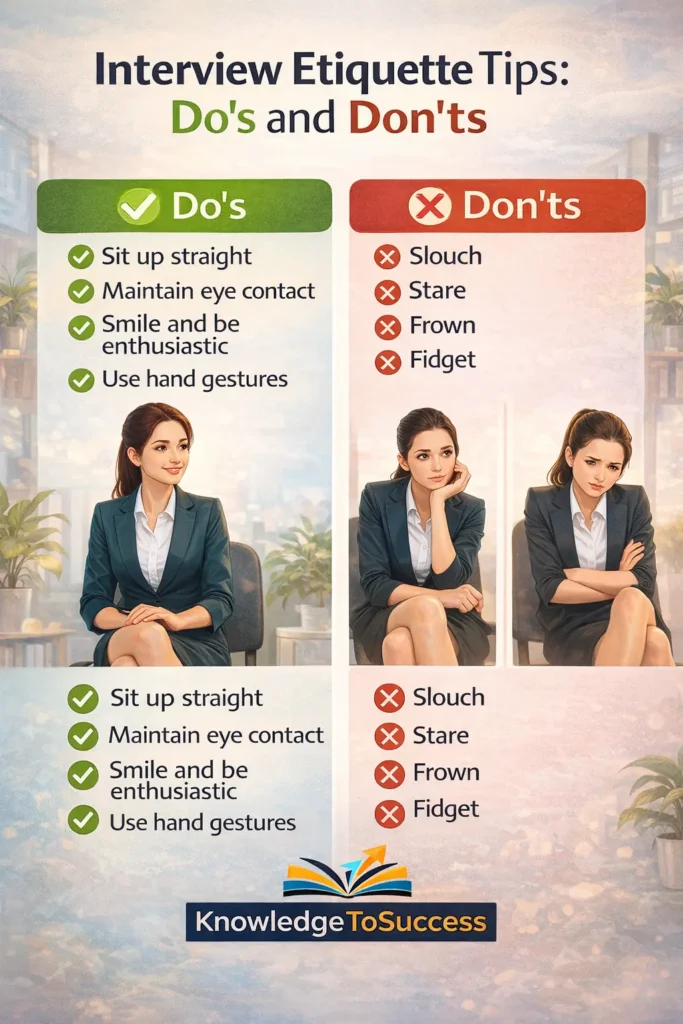
Step 5: Control Your Body Language
Your body influences your mental state.
Calm Body Signals:
- Straight posture
- Relaxed shoulders
- Steady eye contact
- Controlled hand movements
Even if you feel nervous, calm body language reduces visible stress.
Step 6: Reframe Nervousness as Energy
Stress and excitement feel similar in your body.
Instead of thinking:
“I am nervous”
Think:
“I am ready and focused”
This shift improves performance without forcing artificial confidence.
Step 7: What to Do When You Freeze Mid-Interview
Freezing happens to many candidates.
If it happens:
- Pause
- Take one breath
- Acknowledge the question
- Start with what you know
Example: “That’s a good question. Let me think for a moment.”
This shows composure instead of panic.
Step 8: Prepare Your Mind the Day Before
Stress begins before the interview day.
Do This:
- Stop heavy preparation early
- Avoid negative content
- Get proper sleep
- Prepare outfit and documents
Preparation reduces uncertainty. Reduced uncertainty reduces stress.
Step 9: Avoid These Stress-Making Habits
Even strong candidates increase their own stress.
Common Mistakes:
- Over-preparing late at night
- Comparing with other candidates
- Skipping sleep
- Rushing to the interview
Avoiding these mistakes improves performance instantly.
Practical Stress-Control Checklist
| Action | Purpose |
|---|---|
| Practice questions | Builds familiarity |
| Breathing exercise | Reduces anxiety |
| Prepare outfit early | Removes last-minute stress |
| Sleep well | Improves clarity |
| Arrive early | Prevents panic |
Important Insight: Interviewers Expect Some Nervousness
Interviewers do not expect perfection.
They look for:
- Calm recovery
- Clear thinking
- Professional behavior
Handling stress well often creates a stronger impression than perfect answers
Conclusion
Interview stress is normal. However, losing control is optional.
When you understand how to handle stress and nerves during an interview, you protect your ability to think clearly, communicate effectively, and present yourself confidently.
You do not need to eliminate stress.
You need to manage it.
Strong candidates do not succeed because they feel no pressure. They succeed because they handle pressure better.
Frequently Asked Questions
1. How to handle stress and nerves during an interview quickly?
Use breathing techniques, pause before answering, and maintain calm body language.
2. Is it normal to feel nervous in interviews?
Yes. Almost every candidate experiences anxiety.
3. Can stress affect interview performance?
Yes. It affects thinking, speech, and confidence.
4. What is the fastest way to calm down before an interview?
Deep breathing and slowing your thoughts help immediately.
5. Do experienced professionals feel interview stress?
Yes. Experience reduces fear slightly, but stress still exists.