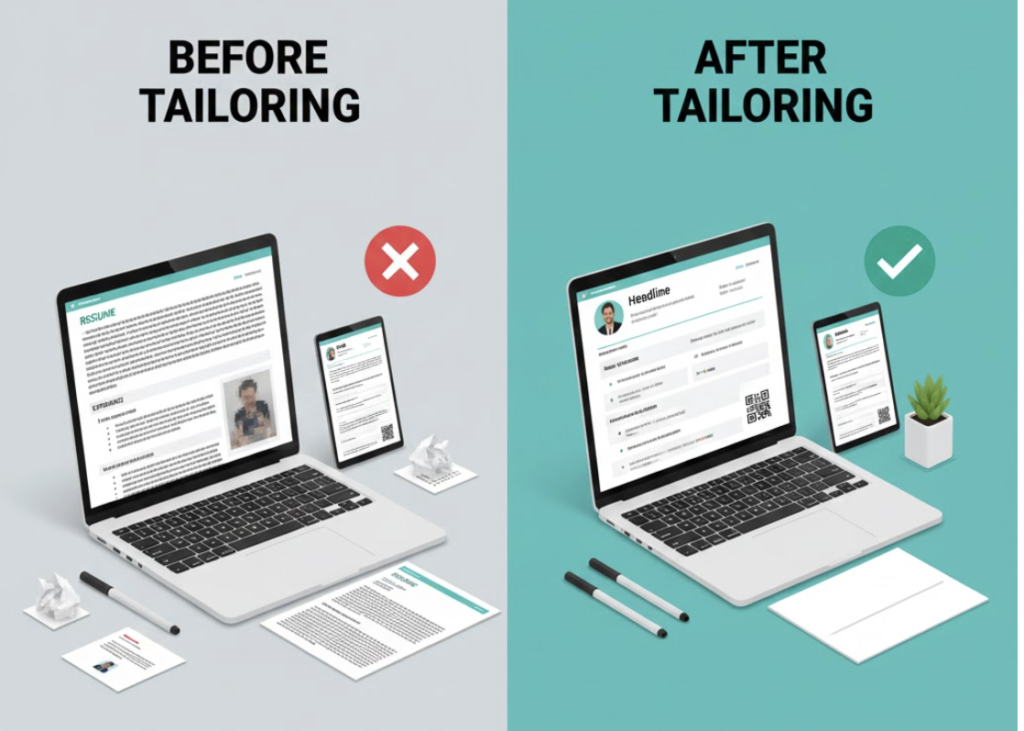
Sending the same resume to every job is one of the biggest mistakes candidates make. Although it feels efficient, it often backfires. Recruiters can spot generic applications instantly. Therefore, learning how to Tailor Resume and Cover Letter for role is no longer optional, it’s essential.
Hiring managers review hundreds of applications. As a result, they spend only a few seconds scanning each resume. If your profile doesn’t clearly match the job description, it gets skipped. However, when your resume speaks directly to the role, it stands out.
In this guide, you’ll learn how to customize your resume and cover letter step by step without rewriting everything from scratch.
Why Tailoring Your Resume and Cover Letter Matters
Recruiters don’t look for “good resumes” Instead, they look for relevant resumes.
When you tailor your application:
- You pass ATS (Applicant Tracking Systems) more easily
- Your strengths appear clearer
- Your experience feels more aligned
- You increase interview shortlisting chances
According to LinkedIn Talent Solutions, tailored resumes receive significantly higher response rates.
External reference: LinkedIn Career Advice
Step 1: Start With the Job Description (Again)
Everything begins with the job description. Therefore, never skip this step.
What to Extract
- Core responsibilities
- Required skills
- Tools and technologies
- Soft skill signals
Highlight keywords and phrases. Then, prioritize them based on repetition and importance.
Internal link suggestion: Read Decoding the Job Description: What Employers Are Really Looking For to master this step.
Step 2: Customize Your Resume Summary First
Your resume summary is prime real estate. However, many candidates waste it.
How to Tailor the Summary
- Mention the job title or role focus
- Highlight 2–3 most relevant skills
- Align with company needs
Before (Generic):
“Experienced professional with strong skills and a passion for growth.”
After (Tailored):
“Data analyst with 4+ years of experience driving insights through SQL, Power BI, and stakeholder collaboration.”
This change alone improves relevance dramatically.
Step 3: Reorder Experience Based on Relevance
Not all experience deserves equal attention.
Smart Reordering Strategy
- Bring relevant roles to the top
- Expand bullet points for matching roles
- Reduce details for unrelated roles
Even within a role, reorder bullets so the most relevant achievements appear first.
As a result, recruiters see alignment immediately.
Step 4: Use Job Description Keywords Naturally
ATS systems scan for keyword matches. However, keyword stuffing hurts readability.
Best Practices
- Use exact terms where possible
- Maintain natural sentence flow
- Avoid forced repetition
For example, if the job mentions “stakeholder communication,” use the same phrase instead of synonyms everywhere.
According to Indeed, resumes aligned with job keywords perform better in ATS scans.
External reference: Indeed Career Guide
Step 5: Quantify Achievements Wherever Possible
Numbers add credibility. Therefore, use them wisely.
Examples
- “Improved conversion rate by 18%”
- “Managed a team of 6”
- “Reduced processing time by 30%”
Even approximate metrics are better than vague statements.
Step 6: Tailor the Cover Letter (Not Optional Anymore)
Many candidates skip cover letters. However, when done right, they create strong impact.
Structure That Works
- Opening: Why this role and company
- Middle: Relevant experience and skills
- Closing: Enthusiasm and next steps
Keep it short. Keep it specific. Keep it human.
Harvard Business Review notes that cover letters help reveal motivation and communication skills.
External reference: Harvard Business Review – Job Applications
Step 7: Match Soft Skills With Role Expectations
Soft skills matter more than ever. Yet, they must be shown not told.
Instead of Saying:
- “Good communicator”
- “Team player”
Show It:
- “Led cross-team discussions to align marketing and sales goals”
- “Collaborated with designers and engineers to deliver projects on time”
This approach feels authentic and convincing.
Step 8: Adjust Formatting for Readability and ATS
Design matters. However, clarity matters more.
Resume Formatting Tips
- Use simple fonts
- Avoid tables and graphics for ATS roles
- Keep bullet points concise
- Maintain consistent spacing
Meanwhile, ensure your resume is easy to skim in under 10 seconds.
Step 9: Review From a Recruiter’s Perspective
Before submitting, pause and review.
Ask Yourself:
- Does this resume clearly match the role?
- Are keywords visible naturally?
- Would I shortlist this in 10 seconds?
Reading it aloud often helps identify unclear sections.
Read Previous Article on Career Guidance
Common Resume and Cover Letter Tailoring Mistakes
Avoid these frequent errors:
- Sending the same resume everywhere
- Overloading with buzzwords
- Writing long paragraphs
- Ignoring ATS compatibility
- Being too modest or too vague
Fixing these instantly improves quality.
Quick Resume Tailoring Checklist
Before applying, confirm:
- Job title reflected in summary
- Keywords matched naturally
- Achievements quantified
- Cover letter customized
- Formatting ATS-friendly
Conclusion: Tailoring Is the Shortcut to Interviews
Tailoring your resume and cover letter is not about exaggeration. Instead, it’s about clarity and relevance. When recruiters immediately see why you fit the role, interviews follow naturally.
Most candidates rely on volume. Smart candidates rely on precision. If you want better results with fewer applications, learn to tailor your resume and cover letter for role every single time.
Resume and Cover Letter – FAQs
1. Do I need to tailor my resume for every job?
Yes. Even small tweaks significantly improve relevance and response rates.
2. How much time does tailoring take?
Usually 20–30 minutes once you get comfortable with the process.
3. Is a cover letter really necessary?
Not always mandatory, but it strongly improves your chances when done well.
4. Can tailoring hurt ATS performance?
No. In fact, tailoring improves ATS compatibility when keywords are aligned.
5. Should I use the same resume for similar roles?
You can reuse a base version, but always adjust keywords and summary.