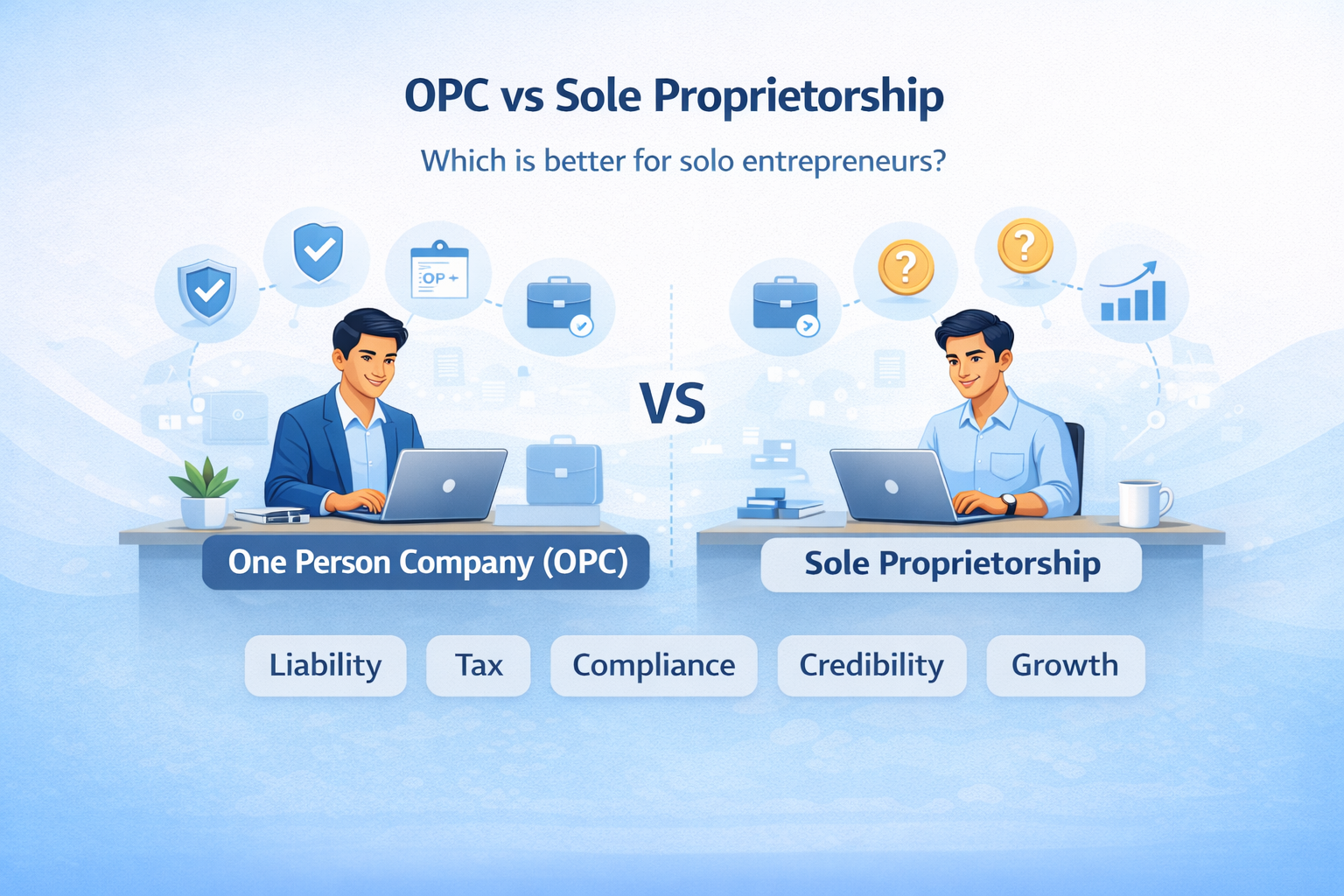
If you are starting a business alone in India, the first and most common question you face is simple yet critical: Should I register as a Sole Proprietor or form an OPC (One Person Company)? Both structures are designed for solo entrepreneurs. However, when you look deeper at legal protection, credibility, compliance, and long-term growth, the differences become impossible to ignore. This article gives you a clear, practical comparison of OPC vs Sole Proprietorship in India, helping you choose the structure that truly fits your goals—not just today, but five years down the line.
OPC vs Sole Proprietorship – Why This Decision Matters for Solo Founders
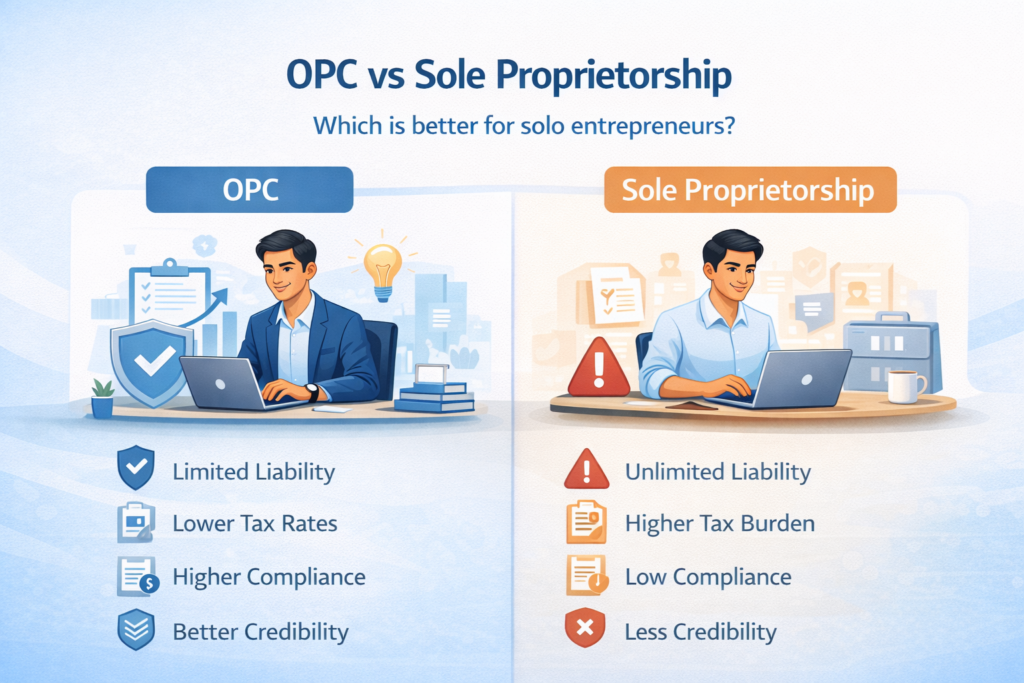
Many solo founders start fast, without thinking long-term. While that approach may work initially, it often leads to:
- Personal financial risk
- Limited credibility with clients and banks
- Difficulty scaling
- Forced legal conversion later
Understanding OPC vs Sole Proprietorship early can save you time, money, and stress.
Basic Overview: OPC vs Sole Proprietorship
| Aspect | OPC | Sole Proprietorship |
|---|---|---|
| Owners | 1 | 1 |
| Legal Identity | Separate | Not separate |
| Liability | Limited | Unlimited |
| Governing Law | Companies Act, 2013 | No separate law |
| Continuity | Perpetual | Ends with owner |
This single table already reveals the core difference: legal separation.
1. Legal Identity & Liability Protection
Sole Proprietorship
- No separation between owner and business
- Owner is personally liable for all debts and losses
- Personal assets (house, savings) are at risk
OPC
- Separate legal entity
- Liability limited to company assets
- Personal assets remain protected
👉 If risk management matters to you, OPC is clearly safer.
2. OPC vs Sole Proprietorship – Ease of Formation & Cost
Sole Proprietorship
- Very easy to start
- No formal incorporation
- Minimal cost
- GST/Shop Act registration usually sufficient
OPC
- Formal registration through MCA
- Requires DSC, DIN, MOA, AOA
- Slightly higher setup cost
👉 Proprietorship wins on speed, OPC wins on structure.
Read Previous Article on Startup Guides India.
3. OPC vs Sole Proprietorship – Compliance & Ongoing Legal Requirements
Sole Proprietorship
- Minimal compliance
- Income tax filing under individual PAN
- Fewer statutory obligations
OPC
- Annual ROC filings
- Auditor appointment
- Income tax filing as a company
👉 OPC has more compliance, but also more legitimacy.
4. OPC vs Sole Proprietorship – Taxation Differences
Sole Proprietorship
- Taxed as individual income
- Slab-based taxation
- Higher income = higher tax
OPC
- Taxed as a company
- Corporate tax rates apply
- Better tax planning flexibility
Depending on income level, OPC can be more tax-efficient.
5. OPC vs Sole Proprietorship – Credibility & Market Perception
This is where many solo founders feel the difference.
Sole Proprietorship
- Seen as small or informal
- Limited trust from corporate clients
- Difficult to win large contracts
OPC
- Recognised corporate structure
- Higher credibility with banks and vendors
- Better acceptance in B2B environments
If brand perception matters, OPC has a clear edge.
6. OPC vs Sole Proprietorship – Funding & Growth Potential
Sole Proprietorship
- No equity funding possible
- Growth limited to personal capital
- Difficult to scale
OPC
- Cannot raise equity funding either
- But easier to convert into Pvt Ltd later
- Better positioned for growth
OPC acts as a stepping stone, while proprietorship often becomes a dead end.
7. OPC vs Sole Proprietorship – Business Continuity & Succession
Sole Proprietorship
- Ends with owner’s death or incapacity
- No succession planning
OPC
- Mandatory nominee
- Business continuity ensured
- Legal succession defined
This makes OPC far more reliable for long-term planning.
8. OPC vs Sole Proprietorship – Conversion & Future Flexibility
- Sole Proprietorship → Conversion is complex
- OPC → Easy conversion to Pvt Ltd
If you plan growth, OPC gives you flexibility without rebuilding everything.
OPC vs Sole Proprietorship: Quick Comparison Table
| Feature | OPC | Sole Proprietorship |
|---|---|---|
| Legal Protection | Yes | No |
| Compliance | Medium | Low |
| Credibility | High | Low |
| Scalability | Medium | Low |
| Business Continuity | Yes | No |
| Best For | Serious solo founders | Small local businesses |
Which One Should You Choose – OPC vs Sole Proprietorship?
Choose Sole Proprietorship if:
- You want to start instantly
- Risk is very low
- Business is small and local
Choose OPC if:
- You want legal protection
- You value credibility
- You plan future growth
- You want an easy path to Pvt Ltd
All OPC rules and structures are governed by the Ministry of Corporate Affairs
OPC vs Sole Proprietorship – Conclusion: Start Smart, Not Just Fast
The choice between OPC vs Sole Proprietorship in India is not about which is easier—it’s about which is safer and future-ready.
If your goal is a small lifestyle business, proprietorship may be enough.
If your goal is to build something serious, OPC is the smarter foundation.
Your structure should protect you today and support you tomorrow.
FAQs – OPC vs Sole Proprietorship
1. Is OPC better than Sole Proprietorship?
Yes, OPC offers limited liability and better credibility.
2. Can a Sole Proprietorship be converted to OPC?
Conversion is complex; many prefer closing and reopening as OPC.
3. Is OPC suitable for freelancers?
Yes, especially when income and risk increase.
4. Which has lower compliance?
Sole Proprietorship has lower compliance.
5. Which is better for long-term growth?
OPC provides better growth flexibility.