Registering a company is a major milestone in every entrepreneur’s journey. Among all legal structures available, a Private Limited Company remains the most trusted, scalable, and investor-friendly option in India. However, many founders feel overwhelmed by the legal process, documentation, and compliance requirements. As a result, they delay incorporation or worse register incorrectly. This master guide explains Private Limited Company Registration in India in a clear, step-by-step manner so you can incorporate confidently, legally, and efficiently.
Why Choose a Private Limited Company in India?
Before understanding the process, it’s important to know why so many startups choose this structure.
Key Benefits:
- ✅ Limited liability protection
- ✅ Separate legal identity
- ✅ Easy fundraising from investors
- ✅ Higher credibility with banks & clients
- ✅ ESOPs for employee retention
- ✅ Smooth ownership transfer
That’s why Private Limited Company Registration in India is the first choice for startups, tech companies, and growth-oriented businesses.
Who Can Register a Private Limited Company? (Eligibility)
You can register a Private Limited Company if:
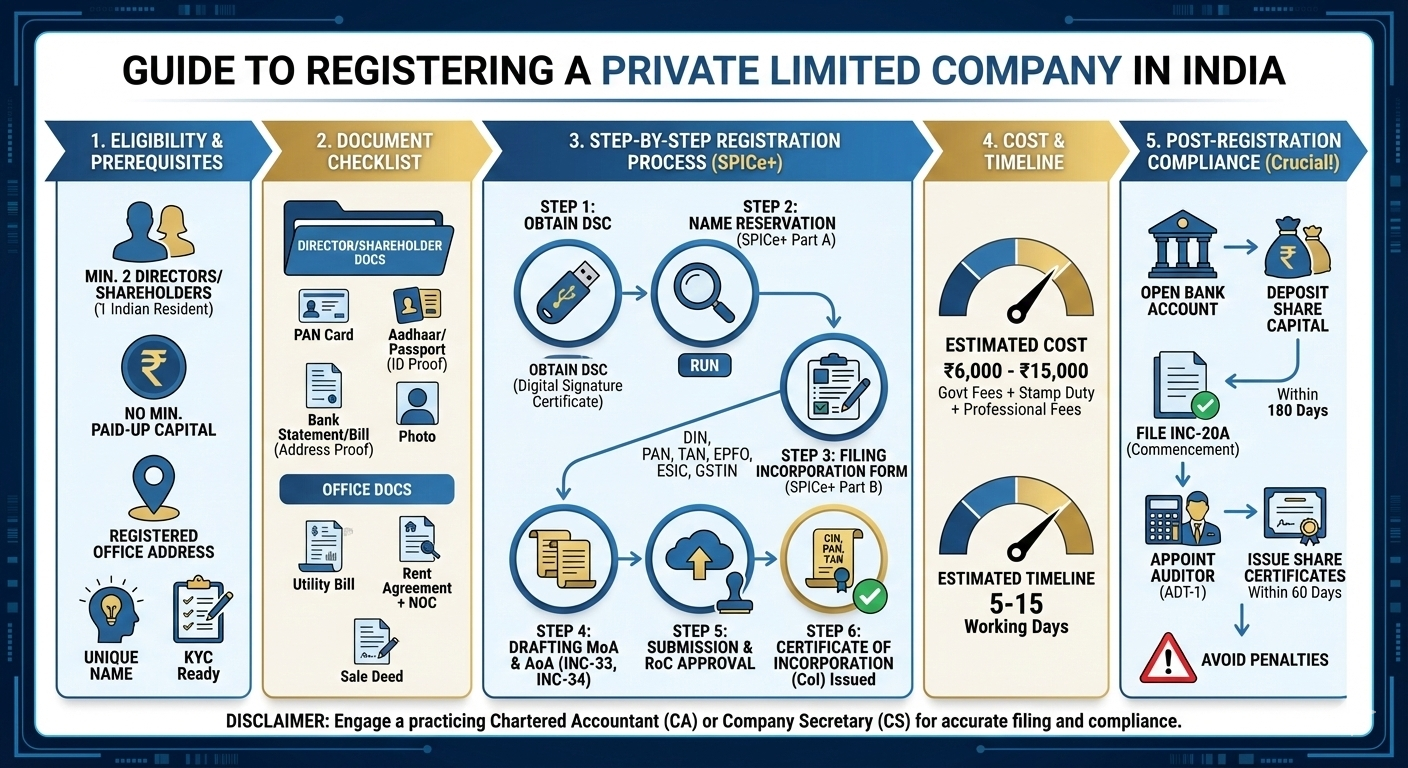
- Minimum 2 directors
- Minimum 2 shareholders
- At least one director is an Indian resident
- No minimum paid-up capital required
- Directors must be above 18 years
👉 Directors and shareholders can be the same people.
Read Previous Article on Startup Guides India.
Minimum Requirements for Pvt Ltd Registration
| Requirement | Details |
|---|---|
| Directors | Minimum 2 |
| Shareholders | Minimum 2 (Max 200) |
| Registered Office | Mandatory |
| Capital | No minimum requirement |
| Digital Signature (DSC) | Required |
| DIN | Required for directors |
Step-by-Step Process for Private Limited Company Registration in India
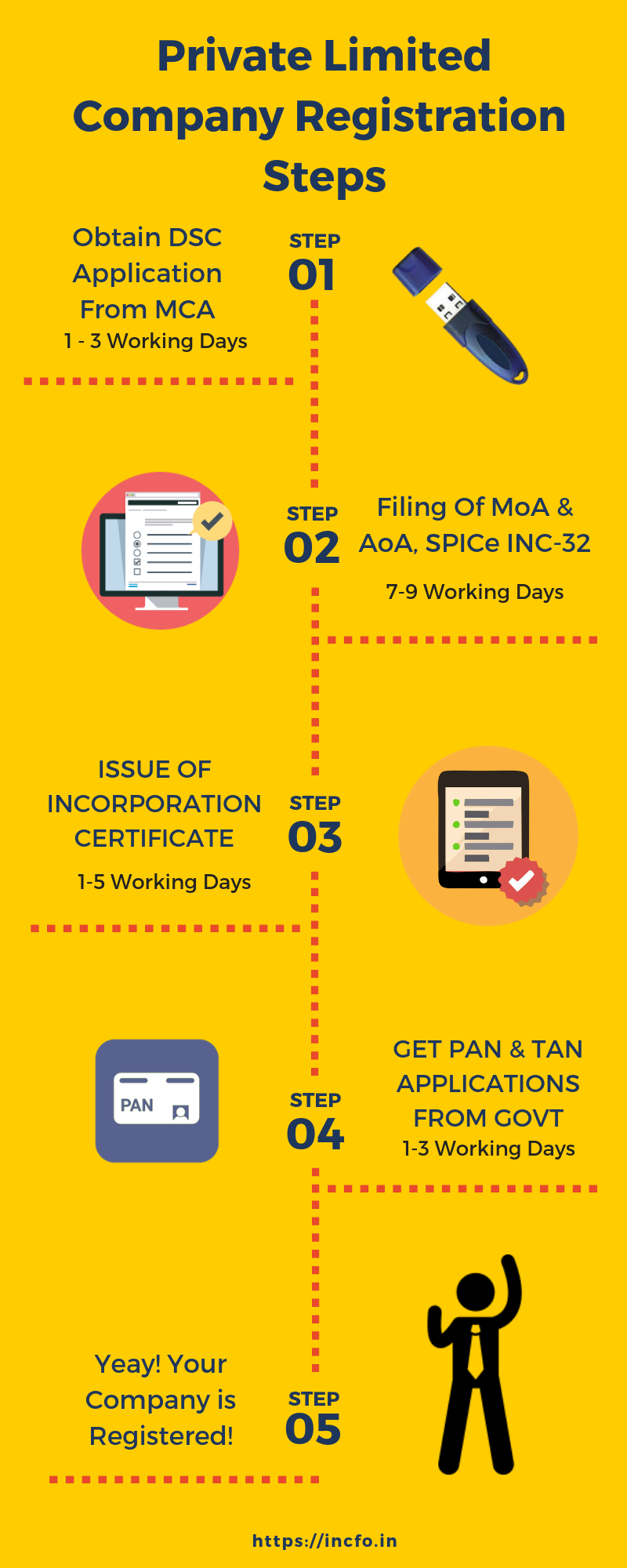
Step 1: Obtain Digital Signature Certificate (DSC)
DSC is required to sign electronic documents during registration.
✔ Mandatory for all directors
✔ Issued by government-authorized agencies
Step 2: Apply for Director Identification Number (DIN)
DIN is a unique identification number for company directors.
✔ Applied through SPICe+ form
✔ All directors must have DIN
Step 3: Name Approval (SPICe+ Part A)
Choose 2–3 unique company names aligned with MCA naming guidelines.
✔ Avoid trademark conflicts
✔ Name must reflect business activity
Step 4: Draft MOA & AOA
- MOA (Memorandum of Association) defines business objectives
- AOA (Articles of Association) governs internal management
These are mandatory legal documents.
Step 5: File SPICe+ Form (Part B)
This integrated form covers:
- Company incorporation
- PAN & TAN allotment
- Director details
- Registered office address
Step 6: Certificate of Incorporation Issued
Once approved, MCA issues:
- Certificate of Incorporation
- CIN (Company Identification Number)
- PAN & TAN
🎉 Your company is now legally registered.
Read Previous Article on Startup Guides India.
Documents Required for Private Limited Company Registration
For Directors & Shareholders
- PAN card
- Aadhaar / Passport / Voter ID
- Address proof (utility bill/bank statement)
- Passport-size photograph
For Registered Office
- Rent agreement / Sale deed
- NOC from owner
- Electricity bill (latest)
How Long Does Registration Take?
| Stage | Time |
|---|---|
| DSC & DIN | 1–2 days |
| Name approval | 1–3 days |
| MCA approval | 3–5 days |
⏱️ Total Time: 7–10 working days (average)
Cost of Private Limited Company Registration in India
| Component | Approx Cost (₹) |
|---|---|
| Government fees | 1,000 – 2,000 |
| DSC & DIN | 1,500 – 3,000 |
| Professional fees | 5,000 – 10,000 |
💡 Costs vary based on capital and services chosen.
Post-Incorporation Compliance (Very Important)
Many founders forget this step.
After registration, you must:
- Open a current bank account
- Issue share certificates
- Appoint auditor within 30 days
- File INC-20A (Commencement of Business)
- Maintain statutory registers
Ignoring these can lead to penalties and legal issues.
Common Mistakes During Pvt Ltd Registration
- Choosing a name without trademark check
- Incorrect director details
- Wrong business activity code
- Delaying post-incorporation filings
Avoiding these ensures smooth Private Limited Company Registration in India.
Conclusion: Register Right, Grow Strong
Registering a Private Limited Company is not just a legal step—it’s a growth decision.
When done correctly, it:
- Protects founders
- Builds trust
- Enables funding
- Supports scalability
If you plan to build a serious business, Private Limited Company Registration in India is the strongest legal foundation you can choose.
FAQs
1. Is Private Limited Company registration mandatory for startups?
Not mandatory, but highly recommended for growth and funding.
2. Can a single founder register a Private Limited Company?
No. Minimum two directors/shareholders are required.
3. Is GST required immediately after registration?
Only if your business crosses the GST threshold or requires it mandatorily.
4. Can foreigners be directors in an Indian Pvt Ltd company?
Yes, subject to RBI and FEMA guidelines.
5. What happens if post-incorporation compliance is missed?
Penalties and legal notices may apply.
Official MCA Portal: https://www.mca.gov.in
Read Previous Article on Startup Guides India.