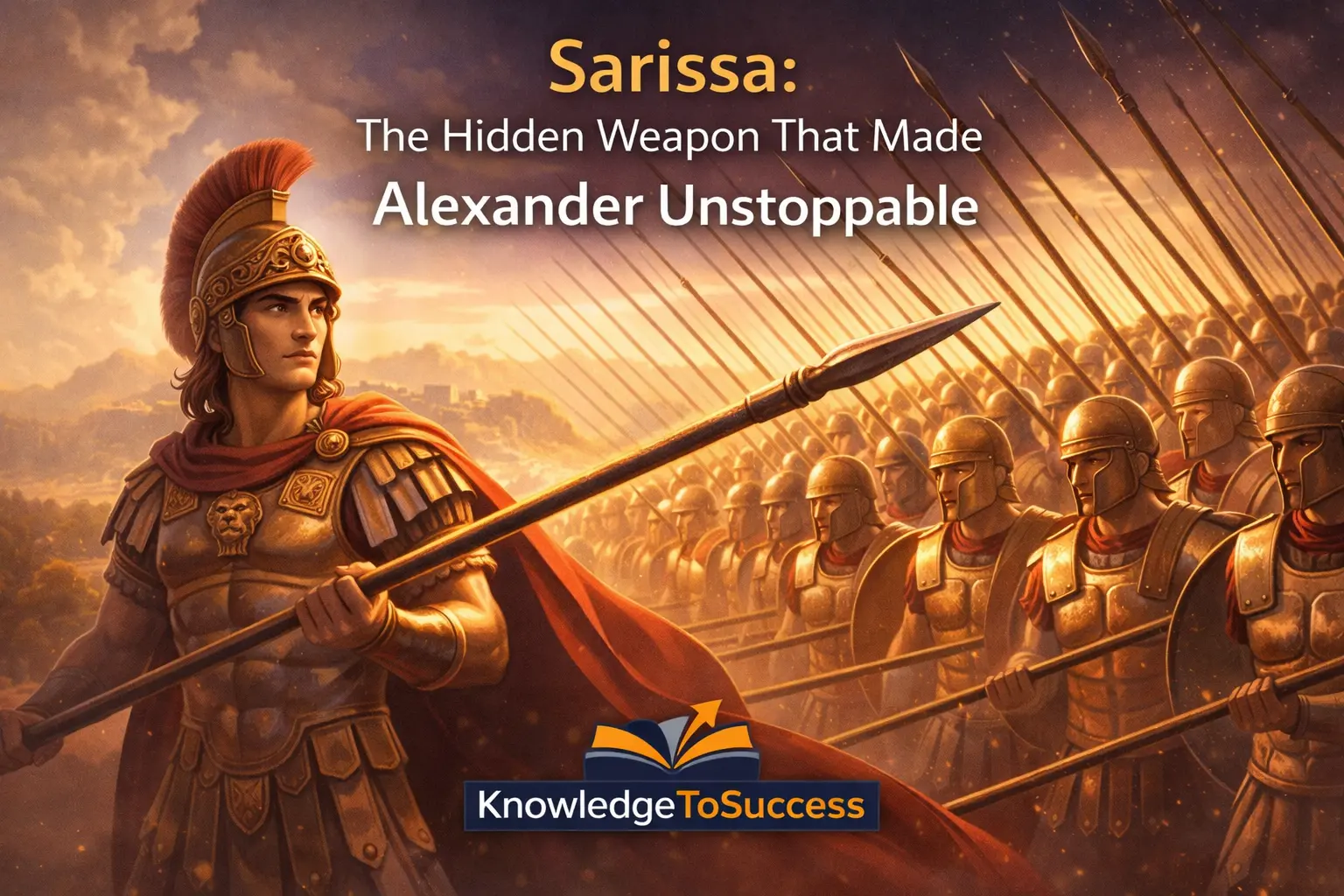
In 331 BC, at the Battle of Gaugamela, the Persian emperor Darius III stood confident. His army was massive. His numbers were overwhelming. Facing him was a much smaller force led by Alexander the Great. But within minutes of battle, something unexpected happened. Before Persian soldiers could even reach their enemies, they began to fall. They were being struck from a distance they could not match. The reason was simple, yet terrifying: Sarissa.
The Sarissa was not just a weapon.
It was a system that turned soldiers into a moving wall of death.
What Is Sarissa and Why It Was Revolutionary
The Sarissa was a long spear used by Macedonian soldiers.
- Length: 4 to 6 meters
- Used with both hands
- Designed for formation combat
Compared to traditional spears:
- Normal spears → 2 meters
- Sarissa → up to 6 meters
This gave soldiers a massive advantage.
Enemies could be killed before they even got close.
Sarissa and the Phalanx Formation
The true power of the Sarissa came from how it was used.
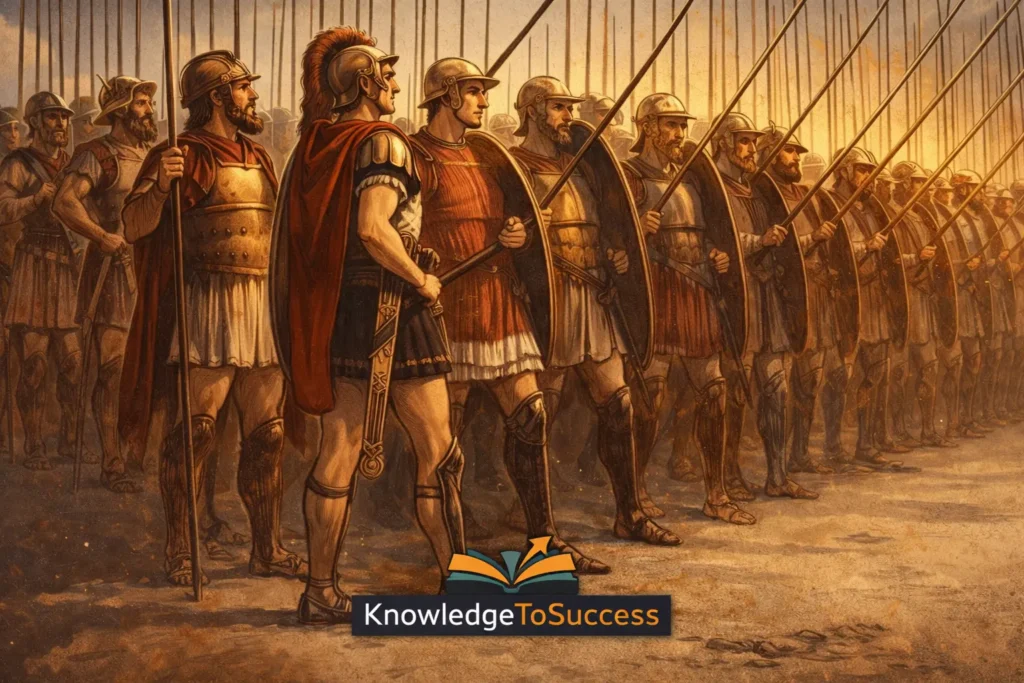
Macedonian soldiers fought in a formation called the Phalanx.
How Sarissa worked in Phalanx:
- Soldiers stood tightly packed
- First five rows pointed Sarissa forward
- Multiple layers of spear tips faced the enemy
The result:
👉 A moving forest of deadly points
👉 Five layers of attack at once
This was not just defense. It was controlled destruction.
Why Sarissa Made Alexander’s Army Unstoppable
1. Sarissa Gave Unmatched Reach
The biggest advantage of the Sarissa was distance.
- Enemy reach → 2 meters
- Sarissa reach → up to 6 meters
Before enemies could strike, they were already hit.
2. Sarissa Was an Engineering Innovation
This was designed intelligently.
- Could be split into two parts
- Joined with a metal connector
- Balanced for control
Archaeological findings from Vergina confirm this design.
3. Sarissa Included the Sauroter (Rear Spike)
This had a second sharp end called the Sauroter.
It helped in:
- Balancing the spear
- Acting as a backup weapon
- Stopping cavalry charges
This made the Sarissa versatile.
4. Sarissa Created a Defensive Shield
Rear soldiers held Sarissa upward.
This formed a protective layer against arrows.
It acted like an invisible shield above the army.
The Origin of Sarissa: Philip II’s Military Revolution
The Sarissa was introduced by:
👉 Philip II of Macedon
He transformed the Macedonian army into a disciplined force.
He didn’t just create a weapon.
He created a system.
Alexander inherited:
- The Sarissa
- The Phalanx
- The discipline
And used them to conquer the world.
Sarissa in Real Battles: Changing History
The Sarissa played a crucial role in:
- Defeating Persian elite forces
- Winning the Battle of Gaugamela
- Conquering Greek city-states
- Fighting war elephants in India
The Sarissa was not just a weapon.
It was a strategy multiplier.
Common Mistakes About Sarissa
❌ Sarissa alone won battles
No. It worked because of discipline and formation.
❌ It was just a longer spear
It was part of a complete military system.
❌ Bigger armies should win
Sarissa proved strategy beats numbers.
Why Sarissa Still Matters Today
The story of Sarissa teaches a bigger lesson.
Success comes from:
- System + strategy
- Discipline + execution
- Tools + coordination
This weapon was powerful. But the system behind it made it unstoppable.
Read more articles on Unknown Facts
Conclusion: Sarissa – More Than a Weapon
The Sarissa was not just a spear.
It was a revolution.
It allowed a young king to defeat empires and reshape history.
Alexander did not win because of luck.
He won because he had:
- The right weapon
- The right system
- The right strategy
And at the center of it all was Sarissa.
FAQs
1. What is Sarissa?
It is a long spear used by Macedonian soldiers.
2. Why was Sarissa so effective?
Because of its length and use in formation.
3. Who created Sarissa?
Philip II of Macedon.
4. How long was Sarissa?
Around 4 to 6 meters.
5. Did Sarissa alone win battles?
No. It worked with strategy and discipline.