Behavioral interview questions make even strong candidates uncomfortable. You know the experience. You understand your work. Still, when interviewers ask, “Tell me about a time when…”, answers suddenly feel messy. This is where the STAR method for behavioral interview answers becomes a game changer.
Interviewers don’t ask behavioral questions to trap you. Instead, they want proof. They want to see how you think, act, and deliver results. Therefore, vague answers hurt your chances even when your experience is solid.
This article explains the STAR method step by step, shows how to use it naturally, and helps you avoid the mistakes that cause candidates to fail behavioral interviews.
Why Behavioral Interview Questions Matter So Much
Behavioral questions are built on a simple belief:
Past behavior predicts future behavior.
That’s why interviewers rely on them heavily. According to Harvard Business Review, structured answers help interviewers assess problem-solving, leadership, and decision-making more accurately.
Therefore, answering these questions well is not optional especially for mid-level and senior roles.
What the STAR Method Really Is (In Simple Terms)
STAR is a storytelling structure. It helps you answer clearly without rambling.
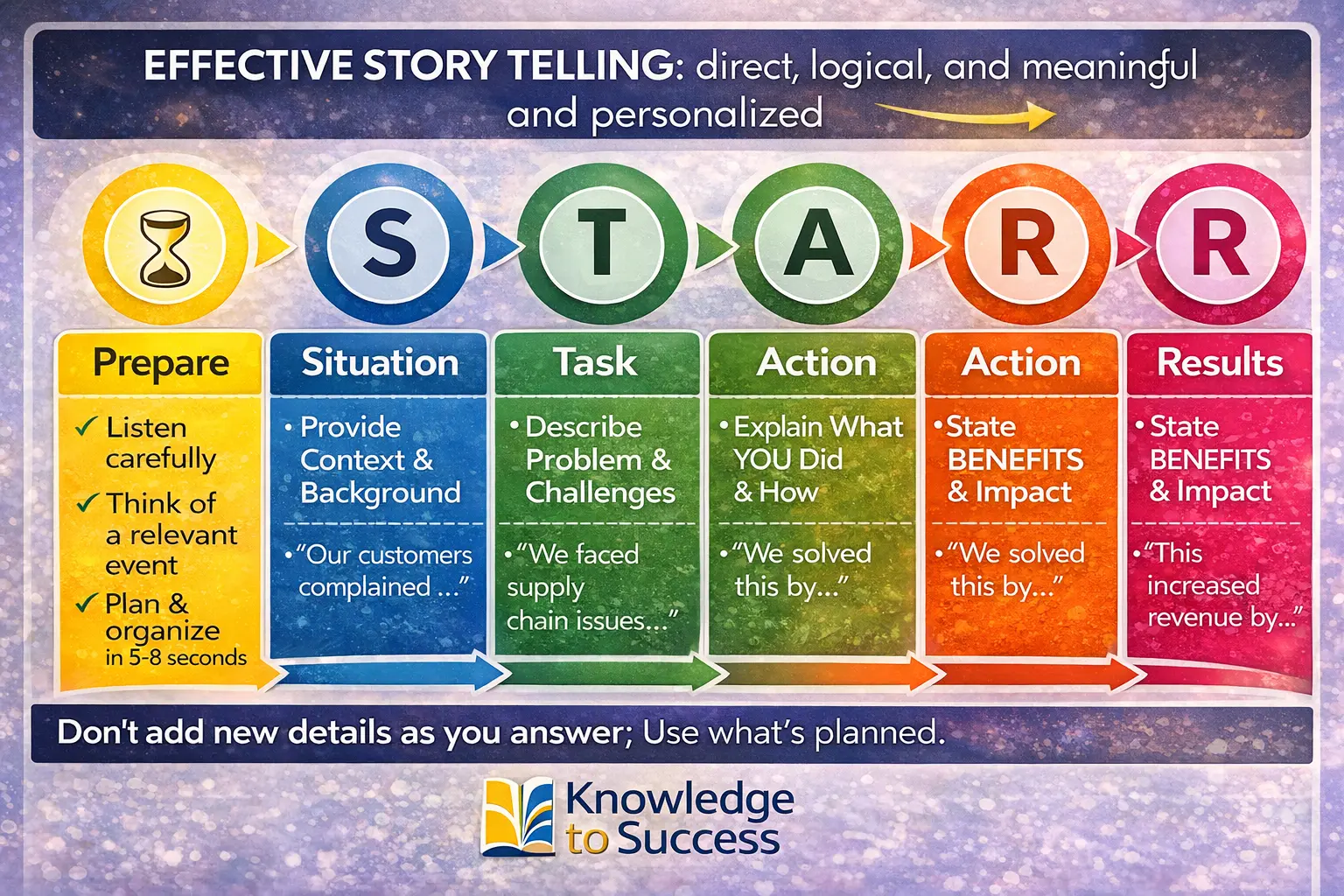
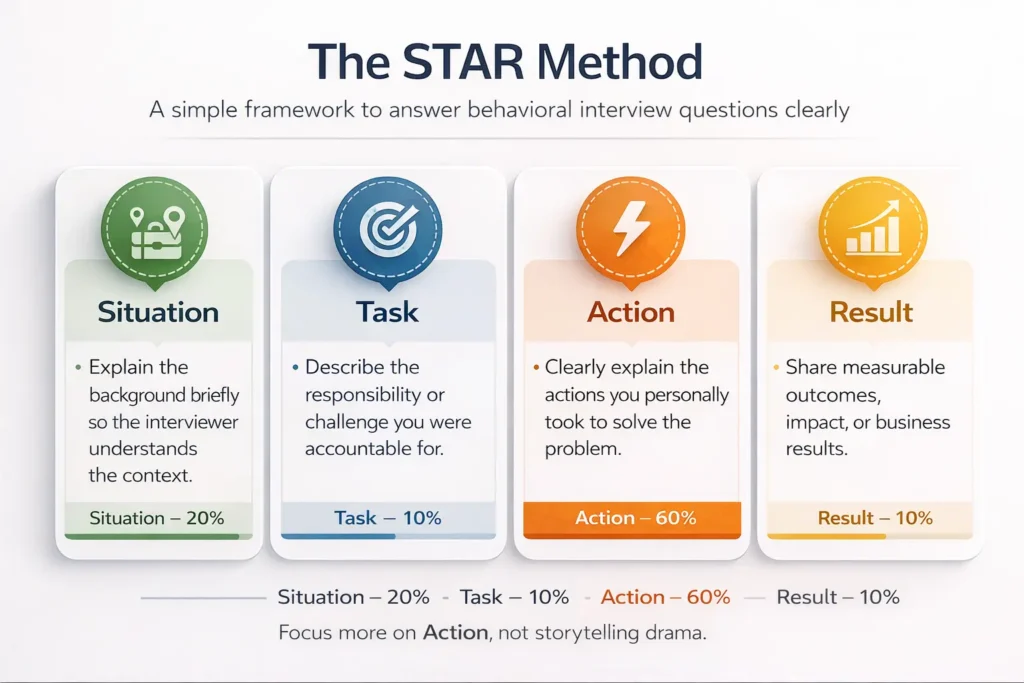
STAR stands for:
- S – Situation: Set the context
- T – Task: Explain your responsibility
- A – Action: Describe what you did
- R – Result: Share the outcome
When used correctly, STAR turns confusing stories into clear evidence.
Step-by-Step Breakdown of the STAR Method
Let’s break each part down simply.
S – Situation (Set the Scene Briefly)
Start by giving just enough context.
Good examples:
- “In my previous role, our team faced a tight deadline.”
- “During a major product launch…”
Avoid long background stories. Keep this to 1–2 sentences.
T – Task (Clarify Your Responsibility)
Next, explain your role in the situation.
This is important. Interviewers want to know what you were responsible for, not what the team did.
Example:
- “I was responsible for coordinating between design and development.”
A – Action (This Is the Most Important Part)
This is where most candidates fail. They talk about the team, not themselves.
Focus on:
- What you did
- Decisions you made
- Steps you took
Use “I” statements. Be specific. Avoid vague phrases like “we worked hard”.
R – Result (Always End With Impact)
End with outcomes. Results make your story credible.
Results can include:
- Metrics
- Improvements
- Learnings
- Feedback
Example:
- “As a result, we reduced delivery time by 20%.”
If possible, quantify results. Numbers increase trust.
Read all the articles on Career Guidance
A Full STAR Example (Simple and Clear)
Question: Tell me about a time you handled a difficult situation.
Answer (STAR):
“In my previous role, our client raised concerns about delayed delivery (Situation). I was responsible for coordinating communication and fixing the issue (Task). I reviewed the process, identified bottlenecks, and reorganized task priorities with the team (Action). As a result, we delivered the project within the revised timeline and retained the client (Result).”
Clear. Focused. Effective.
How Long Should a STAR Answer Be?
Length matters.
Ideal STAR Answer Length
- 1.5–2 minutes
- Short sentences
- Clear transitions
Long answers dilute impact. Short answers feel incomplete. Balance is key.
Common STAR Method Mistakes Candidates Make
Even when candidates know STAR, they misuse it.
Avoid these mistakes:
- Spending too long on Situation
- Skipping the Result
- Talking only about the team
- Sounding memorized
- Forgetting the question
Fixing these mistakes alone can double answer quality.
How to Prepare STAR Stories Before Interviews
Preparation reduces pressure.
Smart Preparation Method
- Identify 6–8 core stories
- Cover different skills (leadership, failure, conflict, success)
- Practice structure, not wording
This approach keeps answers flexible and natural.
Internal link suggestion: Combine this with The Power of Mock Interviews to practice STAR delivery.
STAR Method for Freshers vs Experienced Professionals
STAR Method works for everyone. However, examples differ.
For Freshers
- Use internships
- Academic projects
- Group activities
For Experienced Professionals
- Workplace challenges
- Team leadership
- Client situations
What matters is clarity not scale.
STAR Method in Virtual Interviews
Virtual interviews demand extra clarity.
Tips:
- Speak slightly slower
- Pause between STAR sections
- Keep answers structured
Clear structure helps interviewers follow you on screen.
Why Interviewers Love STAR Method Answers
STAR answers:
- Reduce guesswork
- Show thinking clearly
- Highlight accountability
- Make comparison easier
That’s why interviewers often guide candidates toward STAR even indirectly.
When NOT to Use STAR Method Fully
Not every question needs a full STAR response.
Use STAR mainly for:
- “Tell me about a time…”
- “Give an example…”
- “Describe a situation…”
For opinion questions, keep answers conversational.
How STAR Improves Confidence Automatically
Structure reduces anxiety. When you know the path, you stop panicking.
STAR:
- Removes rambling
- Keeps you on track
- Builds confidence
Prepared structure feels like control and control feels like confidence.
Conclusion: STAR Turns Experience Into Proof
Experience alone doesn’t impress interviewers. Evidence does. The STAR method for behavioral interview answers helps you convert experience into clear proof.
When you answer with structure:
- Interviewers listen better
- Follow-up questions improve
- Your credibility increases
Strong candidates don’’’t just tell stories. They tell structured stories.
FAQs
1. Is STAR required for every interview?
Not every question, but most behavioral ones benefit from it.
2. Can STAR answers sound robotic?
Only if memorized. Focus on structure, not scripts.
3. How many STAR stories should I prepare?
6–8 versatile stories are usually enough.
4. Do interviewers expect exact STAR Method labels?
No. They expect clarity, not terminology.
5. Is STAR Method useful for senior roles?
Yes. Especially for leadership and decision-making questions.