Many startups don’t fail because of poor ideas. They fail because they ignore compliance until it becomes a problem.
Missing just one filing deadline can result in:
- Heavy penalties
- Director disqualification
- Legal notices
- Loss of investor confidence
That’s why every founder needs a structured annual compliance calendar.
This article gives you a clear month-by-month compliance roadmap for Indian startups, covering ROC filings, income tax, GST, board meetings, and more.
Why an Annual Compliance Calendar for Indian Startups Is Critical
Compliance is not a one-time task. It is a continuous legal responsibility.
Your annual compliance calendar ensures:
- No missed ROC filings
- No surprise tax penalties
- Clean due diligence during funding
- Better credibility with investors
A disciplined startup always follows a predictable compliance rhythm.
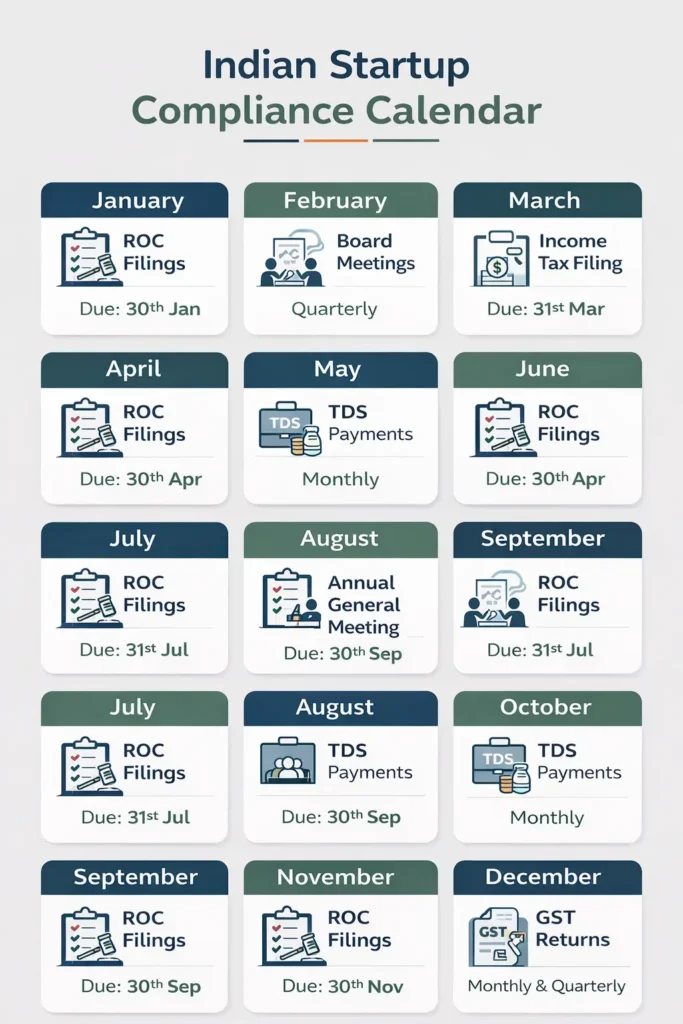
Month-by-Month Annual Compliance Calendar for Indian Startups
Below is a simplified month-by-month guide based on the Indian financial year (April–March).
April – Financial Year Reset
- Start new financial year books
- Verify statutory registers
- Review previous year compliance gaps
- Plan board meetings for the year
April sets the tone for your annual compliance calendar.
May – TDS & GST Review
- File monthly GST returns (if applicable)
- Deposit TDS deducted
- Review vendor compliance
Staying consistent early prevents backlog.
June – Advance Tax & Internal Audit Planning
- First advance tax installment (if applicable)
- Prepare audit documents
- Verify director KYC compliance
June is crucial for tax discipline.
July – Income Tax Filing (Individuals)
- Directors file personal income tax returns
- Review company tax planning
- GST reconciliation
Late personal filings often create corporate complications.
August – Board & Statutory Review
- Conduct board meeting
- Review financial performance
- Prepare audit drafts
This strengthens governance early.
September – Major ROC Filing Month
- Conduct Annual General Meeting (AGM)
- File financial statements (AOC-4)
- File annual return (MGT-7)
September is the most important month in your annual compliance calendar.
October – Second Advance Tax Installment
- Pay second advance tax
- Review cash flow and projections
- Update statutory registers
Ignoring advance tax leads to interest penalties.
November – GST & Audit Finalisation
- GST reconciliation
- Finalise audit reports
- Compliance health check
This prevents year-end stress.
December – Compliance Review
- Verify all statutory filings
- Check pending notices
- Ensure board meeting compliance
December is ideal for corrective action.
January – Third Advance Tax Installment
- Pay third advance tax
- Budget planning for next year
Cash flow planning meets compliance here.
February – Audit & Closing Preparation
- Final review of accounts
- Verify ROC compliance
- Prepare closing entries
Preparation prevents March chaos.
March – Financial Year Closing
- Close books of accounts
- Final advance tax payment
- Review compliance checklist
- Document resolutions
March determines how smooth the next year will be.
Key Annual Compliance Requirements for Private Limited Companies
Apart from monthly tasks, startups must ensure:
- Minimum 4 Board Meetings per year
- Annual General Meeting (AGM)
- Statutory audit
- ROC filings
- Director KYC (DIR-3 KYC)
- Income tax return filing
Skipping even one impacts credibility.
Read Previous Article on Startup Guides India.
Common Compliance Mistakes Indian Startups Make
- Waiting until deadline week
- Ignoring GST reconciliation
- Missing DIR-3 KYC
- Mixing personal and company finances
- Not appointing auditor on time
Most penalties are avoidable with a proper annual compliance calendar.
How Compliance Impacts Startups Funding & Valuation
Investors always check:
- Filing history
- Penalty records
- ROC status
A startup with a clean compliance history commands:
- Faster funding
- Higher valuation
- Stronger negotiation power
Compliance is not cost, it’s credibility.
Best Practices for Startups to Maintain an Annual Compliance Calendar
- Maintain a shared compliance tracker
- Hire a professional CA or CS
- Schedule board meetings in advance
- Review compliance quarterly
- Never ignore government notices
A proactive approach saves money and stress.
Final Verdict: Compliance Is a Growth Strategy for Startups
An annual compliance calendar is not just about avoiding penalties.
It:
- Protects directors
- Builds investor trust
- Improves financial discipline
- Enables smooth exits
Startups that treat compliance seriously scale confidently.
FAQs
1. Is compliance mandatory even if revenue is low?
Yes. Compliance is mandatory regardless of revenue.
2. What happens to Startups, if ROC filing is delayed?
Penalties accumulate daily and may lead to director disqualification.
3. Do startups need statutory audit?
Yes, Private Limited Companies require annual audit.
4. Is GST mandatory for all startups?
Only if turnover crosses threshold or specific services apply.
5. Can compliance be outsourced?
Yes, most startups work with CAs or CS firms.