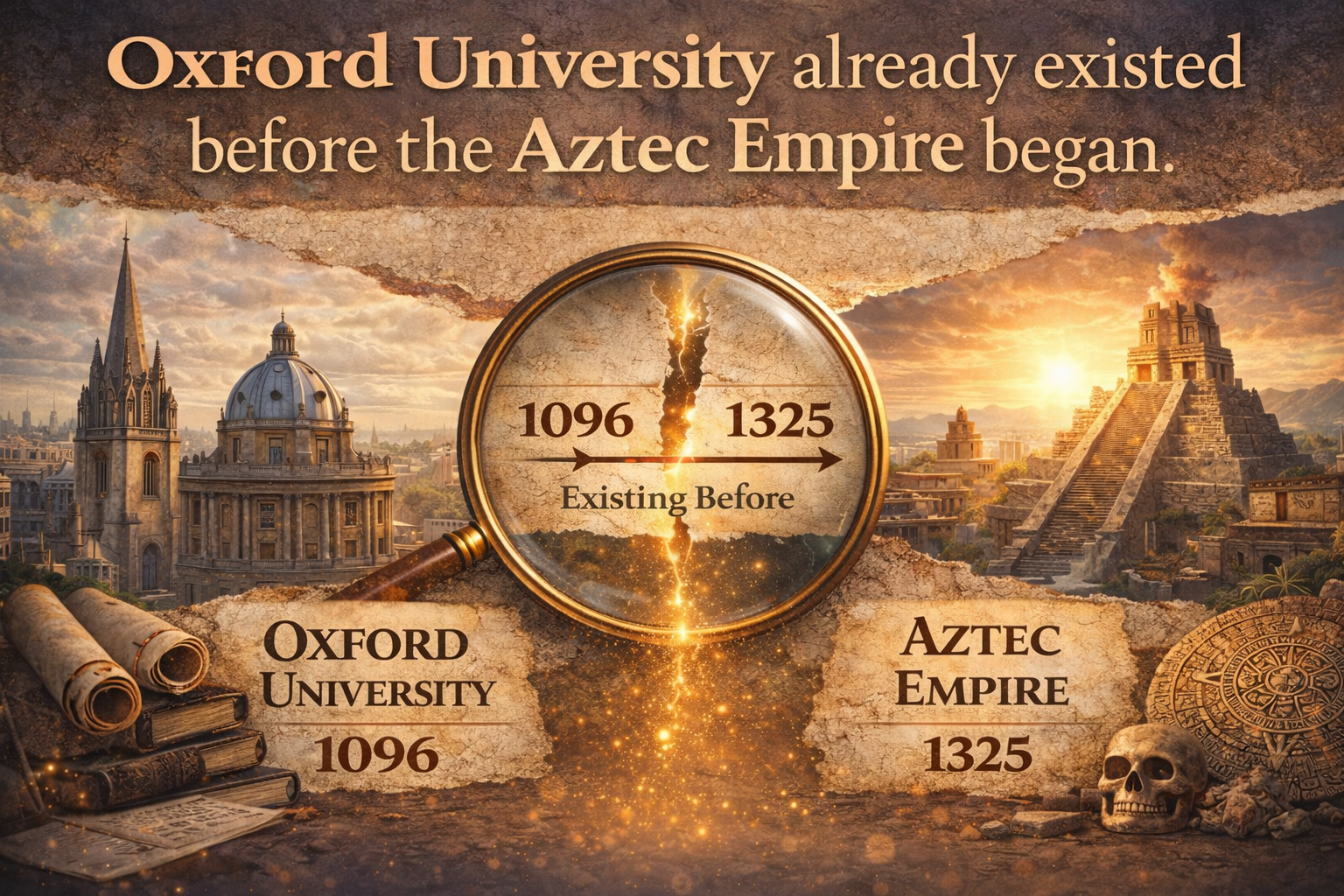
Most of us believe history follows a simple, logical order. Here is the forgotten historical timeline that changes everything we know
Oxford University already existed before the Aztec Empire even began.
Ancient civilizations came first. Modern institutions came later. Universities, governments, and systems of education must surely be younger than empires and pyramids.
That assumption feels natural. It also feels wrong once you see the full timeline.
This single fact quietly dismantles how we imagine progress, civilization, and time itself.
And once you understand the dates, the context, and the reasons behind this overlap, history never looks the same again.
The Forgotten Historical Timeline Explained Simply
Let’s start with the dates because this is where assumptions collapse.
When Did Oxford University Begin?
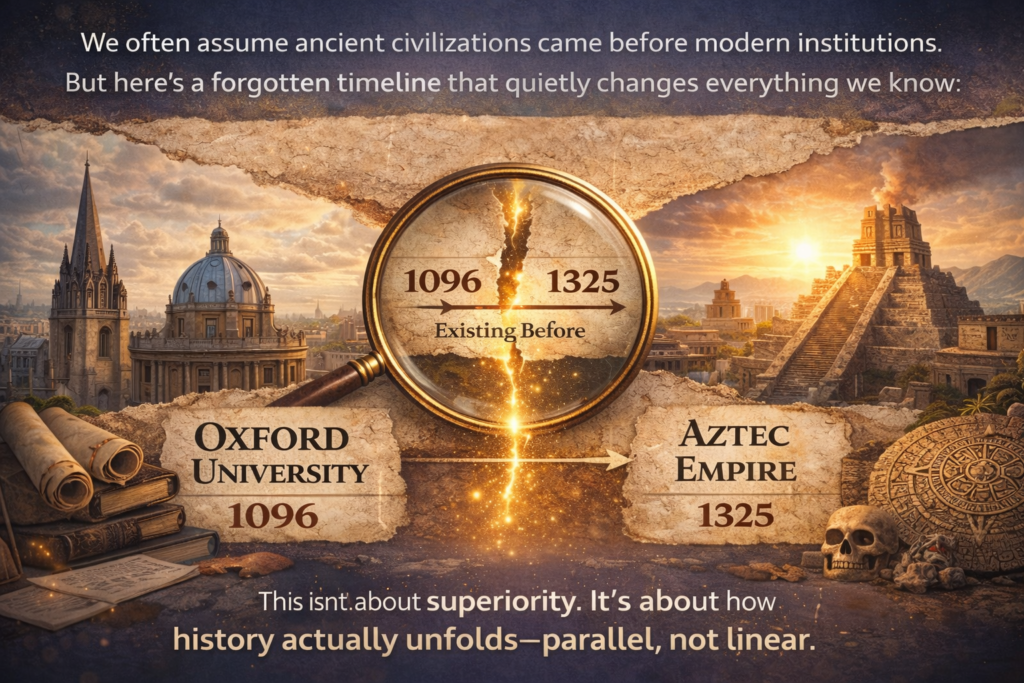
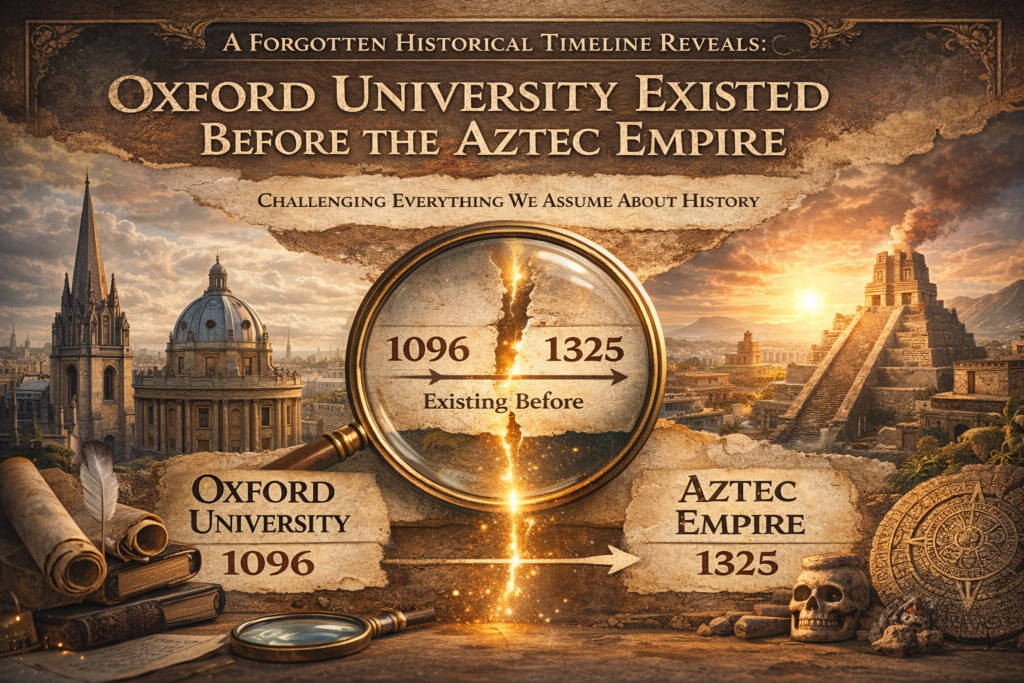
Teaching at Oxford began around 1096. By 1167, Oxford had already grown into a recognised centre of learning.
This was not a single building or campus.
It was a living academic community lectures, debates, libraries, scholars, and students shaping ideas that would influence Europe for centuries.
Oxford did not suddenly appear. It evolved steadily, quietly, and continuously.
When Did the Aztec Empire Begin?
The Aztec civilization rose much later.
The city of Tenochtitlan which became the heart of the Aztec Empire was founded around 1325.
By the time the Aztecs began building their empire:
- Oxford already had generations of scholars
- Academic traditions were firmly established
- Intellectual systems were already centuries old
This overlap creates a timeline few people ever see clearly.
Why This Timeline Feels So Unbelievable
The problem isn’t the dates.
The problem is how our brains categorise history.
We mentally group:
- Empires as “ancient”
- Universities as “modern”
- Europe as “later”
- Indigenous civilizations as “earlier”
This shortcut helps us remember history but it also distorts it.
The forgotten historical timeline exposes a deeper truth:
Human progress does not move in neat, linear stages.
Different parts of the world developed simultaneously, not sequentially.
Two Worlds, One Overlapping Moment in Time
While scholars debated philosophy in Oxford:
- The Aztecs were engineering floating farms
- Building monumental temples
- Developing complex calendars and social systems
Neither civilization was “ahead.”
Neither was “behind.”
They were solving different problems, in different environments, using different knowledge systems at the same time.
This is why the forgotten historical timeline matters.
It reminds us that:
- Progress is contextual
- Intelligence is not centralised
- History is parallel, not hierarchical
What We Get Wrong About “Ancient” and “Modern”
One of the biggest mistakes in popular history is labeling.
We label:
- Civilizations as ancient
- Institutions as modern
But those words often hide more than they reveal.
Oxford feels modern because it still exists today.
The Aztec Empire feels ancient because it does not.
That difference in survival shapes perception but not reality.
The forgotten historical timeline shows that longevity influences memory, not intelligence or advancement.
Why This Forgotten Timeline Changes Everything We Know
This fact doesn’t just surprise us.
It forces us to rethink deeper beliefs.
1. It Challenges Eurocentric and Linear History
History is often taught as a straight line moving westward and forward.
This timeline proves history moved sideways, outward, and simultaneously.
2. It Reframes the Meaning of “Progress”
Progress isn’t about who came first.
It’s about what problems were being solved.
3. It Teaches Humility About Human Achievement
No civilisation holds a monopoly on innovation, knowledge, or wisdom.
Every society builds within its own context.
Common Mistakes People Make When Hearing This Fact
Let’s address the most common misunderstandings.
❌ “So Europe Was More Advanced”
No. Different knowledge systems evolved independently.
❌ “The Aztecs Were Behind”
Absolutely not. Their engineering, agriculture, and astronomy were extraordinary.
❌ “Universities Equal Civilization”
Civilization does not require universities. It requires organisation, knowledge transfer, and culture all of which the Aztecs had.
The forgotten historical timeline corrects these myths instantly.
Why This Timeline Still Matters Today
This is not just a historical curiosity.
It matters because:
- We still rank cultures subconsciously
- We still confuse survival with superiority
- We still assume modern equals better
Understanding this timeline improves:
- Cultural empathy
- Global perspective
- Critical thinking
It reminds us that human intelligence has always existed everywhere.
A Lesson Hidden Inside the Timeline
The real power of this forgotten historical timeline is not shock.
It is humility.
When we stop placing civilizations on a ladder, we begin to see history as a network—rich, diverse, overlapping, and deeply human.
And that perspective matters more than memorising dates.
Read Article on Unknown Facts.
For verified academic history references, see : – https://www.britannica.com
Conclusion: Why Forgotten Timelines Deserve Our Attention
The forgotten timeline that places Oxford University before the Aztec Empire does not exist to shock us.
It exists to correct us.
History is not a straight road.
It is a crowded intersection.
And the more timelines we uncover, the more accurate and human our understanding becomes.
FAQs – Forgotten Historical Timeline
1. Is Oxford University really older than the Aztec Empire?
Yes. Teaching at Oxford began around 1096, while the Aztec capital was founded around 1325.
2. Does this mean the Aztecs were less advanced?
No. The Aztecs developed advanced systems in engineering, agriculture, and astronomy.
3. Why do people find this timeline so surprising?
Because we often assume institutions are newer than civilizations, which isn’t always true.
4. What does this timeline teach us about history?
That human development happens in parallel across cultures, not in a single line.
5. Why is this considered a forgotten historical timeline?
Because it contradicts common assumptions and is rarely taught clearly.