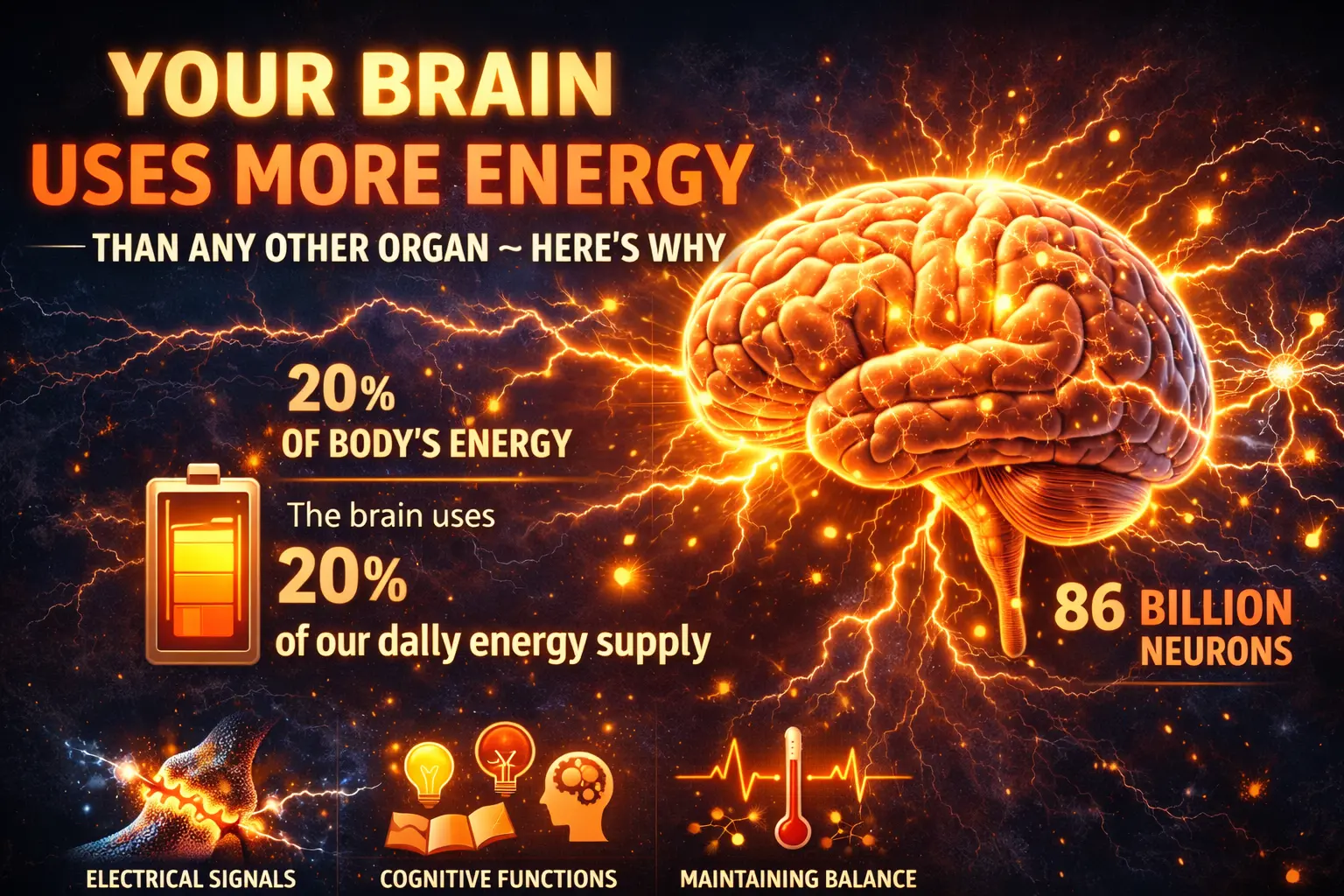
Your brain makes up only about 2% of your body weight. Yet your brain uses more energy than any other organ in your body.
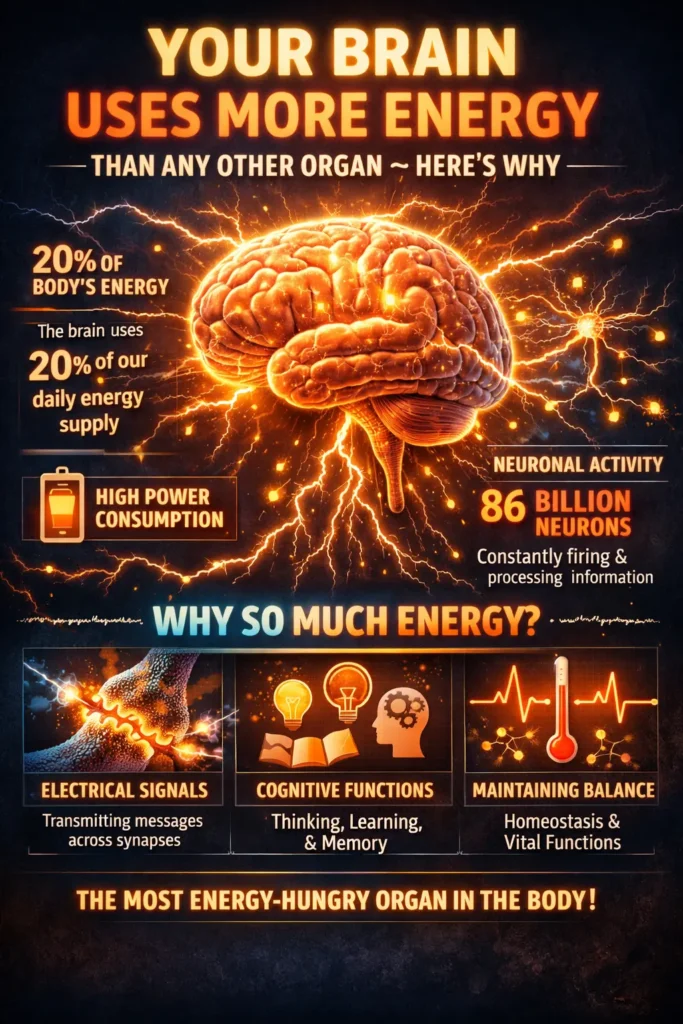
In fact, at rest, your brain uses about 20% of your total energy supply.
That’s more than:
- Your heart
- Your muscles
- Your liver
Why would such a small organ consume so much power?
The answer reveals how demanding thinking really is.
Why Brain Uses More Energy Even When You are Resting
Even when you are:
- Sitting quietly
- Not solving problems
- Not moving
Your brain uses more energy constantly.
Why?
Because your brain never shuts down.
It is always:
- Regulating breathing
- Monitoring heart rate
- Processing sensory input
- Maintaining memory networks
Silence does not mean inactivity.
Your brain is active 24/7.
Why Brain Uses More Energy Than Muscles
You might assume muscles burn the most energy.
But muscles use energy only when active.
Your brain uses more energy continuously.
Neurons communicate using:
- Electrical signals
- Chemical neurotransmitters
Maintaining these signals requires:
- Glucose
- Oxygen
- Ion balance
Even a small disruption can cause confusion, dizziness, or unconsciousness.
Why Brain Uses More Energy: The Role of Glucose
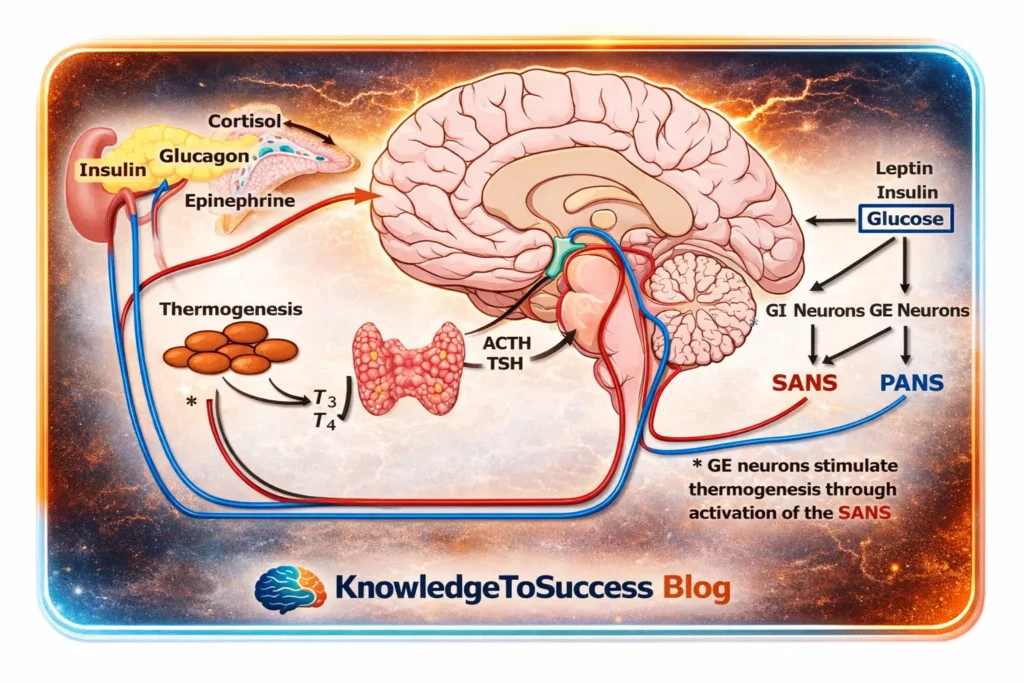
The brain relies primarily on glucose for fuel.
Unlike muscles, it cannot store much energy.
It needs:
- Constant blood supply
- Steady glucose levels
- Continuous oxygen flow
If glucose drops even slightly:
- Concentration declines
- Reaction time slows
- Fatigue increases
This is why skipping meals affects thinking.
Why Brain Uses More Energy During Intense Thinking
Here’s an interesting detail.
Your brain uses more energy overall, but intense thinking does not double energy consumption dramatically.
Instead:
- Energy is redistributed
- Specific regions become more active
- Blood flow shifts to active areas
That’s why:
- Mental work feels exhausting
- Decision fatigue is real
- Long study sessions cause headaches
The energy demand is constant, but focus concentrates it.
Why Brain Uses More Energy in Children
Children’s brains use even more energy proportionally.
In early development:
- Brain energy consumption can reach 40 – 50% of total body energy
- Neural connections form rapidly
- Learning is intense
That’s why children:
- Tire quickly
- Need frequent meals
- Sleep more than adults
Growing brains are extremely energy-demanding.
What Happens When the Brain Doesn’t Get Enough Energy
When the brain uses more energy than it receives:
- Brain fog appears
- Mood changes occur
- Memory weakens
- Physical fatigue increases
Severe shortages can lead to:
- Fainting
- Seizures
- Loss of consciousness
Energy supply is critical.
Common Myths About Brain Uses More Energy
❌ Thinking harder burns massive calories
Mental work increases energy use slightly, but not dramatically.
❌ The brain only works when we concentrate
It is active even during sleep.
❌ Brain size determines intelligence
Energy efficiency matters more than size.
Why This Unknown Fact Matters
The fact that your brain uses more energy than any other organ explains:
- Why sleep is essential
- Why nutrition affects focus
- Why stress is exhausting
- Why multitasking drains you
Thinking is biologically expensive.
Your brain is the most energy-demanding machine in your body.
Read more articles on Unknown Facts
For scientific information on brain metabolism
Conclusion: A Small Organ With Massive Demands
Your brain may be small in size.
But it uses more energy than any other organ in your body.
Every thought, memory, and decision costs biological fuel.
That realization changes how we see fatigue, focus, and mental health.
Sometimes being “tired” isn’t weakness.
It’s biology.