
Successful marketing rarely happens by accident. Behind every effective campaign, product launch, or brand message lies a deep understanding of the market. Businesses that ignore research often rely on assumptions. However, assumptions can be costly. This is where Market Research Skills in Marketing Strategy become essential.
Market research helps organizations understand customer needs, evaluate competitors, and identify emerging opportunities.
Instead of guessing what customers want, research allows marketers to make informed decisions backed by real insights.
Why Market Research Matters in Marketing
Markets evolve constantly.
Customer preferences change. Competitors launch new products. Technologies reshape entire industries.
Without proper research, businesses struggle to keep up.
According to Harvard Business Review, companies that base strategy on customer insights consistently outperform those relying on assumptions.
Similarly, insights shared on LinkedIn highlight research and analytical thinking as essential marketing capabilities.
Market research provides several advantages:
- deeper customer understanding
- improved product positioning
- stronger marketing messaging
- better competitive awareness
In short, research reduces uncertainty.
What Is Market Research in Marketing?
Market research is the systematic process of gathering, analyzing, and interpreting information about customers, competitors, and market conditions.
It helps businesses answer questions such as:
- Who are our target customers?
- What problems do they face?
- What solutions already exist?
- What influences purchasing decisions?
Research transforms raw information into actionable insights.
Core Elements of Market Research Skills in Marketing Strategy
Customer Research
Understanding customer behavior is central to marketing success.
Customer research may involve:
- surveys
- interviews
- behavioral analytics
- feedback analysis
These methods reveal motivations and preferences.
Competitor Analysis
Competitor research helps businesses identify strengths and weaknesses within the market.
Typical analysis includes:
- competitor products
- pricing strategies
- marketing messaging
- distribution channels
Understanding competitors helps refine positioning.
Market Trend Analysis
Markets constantly evolve.
Trend analysis identifies emerging opportunities such as:
- new consumer behaviors
- technology adoption
- cultural shifts
Recognizing trends early gives businesses a strategic advantage.
Data Interpretation
Collecting data alone is not enough.
Marketers must interpret research findings and convert them into strategy.
Effective interpretation transforms insights into actionable marketing decisions.
Step-by-Step Framework for Effective Market Research
Step 1: Define the Research Objective
Every research project should start with a clear objective.
Examples include:
- understanding customer pain points
- evaluating product demand
- analyzing competitor strategies
Clear goals ensure research stays focused.
Step 2: Select Research Methods
Research can use several methods.
Common approaches include:
| Research Method | Purpose |
|---|---|
| Surveys | Collect quantitative insights |
| Interviews | Understand deeper motivations |
| Online analytics | Track behavior patterns |
| Focus groups | Explore customer opinions |
Selecting the right method improves research accuracy.
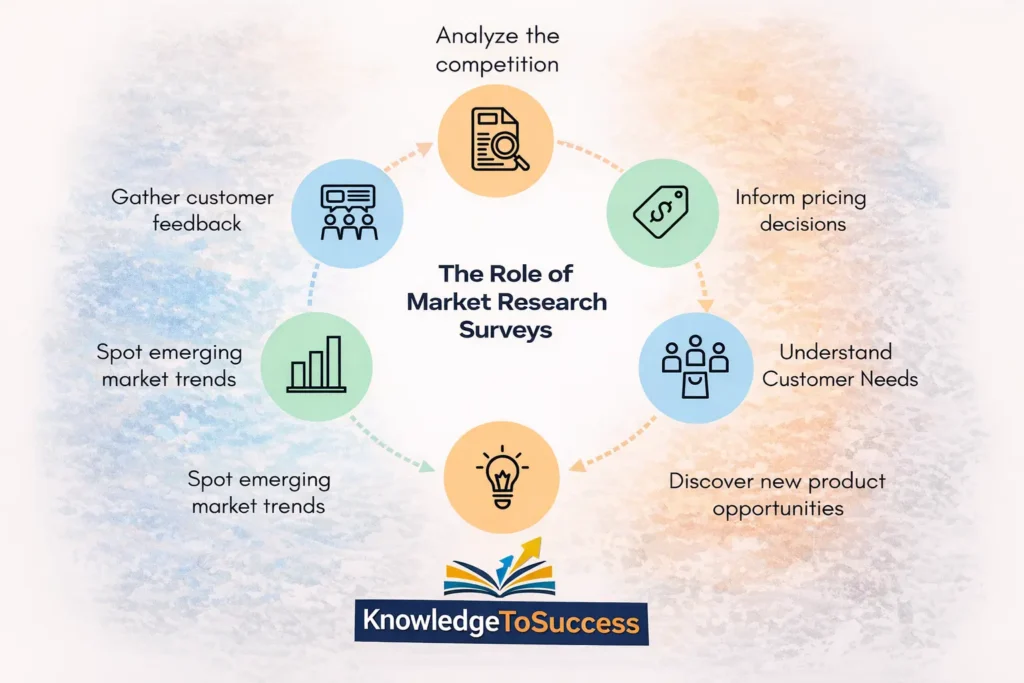
Step 3: Collect Data
Once methods are selected, gather information from reliable sources.
Sources may include:
- customer feedback
- online analytics tools
- industry reports
- market surveys
Accurate data strengthens insights.
Step 4: Analyze Research Findings
After collecting data, identify meaningful patterns.
For example:
- which customer segments show highest interest
- which product features matter most
- which marketing channels generate engagement
These insights guide strategy.
Step 5: Apply Insights to Strategy
Research should directly influence marketing decisions.
Examples include:
- refining product positioning
- improving messaging
- targeting specific customer segments
- adjusting pricing strategies
When insights drive strategy, marketing becomes more effective.
Learn Market Insights and Marketing Skills
To explore emerging marketing skills and professional learning opportunities, review LinkedIn’s insights here:
Learning structured research frameworks strengthens Market Research Skills in Marketing Strategy.
Common Market Research Mistakes
Many businesses struggle with research due to avoidable errors.
Research Without Clear Objectives
Unfocused research produces limited value.
Small Sample Sizes
Insufficient data may lead to misleading conclusions.
Ignoring Customer Feedback
Customer opinions often reveal valuable insights.
Bias in Interpretation
Researchers must analyze data objectively.
Failure to Act on Insights
Research is valuable only when it informs strategy.
Practical Market Research Checklist
Before launching a marketing campaign, confirm:
| Checklist | Status |
|---|---|
| Research objective defined | |
| Target audience identified | |
| Research method selected | |
| Data collected and verified | |
| Insights analyzed | |
| Strategy updated accordingly |
A structured process improves research effectiveness.
Founder Perspective: Why Market Research Matters
For founders and startups, market research reduces risk.
Understanding the market helps entrepreneurs:
- validate product demand
- identify customer segments
- refine product features
- develop effective marketing strategies
Research improves decision confidence.
Read More Article on Marketing Skills.
Conclusion
Marketing success depends on understanding the market.
By developing Market Research Skills in Marketing Strategy, professionals can make smarter decisions, identify opportunities, and create more effective campaigns.
Research transforms assumptions into insights and insights into strategy.
Businesses that invest in market understanding consistently outperform those that rely on guesswork.
In the next article of this series, we will summarize the Top 10 Fastest-Growing Marketing Skills for the Future and how professionals can start building them today.
Frequently Asked Questions
What is market research in marketing?
Market research involves collecting and analyzing information about customers, competitors, and market conditions.
Why is market research important for marketing strategy?
It helps marketers understand customer needs, identify opportunities, and reduce strategic risks.
What are common market research methods?
Surveys, interviews, analytics data, and competitor analysis are widely used methods.
How does market research improve marketing performance?
It helps businesses create targeted messaging, better products, and effective campaigns.
Can small businesses conduct market research?
Yes. Even simple surveys and customer feedback analysis can provide valuable insights.