
ITR Filing Due Dates 2026 are not the same for every taxpayer. Many individuals assume that July 31, 2026, is the universal deadline for filing Income Tax Returns (ITR). However, the Income Tax Department has prescribed different filing deadlines based on the taxpayer’s category, source of income, audit requirements, and transfer pricing obligations.
Missing the correct deadline can lead to penalties, interest charges, delayed refunds, and unnecessary compliance issues. Therefore, understanding the applicable due date is just as important as filing the return itself.
Whether you are a salaried employee, freelancer, business owner, professional, or company director, knowing your correct filing deadline can save both money and stress.
Why Understanding ITR Filing Due Dates 2026 Matters
Many taxpayers focus only on filing returns.
However, filing before the correct deadline offers several benefits:
- Avoid late filing penalties
- Receive faster tax refunds
- Maintain compliance history
- Avoid notices from tax authorities
- Improve financial credibility
A single missed deadline can create avoidable costs.
This is why taxpayers should understand which filing category they fall under.
Who Must File an Income Tax Return?
The Income Tax Department requires certain individuals to file returns even if they may not have significant taxable income.
Mandatory filing conditions include taxpayers who:
Spent ₹2 lakh or More on Foreign Travel
Individuals who spent ₹2 lakh or more on overseas travel, either for themselves or another person, may be required to file an ITR.
Paid Electricity Bills Exceeding ₹1 Lakh
Taxpayers whose annual electricity bill crosses ₹1 lakh may fall under mandatory filing requirements.
Deposited ₹1 Crore or More in Current Accounts
Those depositing ₹1 crore or more in one or multiple current accounts during the financial year are also covered.
Other Prescribed Conditions
The government may notify additional categories under mandatory filing provisions.
ITR Filing Due Dates 2026 for Different Taxpayers
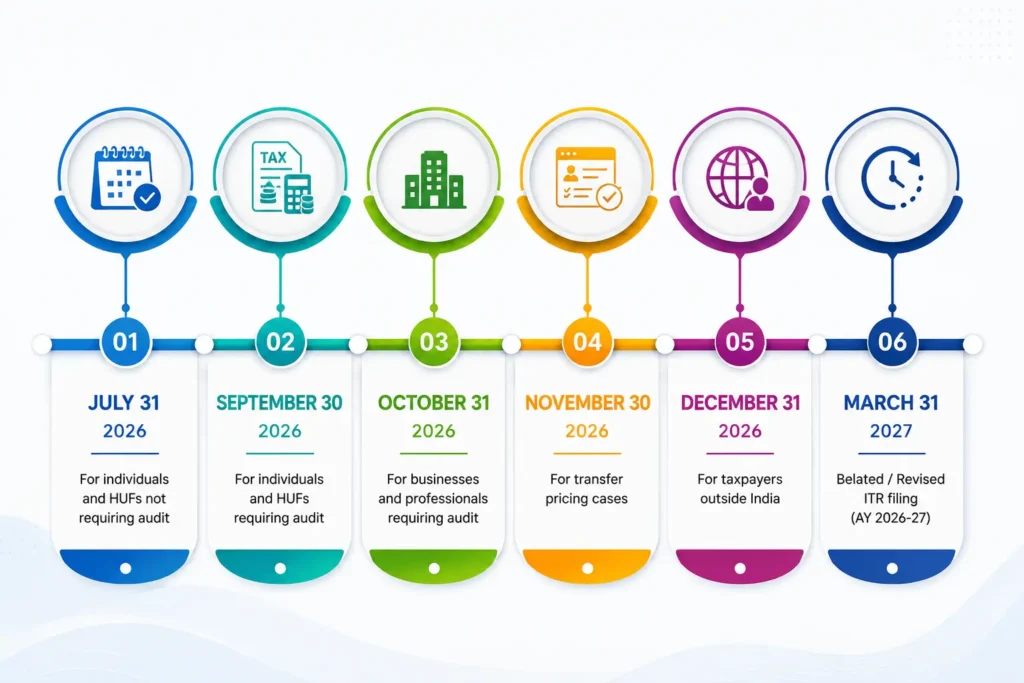
The Income Tax Department has established different due dates based on taxpayer classification.
| Taxpayer Category | Due Date |
|---|---|
| Salaried Individuals, Pensioners, ITR-1 & ITR-2 Filers | July 31, 2026 |
| Non-Audit Businesses & Professionals (ITR-3, ITR-4) | August 31, 2026 |
| Taxpayers Subject to Tax Audit | October 31, 2026 |
| Taxpayers Covered Under Transfer Pricing | November 30, 2026 |
| Belated Return | December 31, 2026 |
| Revised Return | March 31, 2027 |
Understanding these ITR Filing Due Dates 2026 helps taxpayers avoid filing mistakes.
New Relief for Business Owners and Professionals
One of the important changes for AY 2026-27 is the additional filing time granted to non-audit businesses and professionals.
Previously, many taxpayers assumed they shared the same deadline as salaried individuals.
Now:
- Salaried taxpayers continue with July 31, 2026
- Non-audit businesses and professionals can file until August 31, 2026
This creates separate filing windows for different taxpayer groups.
Read Previous Article on Finance & Taxation
ITR Filing Due Dates 2026 for Salaried Individuals
For most employees, pensioners, and taxpayers filing:
- ITR-1 (Sahaj)
- ITR-2
The due date remains:
July 31, 2026
This category includes taxpayers whose accounts are not subject to audit and who are not covered by transfer pricing provisions.
Many taxpayers mistakenly assume this deadline applies to everyone.
That assumption can lead to unnecessary panic or incorrect planning.

ITR Filing Due Dates 2026 for Businesses and Professionals
Business owners and professionals filing:
- ITR-3
- ITR-4
without audit requirements can now file until:
August 31, 2026
This additional month provides more flexibility for:
- Freelancers
- Consultants
- Small business owners
- Professionals
However, taxpayers should avoid waiting until the last week.
System congestion and documentation issues often arise near deadlines
ITR Filing Due Dates 2026 for Audit Cases
Businesses and professionals whose accounts require tax audit have a later deadline.
October 31, 2026
Audit cases generally involve:
- Higher turnover businesses
- Certain professionals
- Specific tax compliance situations
Since audit preparation takes time, the law provides additional filing time.
ITR Filing Due Dates 2026 for Transfer Pricing Cases
Taxpayers covered under transfer pricing provisions have the longest filing timeline.
November 30, 2026
This category generally applies to businesses engaged in international transactions requiring transfer pricing documentation.
Belated Return Deadline
Not everyone files within the original due date.
For such cases:
December 31, 2026
is the deadline for filing a belated return.
However, taxpayers may face:
- Late filing fees
- Interest liability
- Delayed refunds
Therefore, filing within the original deadline remains the better option.
Revised Return Deadline
Mistakes happen.
Taxpayers who discover errors in their previously filed returns may submit a revised return.
March 31, 2027
is the deadline for revising returns for AY 2026-27.
This provision allows taxpayers to correct:
- Income reporting mistakes
- Deduction claims
- Tax calculation errors
- Reporting omissions
Penalty for Missing ITR Filing Due Dates 2026
One of the biggest reasons to track ITR Filing Due Dates 2026 is avoiding penalties.
Under Section 234F of the Income Tax Act:
| Taxable Income | Penalty |
|---|---|
| Up to ₹5 Lakh | ₹1,000 |
| Above ₹5 Lakh | Up to ₹5,000 |
Importantly, the penalty may apply even if no additional tax is payable.
Late filing can therefore become an unnecessary expense.
Benefits of Filing Your ITR on Time
Timely filing offers advantages beyond legal compliance.
Faster Refund Processing
Refund claims are processed more smoothly when returns are filed early.
Better Loan Eligibility
Banks often request ITR copies when evaluating:
- Home loans
- Personal loans
- Business loans
Strong Financial Profile
ITRs act as proof of income and financial discipline.
Reduced Stress
Early filing avoids last-minute technical issues.
Important Changes Under the Income Tax Act, 2025
The provisions relating to return filing are now consolidated under Section 263 of the Income Tax Act, 2025.
The section includes provisions relating to:
- Original Return
- Belated Return
- Revised Return
- Updated Return
Although the structure has been modernized, the overall filing framework remains largely consistent with the earlier Income Tax Act, 1961.
For official guidance, taxpayers can refer to the Income Tax Department and Ministry of Finance, Government of India.
Common Mistakes Taxpayers Make
Assuming July 31 Applies to Everyone
Different taxpayer categories have different deadlines.
Waiting Until the Last Week
Technical issues often increase near due dates.
Ignoring Audit Requirements
Businesses sometimes misunderstand audit obligations.
Missing Revised Return Opportunities
Errors can often be corrected before March 31, 2027.
Not Maintaining Documentation
Proper records simplify filing and verification.
Quick Checklist for AY 2026-27
Before filing your return:
- Confirm your taxpayer category
- Identify your correct due date
- Collect Form 16 and tax documents
- Verify deductions and exemptions
- Review AIS and Form 26AS
- Check refund details
- Submit before the deadline
Conclusion
Understanding ITR Filing Due Dates 2026 is essential for every taxpayer.
The common belief that July 31 is the deadline for everyone is incorrect. Different taxpayer categories have different filing windows, and missing the right deadline can result in penalties, delayed refunds, and compliance complications.
Whether you are a salaried employee, consultant, freelancer, or business owner, identifying your correct due date should be one of your first tax planning tasks for AY 2026-27.
Filing on time is not just about avoiding penalties. It is also about maintaining financial discipline and staying compliant with tax laws.
In our next article, we will explore Common ITR Filing Mistakes That Trigger Income Tax Notices.
FAQs
1. What are the ITR Filing Due Dates 2026 for salaried taxpayers?
The due date for salaried individuals and most ITR-1 and ITR-2 filers is July 31, 2026.
2. What are the ITR Filing Due Dates 2026 for business owners?
Non-audit business owners and professionals filing ITR-3 or ITR-4 can file until August 31, 2026.
3. What happens if I miss the ITR Filing Due Dates 2026?
You may need to file a belated return and pay a penalty of up to ₹5,000 under Section 234F.
4. Can I revise my ITR after filing?
Yes. Revised returns for AY 2026-27 can be filed until March 31, 2027.
5. Why are ITR Filing Due Dates 2026 different for different taxpayers?
Different deadlines exist because audit requirements, transfer pricing rules, and business complexities vary among taxpayers.