
Startup Funding is often seen as a milestone of success.
Many founders believe raising capital validates their business. As a result, they begin preparing pitch decks and contacting investors long before their startup is truly ready.
However, funding is not the goal.
Building a sustainable business is the goal.
The right funding at the right time can accelerate growth. The wrong funding at the wrong time can create pressure, dilute ownership, and distract founders from customers.
That is why understanding when to raise Startup Funding is one of the most important decisions an entrepreneur can make.
Why Startup Funding Timing Matters
Many startups fail because they raise money too early.
Others struggle because they wait too long.
Timing affects:
- Valuation
- Investor interest
- Founder ownership
- Growth opportunities
- Business flexibility
A startup that raises capital before proving demand often receives lower valuations and greater investor scrutiny.
A startup that delays funding despite strong traction may miss valuable growth opportunities.
The timing of Startup Funding influences every stage of a company’s journey.
Startup Funding Is Not the First Milestone
One of the biggest misconceptions among founders is that fundraising should happen immediately after launching.
In reality, investors typically want evidence before investing.
That evidence includes:
- Customer demand
- Product validation
- Revenue traction
- Market understanding
- Founder execution ability
Funding should help scale success.
It should not be used to discover whether a business can succeed.
Before pursuing Startup Funding, founders should focus on validating the problem and proving demand.
Signs Your Startup Is Ready for Startup Funding
There is no perfect moment, but several indicators suggest a startup may be ready.
Product-Market Fit Exists
Customers actively use the product and continue returning.
You are solving a real problem.
Revenue Is Growing
Revenue demonstrates market acceptance.
Even modest growth often matters more than ambitious projections.
Customer Acquisition Is Predictable
You understand:
- Customer acquisition cost
- Conversion rates
- Sales process
Predictability reduces investor risk.
A Clear Growth Opportunity Exists
Funding should unlock growth.
Examples include:
- Expanding into new markets
- Hiring key talent
- Increasing production capacity
- Accelerating customer acquisition
Without a growth opportunity, raising capital may not be necessary.
Investors Are Already Showing Interest
Unexpected inbound interest often signals readiness.
When investors begin approaching founders, it usually reflects market confidence.
Signs You Should Delay Startup Funding
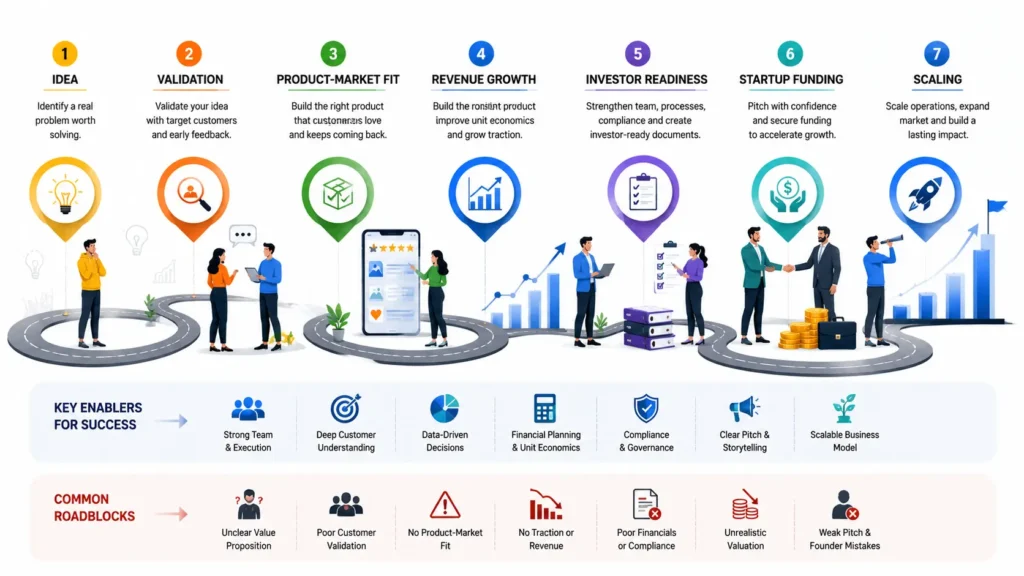
Just as important as knowing when to raise is knowing when to wait.
No Customer Validation
If customers are not using the product consistently, funding may only magnify existing problems.
Revenue Model Is Unclear
Investors need confidence that the business can eventually generate returns.
Constant Product Changes
Frequent pivots suggest the business model is still evolving.
Financial Metrics Are Unknown
Founders should understand:
- Burn rate
- Runway
- Gross margins
- Unit economics
Without these metrics, fundraising becomes difficult.
Compliance Is Incomplete
Investors prefer startups with clean legal and financial records.
Read Previous Article on Startup Guides India.
Common Startup Funding Timing Mistakes
Many founders make predictable fundraising mistakes.
Raising Because Competitors Raised
Funding decisions should be based on business needs, not headlines.
Raising Too Much Capital
Excessive funding can lead to wasteful spending and loss of discipline.
Raising Too Little Capital
Insufficient capital can force startups back into fundraising too quickly.
Chasing Investors Instead of Customers
Customers create traction.
Traction attracts investors.
Using Funding to Fix Core Problems
Funding rarely solves product-market fit issues.
It often amplifies them.
How Investors Evaluate Startup Funding Readiness
Investors rarely ask whether a startup wants funding.
Instead, they ask:
- Is the market large enough?
- Is the team capable?
- Is growth repeatable?
- Is the business scalable?
- Can this generate significant returns?
They also evaluate:
Founder Capability
Strong founders understand customers, markets, and execution.
Market Opportunity
Large markets create larger outcomes.
Growth Metrics
Traction often matters more than projections.
Business Model
Revenue generation must be clear and scalable.
According to Harvard Business Review, execution quality frequently influences investment decisions more than the originality of the idea itself.
Startup Funding Checklist Before Raising Capital
Before approaching investors, confirm the following:
Product
- Product-market fit achieved
- Customer feedback collected
- Core offering validated
Revenue
- Revenue model defined
- Growth trends visible
- Financial metrics understood
Team
- Leadership roles clear
- Key skill gaps identified
- Team alignment established
Compliance
- Company registration complete
- Tax filings current
- Corporate records maintained
Strategy
- Growth plan documented
- Funding requirements justified
- Capital allocation defined
Completing this checklist significantly improves fundraising readiness.

The Right Time to Raise Startup Funding
The right time to raise Startup Funding is when additional capital can clearly accelerate an already working business.
Funding should help:
- Scale customer acquisition
- Expand operations
- Enter new markets
- Build stronger teams
- Capture market opportunities
It should not be used to test whether customers want the product.
The strongest startups usually raise money after proving demand, not before.
Real Founder Insight
Many successful startups spent years validating their business before raising significant capital.
Investors often appear at the end of a validation journey, not the beginning.
Founders who focus first on customers, revenue, and execution typically enter fundraising conversations from a position of strength.
That leads to:
- Better valuations
- Better investors
- Better growth outcomes
Conclusion
Startup Funding is a powerful growth tool.
However, timing determines whether that tool becomes an advantage or a burden.
The right time to raise Startup Funding is when your business has validated demand, demonstrated traction, and identified a clear path for accelerated growth.
Founders who chase funding too early often struggle.
Founders who build first and fund later usually create stronger businesses.
Focus on creating value.
Funding will follow.
FAQs
1. When should startups raise funding?
Usually after validating customer demand and demonstrating early traction.
2. Is it bad to raise funding too early?
Yes. Early funding can create pressure and dilute ownership before the business model is proven.
3. Can startups grow without funding?
Many successful startups bootstrap before raising capital.
4. What do investors look for before funding?
Product-market fit, traction, team quality, scalability, and financial understanding.
5. How much Startup Funding should founders raise?
Enough to achieve the next meaningful growth milestone without unnecessary dilution.



Can you please write more about the funding
Good one
This is one of the best article, very thoughtful