Few interview questions create more anxiety than: “What is your biggest weakness?”
Many candidates fear this question because it feels like a trap. As a result, they either give fake weaknesses, avoid the question completely, or accidentally damage their credibility.
However, interviewers are not looking for perfection. Instead, they want self-awareness. They want to understand whether you can identify your limitations and improve over time.
This is why learning how to talk about weaknesses in an interview is essential. A strong answer can increase trust. A poor answer can raise concerns about maturity, honesty, and growth potential.
This guide explains exactly how to answer the weakness question confidently while protecting your professional image.
Why Interviewers Ask About Weaknesses
Most candidates assume interviewers want to discover flaws.
That’s only partly true.
Interviewers actually assess:
- Self-awareness
- Honesty
- Coachability
- Growth mindset
- Professional maturity
According to insights from Harvard Business Review, employers increasingly value adaptability and continuous learning over perfection.
Therefore, the question is less about weakness and more about personal development.
What Interviewers Do NOT Want to Hear
Before discussing the right answer, let’s eliminate common mistakes.
Bad Answer #1: “I Have No Weaknesses”
Nobody believes this.
It signals:
- Lack of self-awareness
- Overconfidence
- Poor reflection
Bad Answer #2: A Critical Job Weakness
Example:
“I’m applying for an accounting role, but I’m not very detail-oriented.”
This creates immediate concern.
Never choose a weakness that directly threatens core job requirements.
Bad Answer #3: Fake Strengths Disguised as Weaknesses
Examples include:
- “I work too hard.”
- “I’m a perfectionist.”
- “I care too much.”
Interviewers hear these constantly.
As a result, they sound rehearsed rather than genuine.
The Best Framework for Answering Weakness Questions
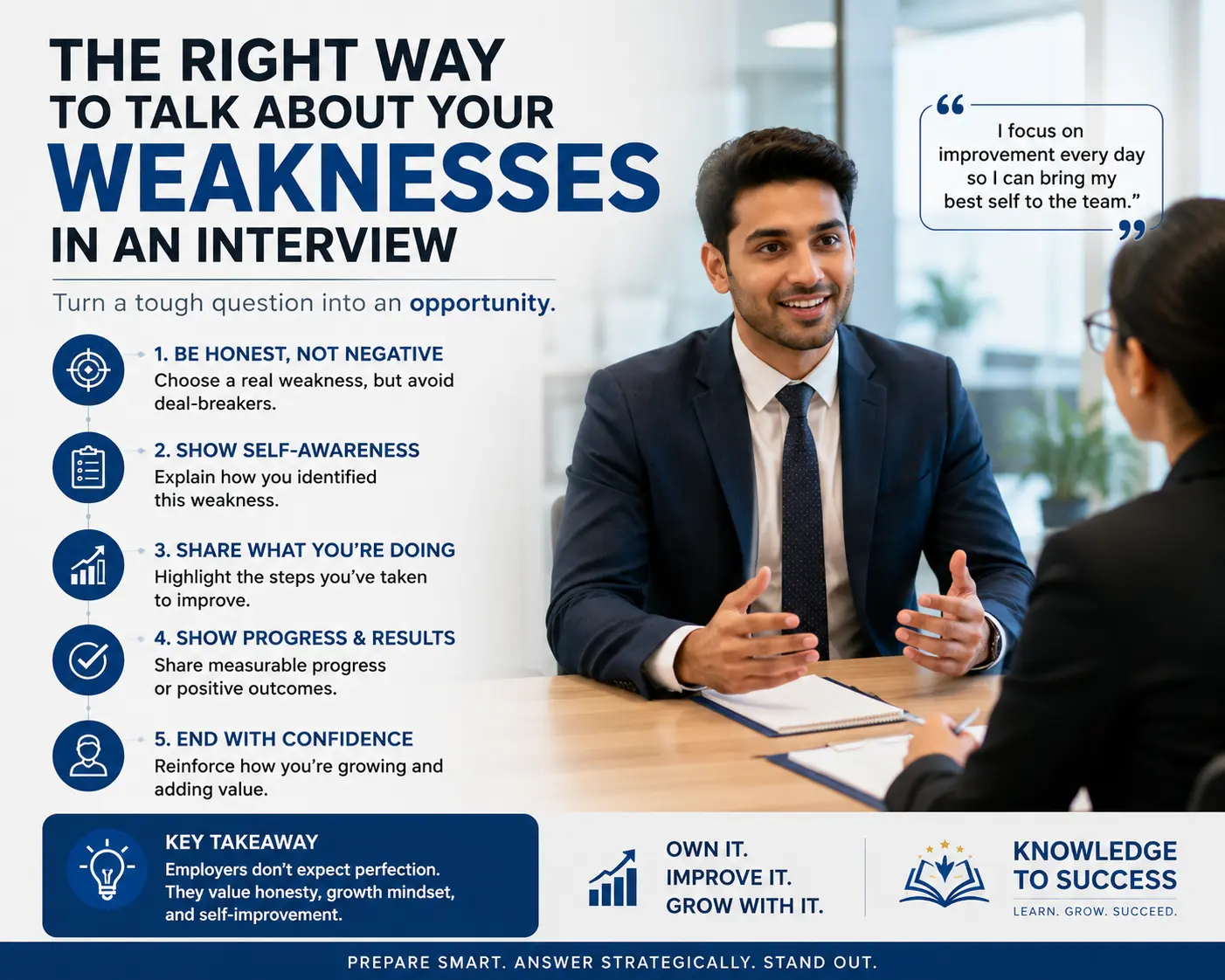
A simple framework works best:
Weakness → Improvement → Result
Structure:
- Share a real weakness
- Explain what you are doing about it
- Show measurable improvement
This approach demonstrates growth.
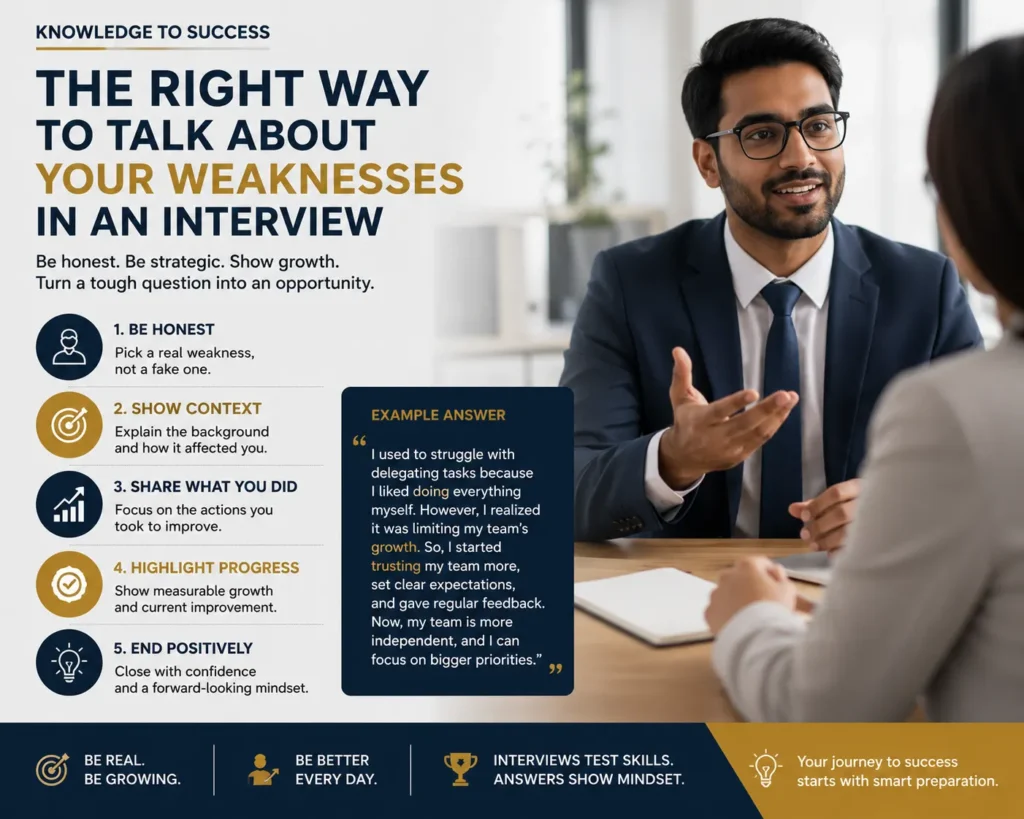
Example 1: Delegation
“Earlier in my career, I struggled with delegation because I wanted complete control over outcomes. However, I realized this limited team efficiency. Therefore, I started assigning responsibilities more clearly and conducting regular check-ins. As a result, projects moved faster, and team collaboration improved.”
Why it works:
- Real weakness
- Clear improvement
- Positive outcome
Example 2: Public Speaking
“Public speaking was initially challenging for me. Although I communicated well in small groups, presenting to larger audiences felt uncomfortable. To improve, I volunteered for internal presentations and joined speaking workshops. Today, I’m much more comfortable leading meetings and presenting updates.”
Example 3: Overcommitting
“I used to say yes to too many requests because I wanted to help everyone. Eventually, I realized this affected prioritization. Since then, I’ve improved my workload management by setting clearer expectations and using prioritization frameworks.”
How Freshers Should Answer
Freshers often worry because they lack extensive work experience.
However, academic and project experiences work well.
Read more articles on Career Guidance
Examples:
- Public speaking confidence
- Time management
- Delegation in group projects
- Presentation skills
The key remains the same:
Weakness → Improvement → Result
How Experienced Professionals Should Answer
Senior candidates face higher expectations.
Therefore, choose weaknesses related to:
- Leadership growth
- Strategic thinking
- Communication development
- Team management
Avoid weaknesses that suggest inability to perform the role.
Common Weaknesses That Are Safe to Use
| Weakness | Why It Works |
|---|---|
| Delegation | Shows leadership growth |
| Public speaking | Common and improvable |
| Overcommitting | Demonstrates desire to contribute |
| Asking for help | Shows growth potential |
| Strategic thinking (early career) | Indicates development journey |
Common Mistakes That Quietly Hurt Candidates
Choosing a Serious Job Risk
Never highlight weaknesses that directly affect essential responsibilities.
Focusing Only on the Problem
Always discuss improvement.
Giving Long Explanations
Keep answers concise.
Sounding Scripted
Authenticity builds trust.
A Quick Weakness Answer Checklist
Before your interview, ask:
- ✅ Is the weakness genuine?
- ✅ Is it non-critical to the role?
- ✅ Have I improved it?
- ✅ Can I explain the improvement clearly?
- ✅ Does it show self-awareness?
If the answer is yes to all five, you’re ready.
Why Growth Matters More Than Weakness
Interviewers know everyone has weaknesses.
What differentiates candidates is:
- Awareness
- Accountability
- Action
Growth mindset often matters more than the weakness itself.
According to career guidance from LinkedIn, employers increasingly prioritize adaptability and learning ability.
Conclusion
The weakness question is not designed to eliminate candidates. Instead, it helps interviewers understand how you learn, adapt, and improve.
When you understand how to talk about weaknesses in an interview, you stop fearing the question. You start using it as an opportunity to demonstrate self-awareness and professional growth.
Strong candidates are not perfect.
Strong candidates improve.
That is what interviewers want to see.
FAQs
1. What is the best weakness to mention in an interview?
Choose a genuine weakness that does not directly affect core job responsibilities.
2. Should I be completely honest about weaknesses?
Yes, but focus on weaknesses you are actively improving.
3. Can I say I am a perfectionist?
It’s possible, but interviewers hear it frequently. More authentic answers are usually better.
4. How long should a weakness answer be?
Usually 60–90 seconds is enough.
5. Why do interviewers ask about weaknesses?
They want to evaluate self-awareness, growth mindset, and professional maturity.