Everyone can build AI today. Few know how to scale it successfully. This is where Agentic Engineering becomes essential.
The rise of artificial intelligence has transformed software development. A startup founder can build a chatbot in a weekend. A developer can create an AI assistant within hours. Even non-technical teams can automate repetitive tasks using modern AI tools.
As a result, businesses across industries are rapidly adopting AI solutions. However, building an AI prototype and scaling an AI system are two completely different challenges.
Many organizations discover that their AI application performs well during testing. Yet when they expand usage across teams, customers, and business processes, problems begin to appear. Responses become inconsistent. Workflows become difficult to manage. Costs increase unexpectedly. Security and compliance concerns emerge.
The issue is rarely the AI model itself. Instead, the real challenge is implementing Agentic Engineering principles that create structure, reliability, and scalability. Without Agentic Engineering, many AI projects remain successful experiments but never become dependable business systems.
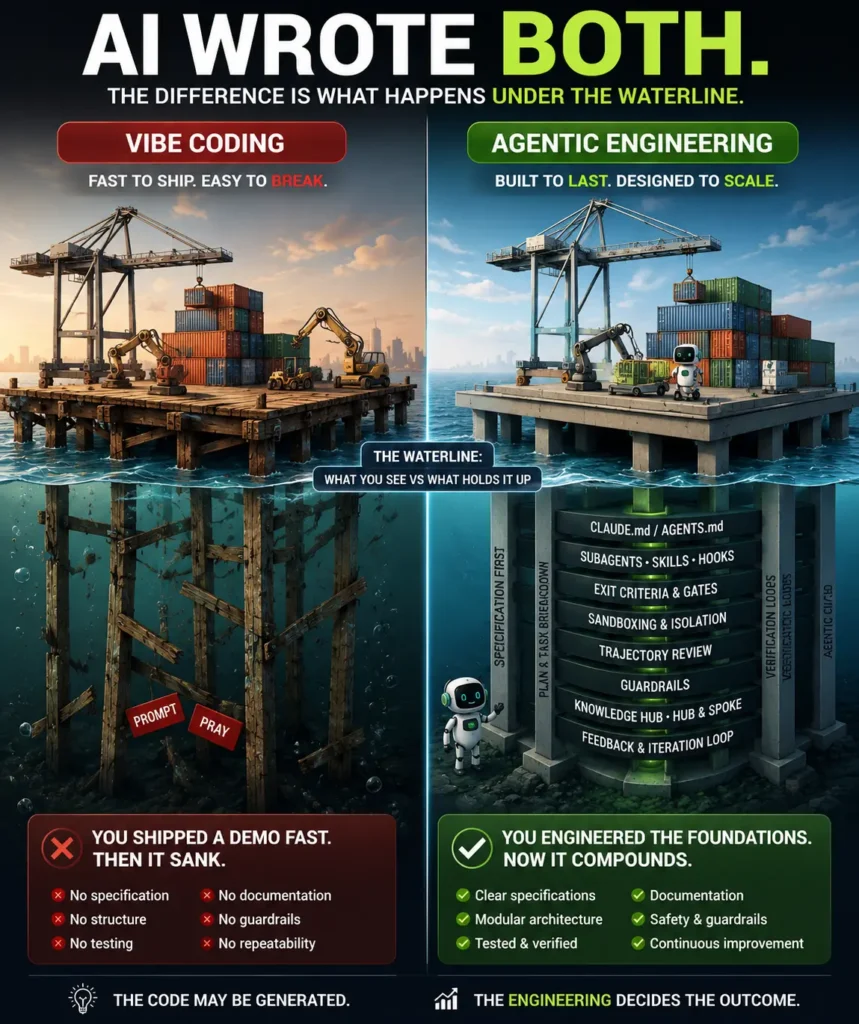
Why AI Projects Often Fail During Growth
Many businesses assume that once an AI application works, scaling it is simply a matter of increasing usage.
Unfortunately, reality is much more complex.
Common Problems During AI Scaling
| Problem | Impact |
|---|---|
| Poor workflow design | Inconsistent results |
| No validation process | Higher error rates |
| Lack of documentation | Difficult maintenance |
| Unclear ownership | Slow troubleshooting |
| Security gaps | Compliance risks |
| Prompt dependency | Unpredictable outputs |
As AI adoption increases, these issues become more visible.
Therefore, organizations need a structured framework rather than relying on isolated prompts and experiments.
What Is Agentic Engineering?
Agentic Engineering is the practice of designing AI systems that operate through structured goals, task decomposition, validation mechanisms, and continuous feedback loops.
Instead of asking one AI model to perform everything, organizations create specialized workflows where different agents perform specific responsibilities.
Think of it like a manufacturing assembly line.
Each worker has a defined role.
Each step is verified.
Quality checks happen continuously.
The same principle applies to modern AI systems.
How Agentic Engineering Creates Scalable AI Systems
1. Agentic Engineering Starts With Clear Outcomes
Most failed projects begin with technology.
Successful projects begin with business objectives.
Before building anything, teams should define:
- Desired outcome
- Success metrics
- Failure criteria
- Business impact
This foundation prevents scope creep and confusion later.
2. Agentic Engineering Breaks Work Into Smaller Tasks
Large AI workflows become easier to manage when divided into smaller components.
Examples include:
- Research agent
- Analysis agent
- Verification agent
- Execution agent
- Reporting agent
As a result, troubleshooting becomes significantly easier.
3. Agentic Engineering Uses Verification Loops
AI systems occasionally make mistakes.
Therefore, verification becomes critical.
Verification layers may include:
- Accuracy checks
- Human approvals
- Compliance reviews
- Confidence scoring
These controls reduce operational risk.
4. Agentic Engineering Isolates Failures
One major advantage of Agentic Engineering is containment.
If a single component fails:
- Other systems continue operating
- Issues remain localized
- Recovery becomes faster
This improves reliability significantly.
5. Agentic Engineering Creates Continuous Learning
The best AI systems improve over time.
Every interaction generates valuable feedback.
Consequently, organizations can refine workflows, improve accuracy, and optimize performance continuously.
Real Business Example: Why Scaling AI Is Different From Building AI
Imagine an e-commerce company launching an AI-powered customer support assistant.
Initially, the chatbot handles FAQs successfully.
The company then adds:
- CRM integration
- Order tracking
- Product recommendations
- Refund processing
- Multilingual support
Suddenly, complexity increases.
Without structured workflows, errors begin appearing across multiple systems.
However, with Agentic Engineering, each capability operates as an independent, monitored component.
This allows teams to identify and resolve issues quickly.
Read More Article on AI & Beyond
Common Mistakes When Scaling AI Projects
Chasing Every New AI Tool
Tools change rapidly.
Systems create lasting value.
Focus on processes rather than trends.
Ignoring Governance
As AI expands, governance becomes essential.
Organizations need clear policies for:
- Security
- Privacy
- Compliance
- Accountability
Scaling Before Standardization
Many businesses attempt expansion before creating repeatable workflows.
This often magnifies existing problems.
Lack of Performance Metrics
If you cannot measure performance, you cannot improve it.
Always establish KPIs before scaling.
A Practical Agentic Engineering Checklist
Use this framework before scaling any AI initiative:
Strategic Checklist
- Define business objectives
- Document workflows
- Assign agent responsibilities
- Create validation checkpoints
- Implement monitoring
- Establish governance policies
- Measure outcomes
- Build feedback loops
- Scale gradually
Why Agentic Engineering Matters for the Future of AI
Over the next few years, access to AI models will become increasingly common.
The competitive advantage will no longer come from simply using AI.
Instead, success will depend on how effectively organizations manage, govern, and scale AI systems.
Companies that master Agentic Engineering will:
- Reduce operational risk
- Improve efficiency
- Increase reliability
- Accelerate innovation
- Generate sustainable business value
In other words, the future belongs to organizations that build systems, not just experiments.
Conclusion: How to Scale AI Projects With Agentic Engineering
Building AI has become easier than ever.
Today, almost anyone can launch an AI-powered application, workflow, or automation system.
However, creating a sustainable competitive advantage requires more than powerful models and clever prompts.
Organizations must understand how to scale AI projects with Agentic Engineering.
By implementing structured workflows, validation mechanisms, governance controls, and continuous feedback loops, businesses can transform AI from a short-term experiment into a long-term business asset.
The companies that succeed in the AI era will not necessarily have access to better technology.
They will have better systems.
FAQs
What is Agentic Engineering in AI?
Agentic Engineering is the practice of building AI systems using structured workflows, validation processes, feedback loops, and specialized AI agents.
Why do AI projects fail when scaling?
Many AI projects fail because they lack governance, validation mechanisms, documentation, and structured workflows.
How does Agentic Engineering help scale AI projects?
It creates predictable workflows, isolates failures, improves reliability, and enables continuous improvement.
Can small businesses use Agentic Engineering?
Yes. Even small AI implementations benefit from structured workflows and verification processes.
Is Agentic Engineering the future of enterprise AI?
Many experts believe structured AI systems will become essential as businesses move from experimentation to enterprise-wide AI deployment.